|
By: Paul S Cilwa |
Posted: 11/9/2009 |
|
Page Views: 4,475 |
| Hashtags: #VerdeHotSpring #Arizona #Saipan #ChumorroPeople #Travel #Slavery |
| I relate Ike's adventures as an accidental world tourist who stumbles on a legal slave trade. |
| Estimated reading time: 17 minute(s) (3908 words) |
"He drums?" I asked. "On what?"
"On anything," Carl explained. "But mostly on this drum he made
himself."
"He'll be along pretty soon," Eddie predicted. "He makes the
rounds of the campsites every evening about this time."
Sure enough, the sound of drumming became louder and more
immediate, and then the drummer himself appeared in the light of the
campfire. "Howdy, folks," he said.
Eddie introduced him to Michael and me as Ike, and he shook our
hands. He was tall, about 6'4", and slim though it was hard to tell
because of the bulletproof vest he seemed to be wearing. On the
other hand, maybe it was a camper's vest, or a hiker's vest. Maybe
those were pockets instead of Kevlar plates. It was hard to tell in
the flickering light of the fire, especially since I could barely
keep my eyes away from his full head of spiked black hair which he
wore in a style younger than I suspected he was. From his shoulder
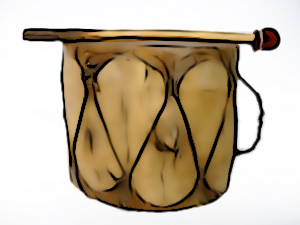
hung a homemade drum, some sort of tribal design that I'd never seen
before, which explained the drum's unusually deep and varied sound.
"How long are you staying?" Eddie asked Ike, meaning in days.
This is a common question at the campground, where it's not unusual
for people to remain a week despite the "official" sign that limits
stays for five days. Eddie had told me of one family that remained
in their broke-down camper for over six weeks.
"A couple of weeks, I guess," Ike said, chowing down on the slice
of chocolate cake we had brought in honor of Eddie and Carl's fourth
anniversary. "Pardon my manners," he added, crumbs rolling from his
face. "I just had some pot and now I'm an eating machine!"
"It's great you can take so much time off work," I said. The
long-stays here are usually either retired folks, or unemployed
hippie types. Ike looked like neither. He was far too young to be
retired, and too clean-cut to be a hippie. He looked more like an
investment banker on holiday.
Nevertheless, he told us he was "between jobs." And, with nothing
better to do with his time, enjoyed hanging out here at the hot
spring although he planned soon to bring his jewelry to Sedona,
hopefully to sell. "I make it from crystals I buy from eBay," he
said. "Then I make jewelry of my own design. It sells well when I
can find a good place for it. I used to live in Cleveland, but
that's not really a hotbed of sales potential for crystal jewelry.
So I'm hoping I'll have better luck in Sedona."
Although his conversation was light, he seemed to be in pain. We
invited him to sit and he grimaced as he lowered himself onto the
seat, then shifted position several times, grunting as he did so.
Finally, I asked him about it.
"Is it that obvious?" he asked. "The pot seems to help less and
less." I offered to look at his back. I'm not a medical professional
but I sometimes have good luck doing energy healing on people and,
given his interest in crystal jewelry, Sedona, and the use of a
number of other metaphysically-associated words, I suspected he'd be
open to the idea. And, in fact, he gave his permission. So he pulled
up his vest a few inches and let me put my hands on his spine.
It was "flat", that is, his lower back did not curve inward as
spines usually do. "How long has your back troubled you?" I asked.
"Since I was eleven," he answered promptly.
"Eleven? What, were you in a car accident or something?"
"No, I was working in a field with a wheelbarrow, trying to push
it across a bunch of ruts. It was really way too much work for an
eleven-year-old, but my uncle put me up for the summer and then made
me do all this work, and because I didn't know any better, I did it.
And my back has hurt ever since."
People's histories are written in their auras, that is, a glow of
subtle light that surrounds each one of us. It's not hard to learn
to see them (we all do, but most people simply ignore them or
dismiss them as a trick of the light). And when you see them, it's
not hard to read them. You've heard the phrase, "He wears his heart
on his sleeve"? It's like that. I'm not snooping or mind-reading or
anything intrusive like that. It's just that some people's histories
are so brilliantly displayed in their auras that I can't ignore it
any more than I can ignore their hair color or gender.
So, sensing his energy fields, but not wanting to sound like
The
Amazing Kreskin, I merely hinted, "It might go back farther than
that."
"You mean, a previous lifetime? I've had that thought. But I
haven't been able to figure out what I might have done, or been, to
deserve this kind of pain. But I've tried chiropractic, and massage,
and a lot of self-diagnosis, but nothing's ever gotten rid of it."
"Since you brought up the wheelbarrow," I said, carefully,
"have you considered that some other life where you were involved
with a wheelbarrow might be the source of your pain? I 'see' an
Asian peasant pushing a wheelbarrow, a kind of old-fashioned,
home-made one, through a field…and a landlord who forces him to
work…and a daughter…" I hesitated.
"An Asian peasant? That's interesting…What?" Ike asked.
"Tell me."
"Well…it would be better if you picked this stuff out for
yourself…" But Ike continued to look expectantly at me, and it
must have been hard to keep his head twisted around like that, since
I was still behind him, trying to calm the energy hot spots that
jagged over his lower spine. "I get that the landlord raped the
daughter, and the peasant farmer kind of went ballistic over it but
couldn't do anything. I'm not sure if you were the peasant, or the landlord,
or even the daughter; but your back pain has the hallmarks of being
unreleased guilt over
some situation."
"An Asian peasant," he repeated. "Interesting."
I felt something hard protruding from his back a few inches from
his spine. "What's that?" I asked bluntly.
"My hip," was the prompt response.
"What's it doing there?" I asked.
"I damaged it in a motorcycle accident with my brother in
Thailand, two-and-a-half years ago."
"Thailand? In Asia. I see.—Sounds like it was serious?" I
sympathized.
"I got off easier than my brother," he said. "He lost one arm and
one foot, and because he was drinking and someone was killed and it
was Thailand, he was arrested and almost wound up in jail for 20
years."
There was a brief, stunned silence as we tried to take in all the
information contained in those two sentences. Finally, Eddie asked,
"What were you doing in Thailand?"
"Are you ready for a story?" he asked. And because we were all
sitting around a campfire we said we were.
"I didn't start out in Thailand," Ike began. "I joined the
Marines when I was 17, and when I got out I decided to see the
world. I went to the Virgin Islands, and Australia, and Tahiti, and
then Saipan, an island in Micronesia. The problem in Saipan was that
I couldn't get work. So I was trapped there.
"Micronesia is a commonwealth in union with the United States.
But there's a native population called the Chamorro people, and they
took me in. The Chamorro have no concept of the ownership of food.
No one ever gets upset with someone for taking the last banana from
a tree, because there is no 'last banana'. They used to be
the entire population of the island, until World War II. Then
Americans and other groups began moving in, but the Chamorro keep
their part of the island, and they don't let just anyone in.
But they let me in for some reason. So I was able to eat, and
they sheltered me, and even showed me how to make their native
drums.
"At first Saipan seemed like paradise. The place has gorgeous
beaches and is very popular with tourists. In the Virgin Islands and
Tahiti, I had always worked at hotels as a bartender or waiter and
made good money. But on Saipan, those jobs are all taken and they
don't hire Americans for them. Or rather, they would, if I accepted
less money than it took me to buy food. I couldn't understand how
the people they did hire could afford to work there. But
that's why I was so hungry when the Chamorro took me in.
"Well, it turns out there's industry besides tourism on that
island. Big textile factories. They make clothes, sheets, blankets,
whatever. They make it out of imported cotton and synthetic yarn.
The Chamorro don't do that work—why should they, when they know how
to eat out of the sea and the jungle? But the government of the
Mariana Islands, when they became a part of the United States, made
a deal that made the laws of the United States regarding immigration
and labor not apply to them. So they kidnap women from Japan
(they tell them they are taking them to the United States for jobs,
and charge them for it!) and then force them to work in the textile
factories on Saipan by day, and prostitute them, mostly to Japanese
tourists, by night. And whenever a US Congressman comes to Saipan,
and goes home shouting how Saipan is a "Fucking miracle of
commerce!" you can bet he's been sleeping with one enslaved textile
worker or a dozen while he was there.
"And the hotel workers also work for slave wages, which is why
I couldn't afford to work for them. They get exactly
enough to pay for food and shelter, so they can never leave Saipan.
"Now, the Chamorro are very nice people but they like to fight.
Especially for young Chamorro men, fighting is their entertainment.
And I was young, and hey, I liked to fight. What I didn't
realize was that, if I beat up a Chamorro—and it wasn't hard, I was
'way taller than any of them, and trained as a Marine—pretty soon
his whole family would be out looking to beat me up.
"So I had to get out of there.
"And then I met a woman, a Japanese woman who was visiting on
holiday. And she wanted to learn English. (Everyone in Japan wants
to learn English.) So she talked her father into paying my way to
Japan in exchange for lessons. And that's how I got off Saipan.
"Japan was a lot better than Saipan. And I liked the girl a lot.
Her family was wealthy and had a lot of influential friends—one was
the owner of the Cirque du Soleil! And because I was fluent
in Japanese and English, and she was so well-connected in Japan, the
man hired us to come to the United States with him every so often to
assist in booking shows and dealing with venues.
"But then there was a problem. She was a Japanese citizen and it
got to the point where she used up her visiting time and couldn't
come into the United States any more. And I was limited to the
amount of time I could stay in Japan. So we solved both problems at
once: I married her. We then effectively had dual citizenship and
could spend as much time in either country as we wanted. And we made
a lot of money, which was cool.
"It worked out well for a couple of years. But then I discovered
that Japanese high school girls are horny little minxes. And they
love tall American men. Every afternoon I'd have two or three of
them crawling all over me. Of course, my wife inevitably discovered
I was fooling around. And even though we had not married for love,
and even though what I was doing was not illegal in Japan—the age of
consent is lower there—she still decided she didn't want to be
married to an adulterer. So that was the end of that, and I moved to
Thailand.
"Thailand was like Saipan, in that there's a whole class of
slaves there. They are mostly Ukrainian girls. The Thais love tall,
blonde, blue-eyed girls. And Ukrainians will do anything to get jobs
in the United States. So it's the same story: A Ukrainian girl pays
to travel to the United States, with a job supposedly waiting for
her. And they stop in Thailand, which she is told is a passport
requirement. Their passports are taken "for stamping" but never
returned. And then she is trapped. The only way she can eat is to
work as a prostitute, conveniently for the same men who brought her
there. The girls are literally held prisoner in brothels, and the
men who go there either know what's going on and like it, or if they
complain are told it's an "act" some of the girls put on to
titillate their customers.
"But I liked Thailand, and I talked my little brother into coming
out to visit. We went for a motorcycle ride in the country. And yes,
we'd had some drinks. He misjudged the time it would take to pass a
truck, and hit the truck, which tore his bike apart at about 70 mph.
He went flying, the truck ran over his arm and foot. And a piece
from his bike came at me and broke my hip and knocked me off my
bike.
"An ambulance took Frank to a hospital, but I was unconscious
behind a tree and I guess they didn't count motorcycles, or his was
so torn up they thought he'd been riding mine. Whatever. When I came
to, I hobbled back into town all cut up and bleeding, with (as it
turns out) a broken hip. I tried to tough it out but after a couple
of days I took myself to a hospital. It was a different one than
they took Frank to. And I met this girl there, a nurse, and she
wanted me to teach her English. (Everyone in Thailand wants to learn
English.) So she hired me to do that.
"Meanwhile, they threw the book at Frank because it turns out a
car that was following him got hit by pieces of his bike when it
disintegrated and the passenger was killed. In the United States the
absolute worse that would happen is a manslaughter charge and
probably the company that made the motorcycle, and maybe the truck,
would be sued. But in Thailand, you have to bribe the prosecutor to
keep out of jail. And we didn't know that, until it was too late to
do it without his losing face, which is very big over there.
"I went to the American embassy and the guy there said, "First
thing is, have your parents mortgage their house." That was his
advice!
"Meanwhile Frank was in agony, because he had phantom limb
syndrome, where he feels the arm that was missing and it feels like
it's burning up but it's not really there so there's nothing they
can do to help.
"It all looked pretty hopeless. Then, one day, I was mentioning
this to the nurse I was teaching English. And it turned out her
uncle was the prosecutor's boss! So thanks to her intervention,
Frank got off the hook but we were given 24 hours to leave Thailand.
Our mom had to front the tickets, and when we got home she blamed
me because I had invited Frank to Thailand in the first place.
"So, now," Ike concluded, "I'm back in the United States after
all these years, my back is in constant pain, I walk with a limp, my
mother has convinced my brother his missing arm and foot are my
fault so I can't really go home, and besides I'm 42 and shouldn't be
living with my parents anyway—especially after having made it on my
own all over the world for 20 years. So I make jewelry, and live
close to the land, and smoke pot when I can get it to ease the pain
in my back."
There was silence for several minutes as we gazed at the sparks
rising into the air from the campfire and digested Ike's story. I
was sitting next to him and could see red and orange energy in his
aura swirling around his hip and lower back. Red suggests
unforgiveness; orange relates to sex.
"I want you to do an exercise," I suggested. "You don't have to do
it now, but definitely do it tonight before you forget about it."
"Okay," Ike agreed, waiting to hear what it was he was agreeing to.
"Close your eyes, and imagine that you are an Asian peasant of a
century or two ago. You are what we would call a sharecropper who
farms land owned by a landowner, and he's cooked the books so you
have to buy your seed and tools from him, and the money from selling
your harvest is just enough to cover what you owe, so you
are, in effect, a slave. And because he holds so much power over
you, if he takes a fancy to your daughter there's nothing you can do
but tell her to be brave and not embarrass the family when he comes
for her."
Ike's eyes were closed. "It's not easy," he said.
"That's right," I agreed. "Because, Ike, you were also the
landlord. In that lifetime, and in the one you just described,
you observed injustice without ever identifying with the people who
were being abused or doing anything to help them. I understand why;
when being faced with unspeakable injustice sometimes the only way
one can survive is to look the other way. But the guilt becomes a
part of you. And guilt hurts. It's like Marley's chains in Dickens'
A Christmas Carol."
Ike's shoulders sunk under the weight. "There wasn't anything I
could do!" he said.
"You could tell people," I said. "How often have you told
this story?"
He shook his head. "Not often," he admitted. "But people high up
know about the slavery already. And who would listen to me?"
"But you've continued the pattern," I pointed out. "No matter what
might have happened in a previous life, you still have a thing for
younger girls and whether it's 'legal' and whether you think they
are 'horny little minxes' or not, you were older and took advantage
of them. At the soul level, none of us gets away with taking
advantage of others. That's what karma is all about. It's not God or
the Universe punishing you; it's you punishing you. That's
why your soul contract allowed yourself to be injured at eleven
years of age by a wheelbarrow, to remind you of what you came to
atone for in this lifetime. And when decades passed and you still
hadn't atoned, indeed, were still engaged in the same behavior, your
deeper self had to take greater measures to get your attention and
so led you to that motorcycle accident."
Ike was pale, even in the firelight. "Then what can I do? Am I
doomed to bear this pain until I die?"
I shook my head. "No, not doomed. You just need to acknowledge what
you're here for: Not to take advantage of others, but to atone for
that by attempting to free others who are being taken
advantage of. If you create the intention to do that, and follow
through, I bet your back will pretty much heal itself."
There wasn't anything else for me to say, and Ike rose and thanked
Michael (who had been working on Ike's back muscles while I did
energy work) and me, then headed with his drum to his camp.
Eddie and Carl followed shortly after, Ike was having a "drum
circle" in which participants from camp could come and bang on
anything they could find as a meditative practice, something Ike had
learned from his time with the Chamorro people. But I felt Ike
needed some processing time without me there.
The next morning, Michael and I walked the mile to the hot spring
and found Ike, who'd already been there for hours, ready to go.
Since I didn't really expect to see him again, I walked with him
partway to the riverbank to say goodbye.
"You aren't limping today," I observed.
"Last night, while I was drumming, I thought about what you said. I
imagined myself as both the landlord and the peasant,
and then I saw the balance. Because I wasn't just the
landlord. I was the peasant too! I don't know if you can have two
lifetimes at once, but that's how it seemed to me. And that's when I
started crying. And I cried almost all night, mostly at the
pointlessness of carrying this guilt for so long. And this
morning—well, look."
Ike lifted up the vest that he always seemed to wear, and put my
hand on his back. The lump I had felt the night before, his
misplaced hip, had shifted at least two inches closer to where it
should be.
"And what about going public about the slavery you encountered?" I asked.
Ike shifted his weight from one leg to the other. "I think that
might be more your issue than mine," he said hesitantly. "I'm not
really a writer or storyteller and I have no solutions and no
audience. Maybe someday…but besides, in the scheme of balance,
aren't all those slaves reincarnated slave owners?"
I nodded. "That's true, but it doesn't mean we should allow
intolerable conditions to remain as they are. Someone should
pass your observations on."
Ike smiled and patted me on the shoulder. "Then you do it," he said.
And so I have.
In researching after we got home, I found that the slavery Ike
referenced is a real phenomenon and is, in fact, being addressed. Specifically,
the
working conditions on Saipan are deplorable and have been
examined by Congress. Unfortunately, the slave labor allows
businesses like Wal-Mart to sell clothing at very low prices, and
Americans continue to buy there, thus supporting an economic system
that exploits hundreds of thousands of human beings, even while it
throws American communities that once made decent wages working with
textiles into unemployment and poverty.
As Ike observed, we are all landlord and peasant both. It
is our actions, here at home, that make slavery profitable
around the world. Just because it doesn't happen here doesn't mean
it doesn't happen.
Think of that the next time you decide to save $20 on a set of
towels made in the USA by buying instead something that looks
similar but was made by enslaved girls in some Asian country.