|
By: Paul S Cilwa |
Posted: 8/12/2008 |
|
Page Views: 4,162 |
| Hashtags: #MarriageEquality #GayMarriage |
| Gays have the right to be as unhappy as anyone else. |
| Estimated reading time: 5 minute(s) (1109 words) |
Today is Michael's and my wedding anniversary. We've now been married for eight years.
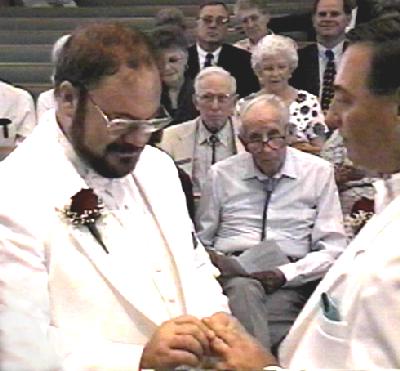
What's that you say—how is it possible? Massachusetts, the first state to
allow "gay marriage", only did so beginning in 2004. So how could we be married?
Simple. We said, "Fuck the government. Marriage is a statement of commitment to
ourselves and our friends and families." We got married in the
Unitarian Universalist Church of Surprise,
Arizona on August 12, 2000.
And now, eight years later, we are still together. (Michael actually moved in
with me in March, 1997; so we have been together 11½ years, well over the
average for "straight" couples.)
We've already been over
the preposterous concept that gay marriages will somehow negate or
threaten straight marriages. But today I read a new perspective.
Diana Hartman,
in BlogCritics Magazine, suggests that the main, emotional thrust of this
nonsensical issue boils down to a grass-is-always-greener concern. She writes,
Many of us have been there: watching other couples who seem so happy when we
are not—or once were, but are no longer. It rarely occurs to us that,
sometimes, when we enter the house of those we see as hopelessly in love, the
squeaking we hear is not coming from their charming screen door or their marital
bed. It is coming from the rats in the walls.
When our own marriage is in trouble, catching sight of what we think is a
happy couple provokes our envy. We remember what we lack and how painful it is.
For some, seeing a happy homosexual couple provokes disgust. While envy and
disgust are two very different responses, the origin of both feelings is the
same: they are happy and we are not.
Certainly the seams of some happy heterosexual marriages are showing some
wear. It has become a joke that
virtually
every single conservative lawmaker and religious leader
who has been most strident against gay rights and gay marriages, has
either been fooling around with guys on the side, or paying prostitutes to spank
them or dress them in diapers.
Not that Michael's and my marriage is an unending ride of constant bliss. We
argue, probably no more or less than any other couple. We've never hit each
other, which puts us ahead of the 31% of heterosexual American marriages that
have suffered from this heinous crime. (Domestic violence does sometimes occur
in gay relationships, but at a far lower rate than in the heterosexual
population…probably because our partners can hit back.)
One problem for any marriage, I think, is TV. Half-hour after half-hour, we
are presented with couples with no serious issues to face. This is an impossible
standard to try to live up to. The number one factor in couples' breakups,
according to statistics, has long been financial issues; but the last time I saw
a TV couple deal with that, it was Lucy Ricardo whose husband, Ricky, wouldn't
give her a raise in her "allowance". (She addressed the problem by selling
homemade mayonnaise on the side, until she discovered it was costing her more to
make and package the product than she could sell it for. That her husband gave
her an "allowance" was never questioned.)
This may lead to another possibility for why the straights are so desperate
to prevent people they don't even know from getting married. Stanford law
professor Richard Thompson Ford suggests a rational reason why some straight
married couples worry that gay marriage would undermine their own marriages:
a desire to preserve traditional sex roles.
Apparently, among some the fear
is that the traditional roles of "husband" and "wife" may become eroded
when a ceremony can involve two "husbands" or two "wives".
It's a joke question I've had asked of me by curious straight friends: "Which
of you is the wife?" But it reveals an underlying concern that, with marriage
equally available to anyone, a traditional husband and wife might be forced to
examine why, exactly, she has to cook and he has to take out the
garbage. I have a couple of straight friends who brag that they "like the woman
to be on top!" That they brag about it, indicates that they know this is
different from the norm. But why should there be a "norm"? Why can't each
couple find many positions that excite them? Perhaps if they put a little
imagination and newness into their time together, their marriages wouldn't drift
into that desert of indifference that seems almost inevitable. Again, jokes
demonstrate the universality of this sad situation. "Q: What's the difference
between your job and your wife? A: After five years, your job still sucks."
Of course, I know a couple of straight couples who are still in love and
still seem to have vibrant, interesting and active lives together. Sadly, it's
only two or maybe three of my many straight friends. The others who have
remained together, seem to have done so more out of inertia than passion.
I hate the phrase "gay marriage" which reeks of "special rights". I prefer
"marriage equality" because that is what we seek: An equality of marriage laws
that doesn't discriminate against gays and lesbians. (Only fifty years ago,
mixed race couples couldn't get married in many states. There was even a word
for it:
miscegenation.) In 1958, political theorist
Hannah Arendt wrote in an essay that the free choice of a spouse was "an
elementary human right". "Even political rights, like the right to vote, and
nearly all other rights enumerated in the Constitution, are secondary to the
inalienable human rights to 'life, liberty and the pursuit of happiness'
proclaimed in the Declaration of Independence; and to this category the right to
home and marriage unquestionably belongs."
But, in reality, I don't really want my marriage to be "equal" to the
heterosexual marriages that fail at a nearly 30% rate. I want my marriage
to be better than those. Yet I don't imagine that starting a campaign to
make marriage between, say, Southern Baptists illegal will somehow make my own
marriage stronger. No, it's gonna take continuing effort on my part, and on
Michael's, to keep it going. As with life, marriage is a journey, not a
destination. And when either party gives up that struggle, the marriage is over.
Which is not to say preventing Southern Baptists from reproducing might not be
a generally good idea.