|
By: Paul S Cilwa |
Posted: 5/1/2010 |
|
Page Views: 1,833 |
| Hashtags: #Hawaii #Linguistics #Travel |
| How to pronounce those wiki-wacky words of our 50th state. |
| Estimated reading time: 4 minute(s) (905 words) |
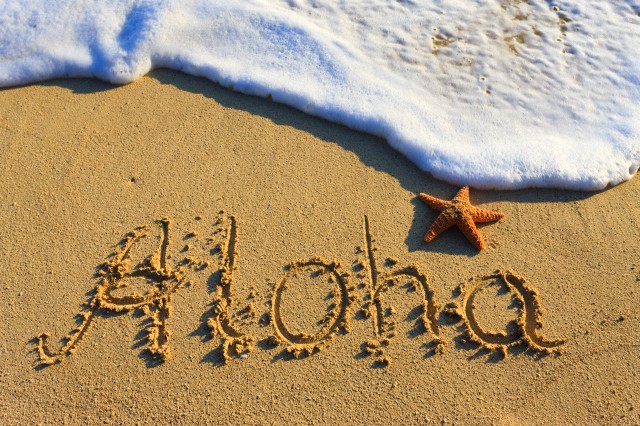
The original Hawaiians spoke Hawaiian exclusively, of course.
Their language came mostly from Tahiti and the Marquesas around 300
CE and evolved independently once the original colonists found
themselves isolated from their homeland. But other groups stumbled
on the islands from time to time, notably from Samoa/Tonga and the
Society Islands; and they brought their words with them, which
became incorporated into the Hawaiian language as well.
Hawaiian words sound long and repetitive to English speakers'
ears. That's because Hawaiian contains fewer sounds than English,
and therefore needs to chain them together in longer words in order
to maintain the same size vocabulary. So, for example, we have the
name of King Kamehameha, or the state fish, the Humuhumunukunuku
apu'a'a. But time and exposure to these words will gradually grant
familiarity to the ear.
Hawaiians did not write their language prior to the arrival of
the Europeans; their history and culture was transmitted via stories
and the hula, a dance consisting of meaningful body movements. The
first words in Hawaiian to be written down, were written
phonetically by Captain Cook in his 1778 ship's log. People weren't
rigid about their spelling in those days, anyway. He wrote it as
"Owhyhee" or "Owhyee". It turned out the initial "O" sound was
actually Hawaiian for "This is". Once that was understood, the O was
dropped and spellings similar to "Whyhee" were used.
But once the islands were discovered, missionary fervor built
rapidly and a Hawaiian written language was essential in order to
translate the Bible so it could be taught to the islanders. This
conversion was performed by learned churchmen, who naturally used
the Latin alphabet and pronunciations in their transliterations.
That's why the "ai" in Hawaii sounds like "eye" and an "i" by itself
is pronounced "ee".
The written Hawaiian language was quickly adopted by the locals,
though, who immediately saw its practicality—especially since the
missionaries forbade the dancing of the hula, under pain of death.
And once the Hawaiians became literate, they immediately began
printing their own newspapers. In the 115 year period between 1834
to 1948, the years spanning the Republic of Hawai'i and its forcible
inclusion into the United States as a "territory", Hawaiian language
newspapers were published and distributed to almost every one of the
main inhabited islands—and this is despite the fact that
schoolchildren were punished with beatings if they spoke Hawaiian in
school.
Hawaiian has only seven vowel sounds, and the transliteration
into Latin made use of five vowels and two diphthongs.
| Letter |
Pronunciation |
| a |
"a" as in "father" |
| e |
"ay" as in "say" |
| i |
"i" as in "ski" |
| o |
"o" as in "go" |
| u |
"u" as in "rue" |
| ai |
"y" as in "sky" |
| au |
"ow" as in "frown" |
Hawaiian has very few consonants, which is why their words sound
so vowel-heavy. That's why, when English words (like "Merry
Christmas") are pronounced in Hawaiian, they come out so different
("Mele Kalikimaka"). But Hawaiian consonants move easily into
English, with two exceptions.
One is W, which is properly pronounced as a cross between V and W.
(That's why you sometimes hear the name of the state pronounced "Ha
Vye Eee".) This is a hard sound for English speakers to hear, let
alone pronounce, because it simply isn't a part of our language.
The second is a sound we don't even have a letter for. It's
called a "glottal stop", and is the sound we make between
syllables when we say, "uh-uh." There is no standardization on what
character to use for this consonant, but it generally looks pretty
much like an apostrophe. So that's why you see the name of the state
or the Big Island spelt. "Hawai'i".
Because the consonant is so unusual in English, it's often simply
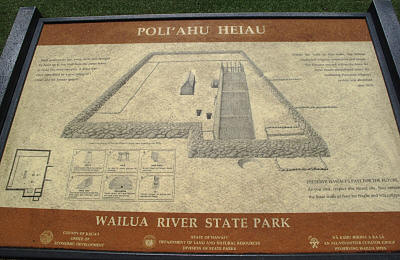
omitted from signage. So you might see "Poipu" or "Po'ipu".
But included or not on signs, the glottal stop is a part of
the word. And, by the way, the "oi" diphthong pronounced as in "oil"
does not exist in Hawaiian. Though to English ears "poi", the bland
staple food made from the taro plant, may sound like "poy"
(rhyming with "boy") it is actually "po-ih" with the two syllables
running together, as would be expected with any commonly used word.
So the town is "Poh IH poo", never "poy poo".
Lots of Hawaiian words end with a double vowel (with or without
the glottal stop) and both are pronounced. So, it's "Ha WY
ee", never "Ha WY". The town Kapa'a or Kapaa is pronounced "Kap ah
ah".
And the state fish? Break it up: Humuhumunukunuku apu'a'a is
pronounced "Hoo moo hoo moo noo koo noo koo ah poo ah ah".
If you're still having trouble, just order the mahi-mahi.