|
By: Paul S Cilwa |
Posted: 7/13/2008
Updated: 7/13/2008 |
|
Page Views: 1,326 |
| Hashtags: #Camping #SierraAnchaWilderness #SaltRiver #LakeRoosevelt #Arizona |
| Blog Entry posted July 13, 2008 |
| Estimated reading time: 9 minute(s) (1905 words) |
I am definitely getting more organized with each camping trip I make. I had
bought several things from Wal-Mart before hand, including a fluorescent lantern
and a terrific plastic box to hold my camp stove and kitchen implements. I was
very pleased with myself, because I had gone into the store with no measurements
and come out with this box into which the Coleman stove fitperfectly. I
now plan to get a few more of these boxes for other camping gear, which I think
will simplify packing the car down to a few minutes' chore each Friday night.
I had been agonizing over where to go that would best
fulfill Wade's wish. None of the places I'd previously visited in Arizona
were really "isolated" though most were, to some extent, remote. I
narrowed the list down to two possibilities: Salt River Warm Springs in the
White Mountain Apache Reservation, and Workman Creek in the Sierra Ancha
Wilderness. The latter won out due to the monsoon rains that fall this time of
year, which make the road to Salt River Warm Springs impassible, even for a
four-wheel drive vehicle.
Wade and I left the house about 10 PM and headed
for Globe on US 60. It's a beautiful drive in itself but I didn't take pictures
because I am saving that stretch for when I get my good camera back from my
daughter, Karen, who is on vacation in Virginia for a couple of weeks. On this
trip I would be using my cell phone for picture-taking.
In Globe we stopped for a snack at Taco Bell and then headed north on the
Globe-Young Highway, also known as AZ-288. This road is not much used, since
presumably the only travelers on it would be from Globe heading to Young, or
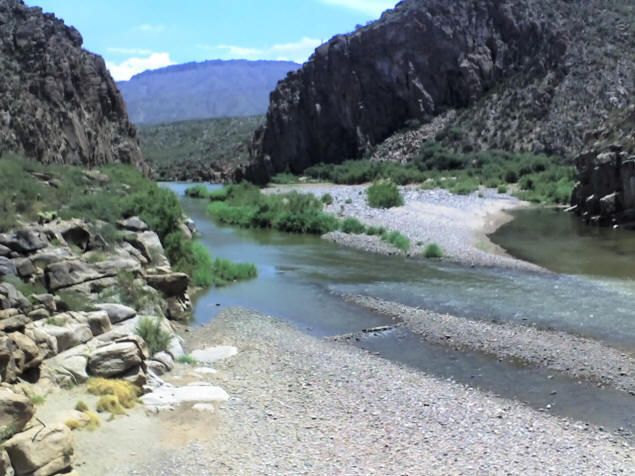
vice versa. In fact, it is so little used that the biggest bridge on it
can accommodate only a single lane of traffic. That bridge crosses the
mid-section of the Salt River, just before it pours into Roosevelt Lake.
Wade had more than once mentioned he hoped it
would rain on the trip, as he loved the sound of rain on the tent and, in fact,
enjoyed running in the rain. This was one of the reasons I was happy to go with him: Not
many people appreciate that apparently less-than-perfect weather, can in fact
be perfect. So, as the SUV entered the mountains east of Roosevelt Lake, the
towering cumulous and otherwise dramatic skies did not discourage.
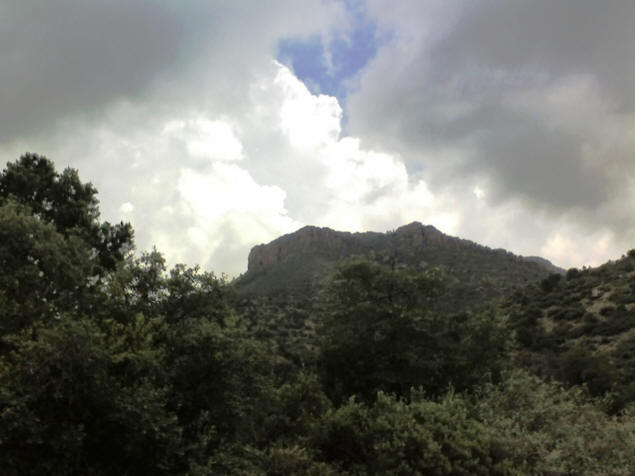
As I've seen all summer, Arizona this year is stunningly lush, with
unusually green vegetation choking the normally-exposed rock and
softening the harsh look of the place that people usually associate
with this state.
The instructions of my GPS were pretty good except at one point,
where it made said to go off the pavement and onto a rather
sketchy-looking primitive track. I drove on it for about 50 yards,
then (by instruction) took a very sharp right turn…and
returned to the pavement, just a few yards from where I'd left! I
think it's because the GPS map is out-of-date in some places, and
AZ-288 was only recently paved. Before it was paved, this little
side trip may in fact have been the faster way to go.
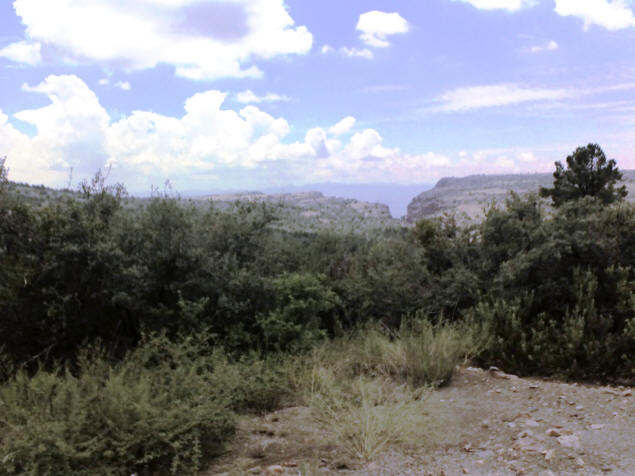
Eventually the pavement did run out on AZ-288, too, as the road prepared to
wind ever higher into the mountains.
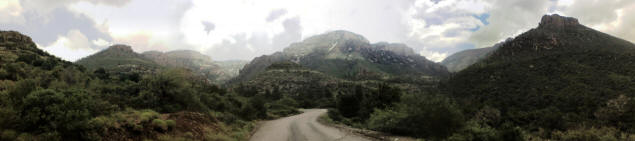
Finally, rounding a switchback, there was an awesome view of
Roosevelt Lake visible just a moment before the SUV dove into the
wilderness.
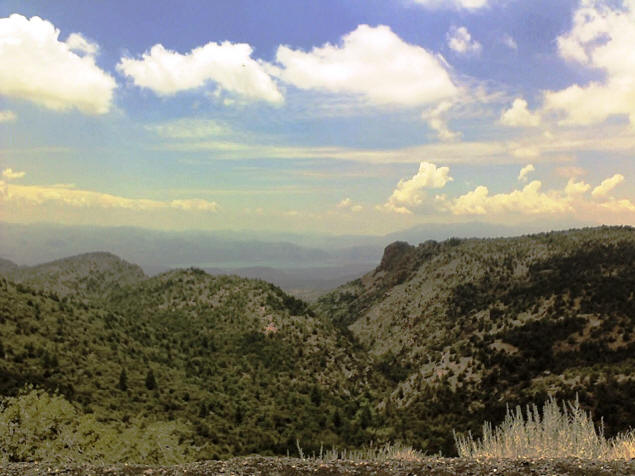
"Sierra Ancha" means broad mountain in Spanish. It's actually
a range of mountains that transition from the lowland deserts of
southern Arizona and the Colorado Plateau of northeastern Arizona.
The Sierra Ancha Wilderness is part of the Tonto National Forest, a
protected area on the eastern flank of the range encompassing a
number of high peaks and deep canyons.
The last 14 miles or so of our trip in, on Forest Road 487, was slow going. I
had to engage my four-wheel-drive to keep on the road, which was composed of
gravel, rock, dirt, and mud.
There were several primitive campgrounds along the way, with pit toilets. But
there were already campers there, and the goal was "isolation". So I drove on.
Finally, about four miles past Workman Creek Falls, I spotted an
undeveloped campsite at the Moody trailhead. There was room for one tent and
plenty of parking for hikers, but none was used.
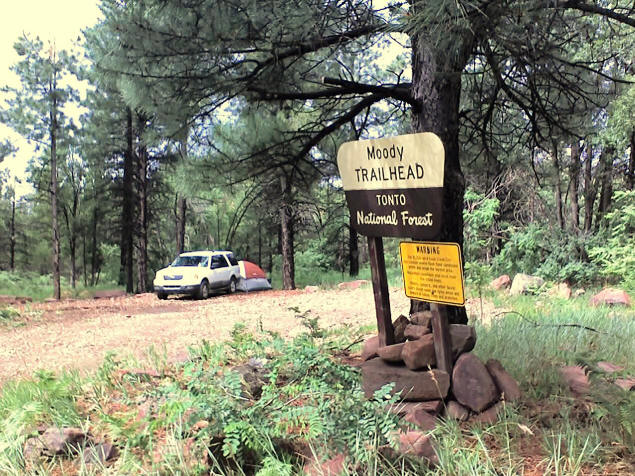
Because it was raining off and on, I parked the Expedition very close to the
tent, so we could use the hatchback as shelter for keeping gear dry as we passed
it into the tent. Once we'd set up camp, Wade donned his
CamelBak and went for a run,
leaving me to enjoy the peace and native sounds of the woods.
I didn't see any lightning, but there were frequent, deep-throated rolls of
thunder, sounding almost like organ notes. I haven't heard that since I was in
Grand Canyon. In the Canyon, the notes are formed when canyon corridors
emphasize some frequencies over others. Even though I wasn't in a canyon,
I had to assume that canyons nearby were causing the same effect.
I don't run. I don't like to run. But I do admire people
who do. Once the rain stopped, I went for a very slow, reflective stroll
in the opposite direction. The first thing I found, just a few dozen
yards further up the road, was a cabin that belonged to the US Forest Service.
It was locked, of course; but hidden from the road by trees was an outhouse. The
Sierra Ancha Wilderness is a pack-it-in-pack-it-out kind of place. If you've got
to go to the toilet, you need to go into "Double-Doody"-type
disposal bags, which are not any more fun to use than they sound. I had the
bags, but it was nice to know I wouldn't need to use them.
The lushness was the single most striking feature of the section. We get so
used to desert in the Phoenix area that it's easy to forget there are Ponderosa
pine forests such a short distance away.
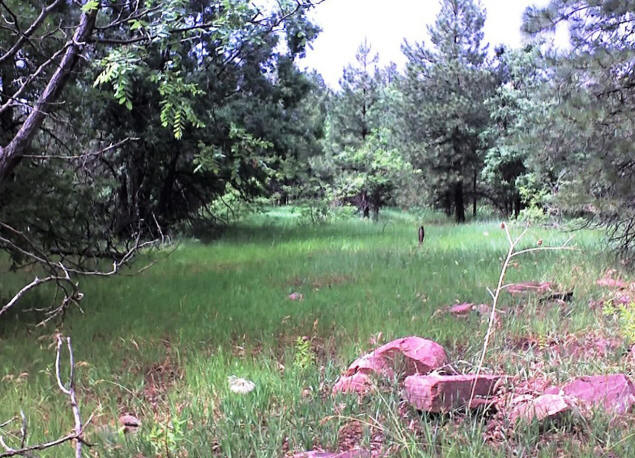
I hiked near the summit of the mountain, and it opened up
slightly—but the vegetation was still exuberant. The Coon Creek Fire
of 2000 had "destroyed" almost 10,000 acres before it was put out a
couple of weeks after it was reported. There are still signs of that
fire: charred tree trunks, many of them fallen, and new meadows
where none previously existed.
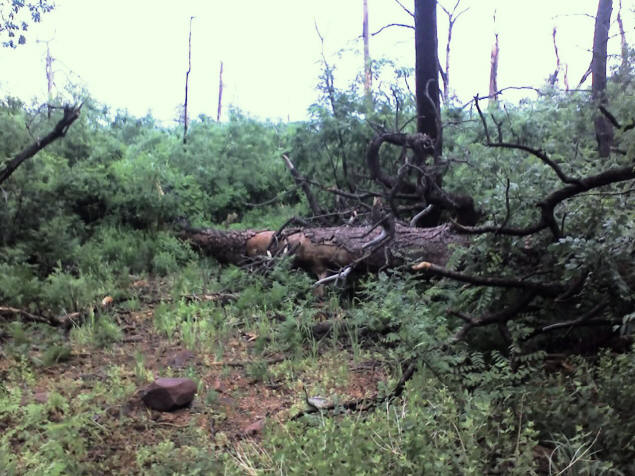
But "destroyed", while it's the word invariably used by the TV news
reporters, is totally incorrect. "Recycle" would be better. Fires
are nature's way of keeping a forest healthy. It's more analogous to
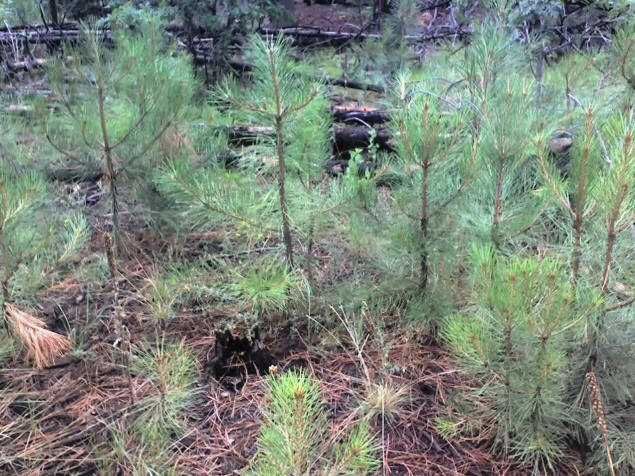
getting a haircut than to being shot by an AK-47. Just 8 years after
this devastating fire, I saw evidence everywhere of the forest's
renewal, like the baby pine trees I saw sprouting next to their
deceased parent's trunks.
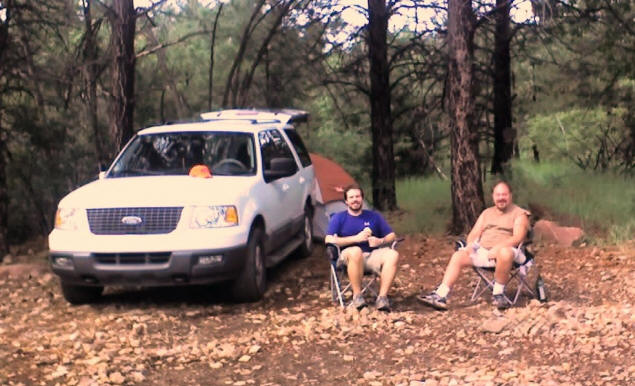
I returned to camp shortly before Wade, who
had run 8 miles in the time I spent strolling about a quarter. We
took out the camp chairs and relaxed, comparing notes, and enjoyed,
in companionable silence, the breeze and the sunbeams shining
between the clouds and the sounds of the occasional cricket and the
songs of birds.
There was a conveniently-placed boulder that was perfect for the
propane camp stove. Wade's a vegetarian, so we
had Boca Burgers and
mixed vegetables, plus apples, bananas, and trail mix. I then did my
best to build a fire in the existing fire pit, with
previously-gathered firewood. Unfortunately, even with a few fire
sticks, it was too wet to actually burn for more than a few minutes.
I made a vain attempt to use the neighboring cabin's outhouse. As I sat down,
a curious mouse could not be dissuaded from investigating my shoes. I am not
afraid of mice, but I prefer they leave my shoes alone. Unable to concentrate, I
finally gave up. As Scarlett O'Hara used to say, "Tomorrow is another day!"
It was about 10 PM that I brushed my teeth, dumped the water on the sodden
ashes of the almost-fire, and went to bed where the quiet was only occasionally
punctuated by the splatter of errant raindrops.
In the morning, I was awakened to an incessant droning, which turned out to
come from a swarm of bees that had arrived to celebrate our camp. I'd only seen
one or two bees the day before, but apparently they had flown home and told
their friends, "Hey, guess whatwe found!" They were thick between
the back of the car and the tent. I was still too sleepy to
get up, but Wade went out to heat some water and they buzzed about me like paparazzi around
Angelina Jolie adopting another baby. I had brought some eggs to make for
breakfast, but decided that cooking in the swarm would probably be
counter-productive. Besides, Wade had wanted to get home on
the early side of afternoon. So we So I decided to strike camp, but
carefully, to avoid trapping a bee in the tent or in the car.
One at a time, I handed items from the tent to Wade, who then
opened a car door and slipped them inside. The tent, of course, went last. The
bees seemed disinterested in us but utterly fascinated with my rear bumper. In a
surprisingly short amount of time, we had camp struck and the SUV loaded.
One at a time, I took items from the tent and then opened a car door and
slipped them inside. The tent, of course, went last. The bees seemed
disinterested in me but utterly fascinated with my rear bumper. In a
surprisingly short amount of time, I had camp struck and the SUV loaded.
We surveyed the campsite. "I am so over those bees," Wade observed.
I was so over those bees as well!
The return trip, in morning light, was as spectacular, yet different, as the
trip up had been.
In Globe, I stopped at a place called Jerry's Restaurant. I usually
like to go to non-chain places, happy to spend money I suspect will
actually make it to (in this case) Jerry. However, the food was
desperately average, with tasteless eggs and a waitress who insisted
the margarine she brought us was "real butter."
Wade gave me the bacon that came with his meal, and I will say it was pretty good.
So we got home before noon, which left time for Michael and I
to take Zachary to see Journey To The Center Of The Earth 3-D.
Wade did agree to make another trip some time in the future, so
hopefully he had as good a time as I.
Sierra Ancha is beautiful and perhaps I'll return some other time.
But maybe not in bee season.