|
By: Paul S Cilwa |
Posted: 5/5/2008 |
|
Page Views: 1,983 |
| Hashtags: #SaltRiver #UpperSaltRiver #WhitewaterRafting #Camping |
| My new friend wanted to go whitewater rafting. Well, me, too! |
| Estimated reading time: 10 minute(s) (2356 words) |
Frank is a flight attendant who lives in Phoenix between flights and wanted
to go whitewater rafting for the first time. It took a little while to pin down
the specifics, and there was a bit of urgency since he wanted to raft the Upper
Salt River and, due to decreasing water flow (the river runs snowmelt from the
White Mountains) as the season progresses, it can only be rafted until the
middle-to-end of May. This year, it looks like the final week will be this one.
So, if we were going to go, we had to go.
By the time I was able to make reservations, Saturday was booked up. But
Sunday was available, so I locked it in. The put-in, which is in the
Salt River Canyon,
is about 2.5 hours from our house in East Mesa (according to my
new GPS). We decided to leave
Saturday afternoon, camp near the put-in, and then not have far to go to get to
the put-in at the appointed time of 9:30 am.
Arizona doesn't have as many campgrounds as you might expect. But I did find
one, Jones Water
Campground, that was associated with the Tonto National Forest. It was
primitive (which is perfect for tent camping), had toilets (pit toilets, but I'm
fine with that) and free (the best part). Very cool: the web page included the
latitude and longitude of the campground, which I could feed directly into the
GPS.
We planned to leave at 2 PM and Frank arrived promptly at that time. Of
course, I was still doing some last-minute packing. We actually left a little
before 3 PM and then had to turn around to pick up my camera, which I had
left out to bring but didn't actually take to the car. (And then it
turned out I had forgotten the baked potatoes I had planned for dinner, and
condiments other than salt and pepper, and the eggs I had planned for
breakfast.) I'm sure Frank wondered what kind of flake he had linked up with and
if he wouldn't have been safer in a jet with two engines out than he was with me
on the ground.
But we had an enjoyable ride through US 60 to Globe, and then north (still on
US 60) to Jones Water, spent getting to know each other. It's always fun to meet
someone new and have the luxury of a couple of hours in which to trade your
stories. Especially with someone as interesting as Frank, who flies monthly to
India, has relatives he frequently visits in Italy, and had been to many of the
same favorite places as I.
When we arrived at Jones Water, there were no other campers. (Two arrived
later that night, but thankfully camped well out of sight of us.) We set up the
tent, complete with queen-sized air mattress (the luxury of car camping as
opposed to backpacking, where you have to settle for a sleeping pad between you
and the ground). With shade trees to keep the tent from getting too warm in the
morning sun, and a fairly level place for it, we seemed pretty well
situated.
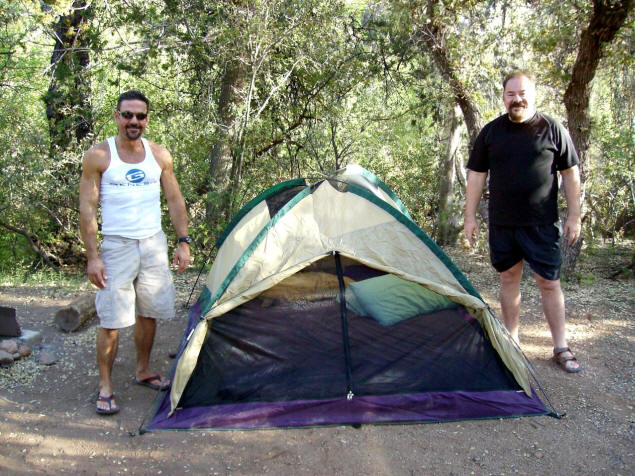
The pit toilet was a few steps up the hill (yet out of sight) and the site
was complete with a picnic table and fire pit. Frank set out after deadwood so
we could have a fire while I set up the two-burner propane stove for dinner. (It
was at this point I realized I had forgotten to bring the potatoes.) Frank was a
master at finding deadwood, even locating and dismantling a dead tree in the
process.
Dinner consisted of hamburgers pre-stuffed with mushrooms and Swiss cheese,
whole wheat buns, and corn on the cob. It always takes quite a while to get a
pot of water burning on a propane stove; but somehow the corn came out
absolutely perfectly. Frank even commented on it, so maybe by this time
he was beginning to feel that I wouldn't inadvertently kill him before the trip
was over.
After the sun had set, twilight faded quickly and then the stars came out. I
think that a sky brilliant with stars is what I most miss living in Phoenix.
Between the air pollution and the light pollution, the Phoenix night sky is so
washed out you're lucky if you can make out the Big Dipper, much less the more
interesting stars. At Jones Water, the sky was awash with steady pinpoints of
light, looking more like backlit holes punched into black velvet than a sky, the
kind of sight that could successfully compete with cable TV for a person's
attention.
In the morning when I realized I had also forgotten the eggs for my planned
scrambled eggs-and-bacon breakfast, we made do with not-from-concentrate orange
juice and cherry turnovers. We had considered going back to Globe for
McDonald's, but by the time we had broken camp and re-packed the car, there
really wasn't time.
The Salt River Canyon bridge was 30 miles north of us. The view from it was
exquisite.
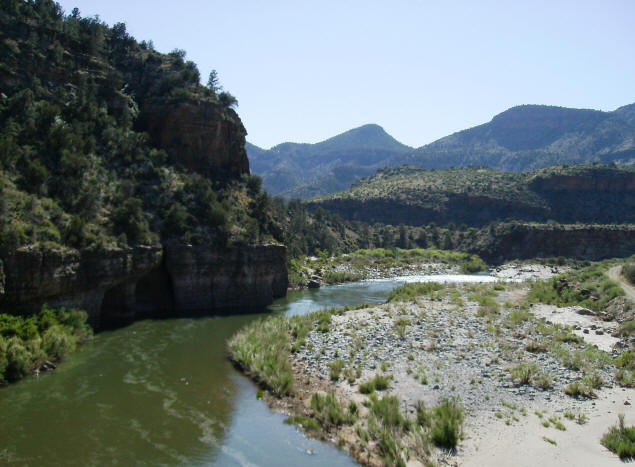
The turn-off for the rafting put-in was just past the bridge. We
parked and joined the crowd of rafters already waiting. Most of them
were wearing blue "splash jackets" provided by the company,
Wilderness Aware.

I asked one of the boatmen, "Are the splash jackets really
necessary? It's already pleasantly warm."
She replied conspiratorially, "Most of them will have them off in an hour,
and then be stuck with them the rest of the day." So neither Frank nor I
bothered with one, and never missed it.

When we checked in, the boatman on the other side of the table and I had a
good laugh. I said, "I do admire your taste in bathing suits." He replied,
"Yours is awesome!" They were identical, except his were far more worn than
mine.
The boatman's name was Reid Williams,
and he turned out to be the lead boatman on this trip and also our
boatman. That is, Frank and I were assigned to Reid's boat. Reid was funny,
smart, irreverent, educated in the geology and fauna of the Upper Salt River
Canyon, and very professional. In short, he epitomized every trait I've
always admired in professional boatmen.
Before getting on the river, I returned my not-waterproof digital camera to
the car, in favor of Frank's waterproof film camera. (That means it'll be a few
days or more before I can post Frank's pictures. Sorry.)
There were eight people on each raft, including a boatman. On our raft, Frank
sat right front and I sat left front. Behind us were a married couple, a man and
woman who, despite their age (about the same as us), were clearly newlyweds and
very much in love. Another couple sat behind them, and an attractive single
woman sat next to Reid, clearly loving being next to the hunky guide and getting
all flirty feminine on him whenever he said anything to her.
As on all these one-day trips, the first half-hour or so was spent in
learning and practicing commands given by the boatman to maneuver the raft.
"Ahead all!" means everyone paddle forward, of course. "Back left!" means for
the people on the left side of the boat to paddle backwards. Reid also explained
that one paddles with one's whole body, not just the hands. Most of the people
in our raft had rafted before; and the few who hadn't were, like Frank, in good
shape and able to carry their weight. Reid frequently praised our group as being
a good team that provided a lot of "power" for him, as steersman, to channel
into maneuverability. Whenever he said this, he sounded absolutely sincere and
spontaneous. I'm certain he says this to every group he leads, but it never
sounded that way, which is just another testament to his professionalism.
However, with Frank and I in front, I could see that "Ahead all!"
resulted in Frank's and my digging our paddles into the water in perfect unison,
and I could feel the raft charge forward as a result, even when my paddle
clunked with that of the woman behind me, who wasn't so much in sync. My two
problems were 1) Taking twenty minutes to memorize that I was on the left
side of the boat, for commands such as "Ahead left!" and "Back left!" and 2)
Resetting quickly from a "Back left!" to an "Ahead all!" instead of taking a few
seconds to congratulate myself for getting the first command right.
Frank had no problems at all. The man is a natural boatman.
Reid's maneuvering style was very economical. That is, he always got
exactly as much power and speed from us as needed—never more, with nothing
wasted. We saw other rafts on the river whose paddlers were always paddling. Our
raft was much more laid back.
This being nearly the end of the season, the river wasn't running hard. Most
of the rapids we encountered were Class II; one or two were Class IIIs; and one,
the last one, was a Class IV. (Rapids on a river run from Class I, a "riffle"
that wouldn't prevent you from threading a needle, to Class VI, which requires
real expertise to run safely. Class "VII" is unrunnable, for example Niagara
Falls.)
In fact, many spots on the river were so shallow the boats dragged a bit. We
got stuck on a rock just once, held up briefly several times. That was
because we were able to follow Reid's commands quickly and accurately enough to
actually take the route he wanted. He seemed to know the location of every
troublesome rock in the riverbed. We saw the other rafts get stuck far more
often than ours; and, as lead boat, we had to wait for them before proceeding.
(Contrary to what you would think, the "lead" boat usually goes last to make
sure none of the other rafts get into trouble they can't get out of. There is,
of course, no question about where we are going: downstream!)
Around 12:30 we stopped for lunch. Reid allowed me to swim a few hundred
yards to the lunch spot. As usual, I was the only paddler interested in doing
so. The water was cool, to be sure, but not Titanic-my-heart-will-go-on icy. And
by this time the sun was definitely warming up the day so the dip was most
welcome.
Lunch was steak and chicken fajitas, cooked of prepared materials by the
boatmen. Maybe not 4-star, but certainly better than anything from Taco Hell.
And, of course, everything tastes better when eaten outside, especially on a
river bank.
Exhibition rapid was a Class III that day, which meant a visible drop and
good-sized waves—and most of us getting wet, even the paddlers who weren't me
and therefore hadn't been swimming. Frank, in particular, got a good splash.
That was followed by Mescal Falls, with a 20-foot (or greater) drop and enormous
waves. The raft bucked so that, in the front, attempts to paddle forward didn't
always connect with actual water. Just before entering, Reid had said, "There's
no shame in checking that your foot is in the foot restraint." It was a good
thing he did; my foot had slipped out without my noticing and with nothing
holding it, I would have gone into the drink for sure.—Not as pleasant a
prospect when there are big rocks and bigger waves involved.
About 3 o'clock, our river run of about ten miles was over. We piled up our
paddles, having been asked to keep our life jackets with us when we got on the
bus. "See my helmet?" Reid told us, pointing. "You will notice I will keep it on
during the ride back to camp. This is a Class IV bus ride!"
Before the bus could leave, though, the rafts had to be tied to the top of
it. I joined the boatmen to help, along with a couple of other passengers. I
like to do it; it makes the adventure last a little longer.
I needn't have worried. Reid was right; if I hadn't trusted the driver and
the rafting company, not to mention the engineers who built the road, the bus
ride would have been quite a harrowing experience. Or, as my mother would have
said had she been there, "Jesus, Mary and Joseph, we're all going to die!" The
gravel road, cut from solid limestone, hugged the river very closely, but
about 200 feet above it. In addition, there were a series of very sharp
snapping sounds that seemed either to be the straps holding the rafts
breaking, or a sniper shooting at us. However, we didn't lose the rafts and no
one was shot, so apparently the sound came from some other source.
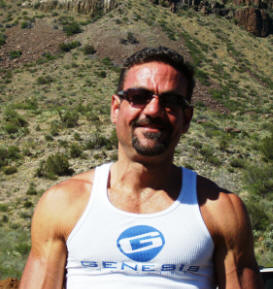
Back at the put-in and rafting camp, we said goodbye to (and tipped) our boatmen,
changed into dry clothes, and with some reluctance, drove back to our day-to-day
lives. Frank was already enthusiastic about his next rafting
experience—as he put it, "I think I'm ready for some seriously rowdy rapids!" I
have no doubt he is.
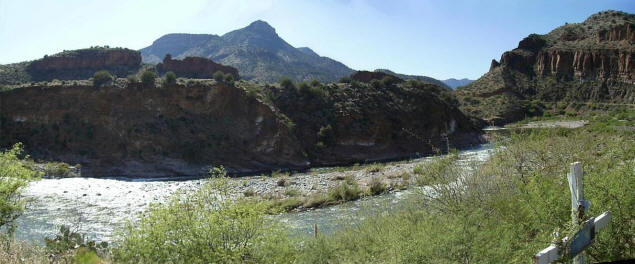
Just before leaving, I stepped to the edge of the cliff overlooking the river
at the put-in and took a panoramic shot of the vista. Whether rafting, floating,
swimming or just looking at it, the Salt River is one of Arizona's true
treasures and one I feel privileged to enjoy and delighted to share.
Reid's Video
Here's a video Reid put together at the beginning of this year, on an
all-the-way Salt River run. It's about ten minutes long. Enjoy!