|
By: Paul S Cilwa |
Posted: 2/5/2008 |
|
Page Views: 1,357 |
| Hashtags: #GrandCanyon #Arizona #Travel #Photography |
| Sightseeing along the Grand Canyon south rim. |
| Estimated reading time: 4 minute(s) (738 words) |
I was last on this road with my son, John, and his then-wife as a side trip
while taking them to Minneapolis. It did not impact the trip length by more than
two hours, and was well worth the small amount of extra time.
As I write this, Grand Canyon has just received a load of snow so I am not
recommending this weekend as being the ideal time to visit. In fact, John
and I were there in June. (Which is not to say the Canyon isn't beautiful under
a
veil of snow!) But in just a few weeks the snow will have melted and, if you
are in the area, this would make a terrific little side-jaunt that will give you
a greater opportunity to appreciate Grand Canyon than you can get by any means
less than hiking into it.
I have well-documented the views from the terminus of US 180 so I won't
repeat that here. But just about twenty minutes or so east of US 180 you'll see
rising before you a stone or brick structure on the left side of the road,
between you and the rim.
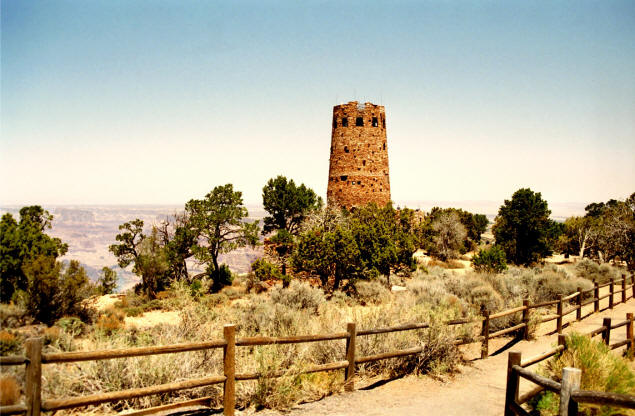
This is called the Watchtower, a 70-foot-high stone building
designed by architect Mary Colter, who modeled it after towers found
at ancient pueblos such as Mesa Verde and Hovenweep. The Watchtower
is connected to a circular observation room fashioned after a Hopi
kiva—a ceremonial room that often adjoined the real pueblo towers.
To climb the Watchtower (which is free), you'll first have to pass
through this room, currently being used as a gift shop selling
Navajo rugs and Native American artifacts. The shop is open daily
8am to 6pm, and the observation deck can be accessed until 5:30pm.
The walls inside the Watchtower are decorated with traditional
Native American art. Some of the finest work is by Hopi artist Fred
Kabotie, whose depiction of the Snake Legend, the story of the first
person to have floated down the Colorado River, graces the
Watchtower's Hopi Room. At the top is an enclosed observation deck,
which at 7,522 feet is the highest point on the South Rim. From
there you can see the Colorado River itself.
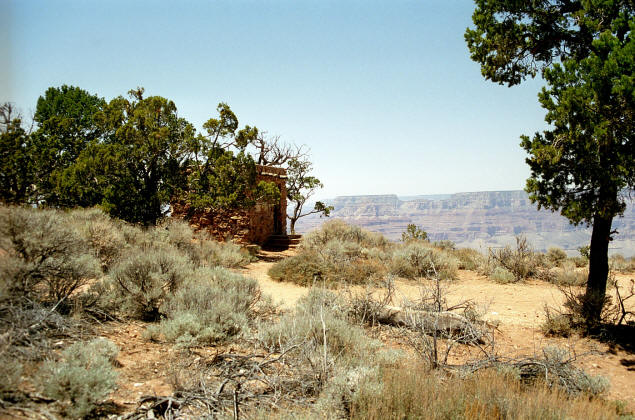
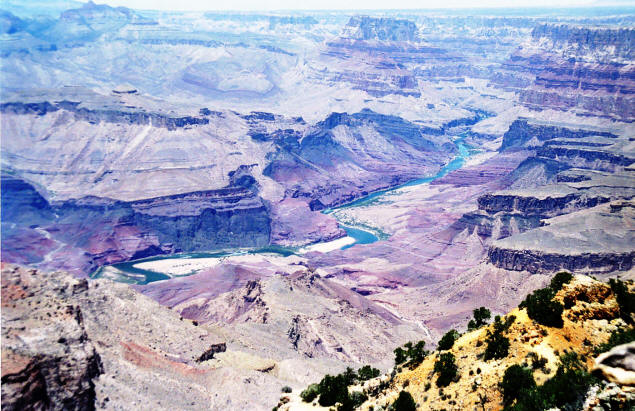
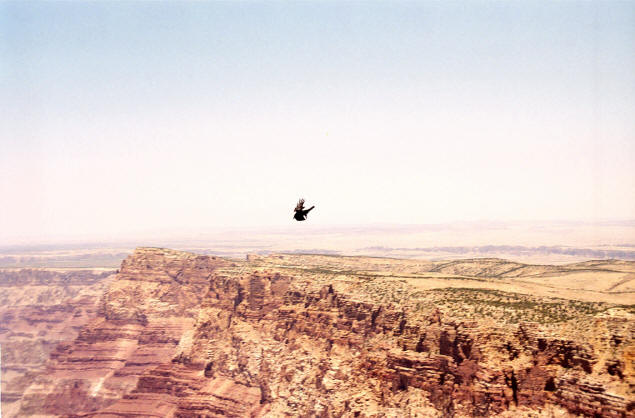
To the northeast you'll see the cliffs known as the Palisades of the
Desert, which form the southeastern wall of Grand Canyon proper.
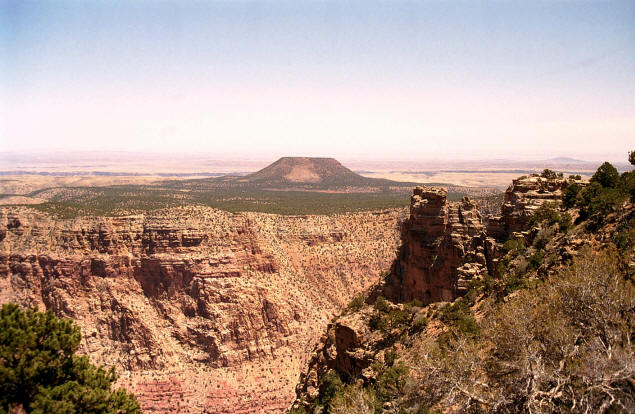
Leaving the Watchtower behind, another half-hour down the road will
lead you to a parking area with wooden shelters erected for local
Navajo to sell the jewelry for which they are famous. But behind
those shelters, a short, easy hike from the road, is the unearthly
Little Colorado River Gorge.
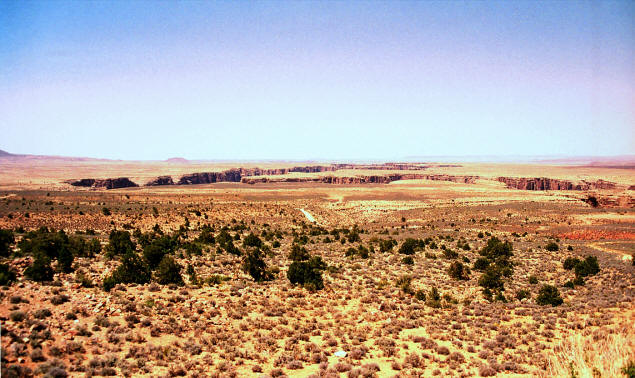
Looking from afar like the remains of some great, prehistoric
earthquake, this geologic masterpiece almost forces one to park and
explore—which is why the Navajo, on whose land the gorge resides,
wisely chose to sell jewelry here. And they don't mind if you check
it out before you check them out.
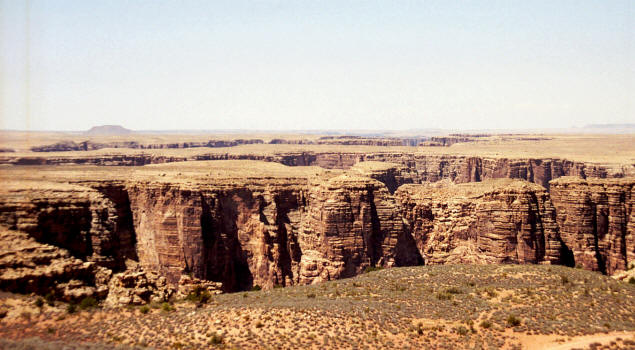
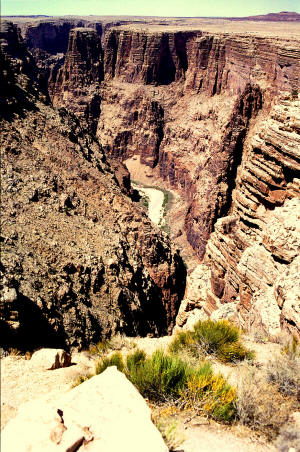
Usually, interesting things resolve themselves as you get closer. But the
Gorge only increases its pull as one approaches, because it just
looks stranger and stranger.
At this point, the Little Colorado River is just a trickle unless it's
actually raining. But the Little Colorado River Canyon continues to gather more
and more water as it approaches the "real" Colorado until, when they merge, the
Little Colorado is dumping as much as 5200 cubic feet per second into its
master.
Such is its draw that, in the 1950s, the pilots of two tourist planes flying
overhead became so enraptured that neither they nor their passengers noticed the
other plane. The two collided and went down. Although the bodies and most of the
wreckage have long since been removed, there is still a wheel down there
somewhere which hikers occasionally encounter. And, no doubt, there are also a
few ghosts who can be heard late on moonlit nights, crying, "Wow! Lookit
that!"