|
By: Paul S Cilwa |
Posted: 9/2/2026 |
|
Page Views: 164 |
| Hashtags: #Science #History #Music #SoundRecording #Stereo #ArtificialIntelligence |
| How we finally solved the one-microphone problem. |
| Estimated reading time: 24 minute(s) (5635 words) |

Real Talk for the Squad
(That's Gen-Z for "A Message For Persons Born Since 2000.")
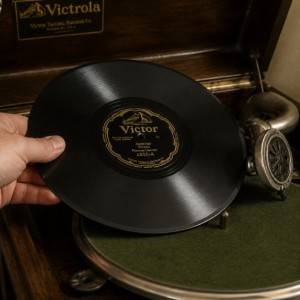
Since I just used two pieces of jargon that stopped being common knowledge somewhere around
the Reagan administration: a 78 is a shellac phonograph record that spins at 78 revolutions
per minute and holds about three minutes of music per side. Three minutes. That's it. That's the
entire reason the pop song is three minutes long; it's not an aesthetic principle, it's a
manufacturing limit that everybody got used to and nobody ever revisited.
Shellac deserves a word of its own, being the least likely substance ever asked to carry a
symphony. It's a resin secreted by the lac insect, a scale bug that swarms certain trees in
India and Thailand and encrusts their twigs with the stuff. The twigs are scraped and the resin
washed and dried into amber flakes. You have almost certainly eaten some: it's the glaze on
shiny candy and the coating on a good many pills, and it's what your grandmother's dining
table was finished with.
A 78 was never pure shellac, though. A typical pressing was mostly filler—
pulverized limestone and slate, carbon black for color, cotton flock for strength—with
the shellac merely binding the aggregate together. And the grit wasn't an economy measure.
Steel needles were sacrificial, meant to wear down to match the groove within a play or two,
and the abrasive in the record is what ground them to shape. You threw the needle away and put
in a fresh one. The record did the sharpening.
All of which imposes a ceiling that has nothing to do with how well the performance was
captured. A stylus dragged across compressed rock flour makes noise, and it makes it worst in
exactly the register where the detail lives: cymbals, brushes, string overtones, the s
at the front of a word. Every 78 has a hiss-and-crackle floor some thirty decibels below the
loudest thing on it, which means the quietest sound a 78 can hold isn't set by the microphone.
It's set by the gravel. And the same abrasive that sharpens the needle is chewing the groove
while it does it, taking the high frequencies first—so a well-loved record is a duller
record.
Those YouTube videos in which 1920s records are played on modern turntables and sound,
well, not awful—the records they are playing, were not beloved by their
original owners; if they had been, the grooves would have worn to almost nothing within
a few years of purchase.
Quieter materials existed but kept losing in the marketplace. Edison pressed his Diamond Discs on a phenolic surface
over a wood-flour core, played with a permanent diamond stylus. It lost anyway, and not on sound.
Edison cut his grooves vertically, so his discs wouldn't play on a Victrola and Victor's wouldn't
play on his machine—and Victor had Caruso. Edison personally auditioned the artists,
and his taste ran narrow and conservative—little use for jazz, few stars signed, and he
marketed the machine rather than the performer, at exactly the moment Victor was
inventing the celebrity recording artist with their Red Seal series.
Vinyl became available in the thirties and got its real trial during the war,
when the lac came from Asia and the shipping didn't: the V-Discs shipped to the troops were
pressed in vinyl because there was no shellac to be had. It still took until 1948, and the
introduction of the "LP", the Long-Playing record, for the industry to give up the gravel.
But those V-Discs, with their quieter surface noise, have given us wonderful examples
of what a 78 could have sounded like if the materials had been better. Sadly, they
returned to shellac after the war—the vinyl had been a shipping decision, not an audio
one, and shellac was cheaper.
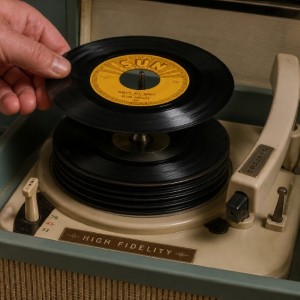
A 45 is the vinyl record that replaced it in 1949—seven inches across, spinning at
45 RPM, with a hole in the middle big enough to push a banana through, with one song per side.
The good song was the A side. The B side was whatever the label had lying around,
though, occasionally, the B-side would surprise everyone and become the bigger hit.
The big hole in a 45 wasn't a design flourish. It was sized for the fat spindle of a
record changer that could stack a half-dozen singles and drop them one at a time—the
1950s equivalent of a playlist.
Both formats are monaural ("mono" for short): one channel, one signal, one loudspeaker's
worth of information, from mon, the Greek for "one," and aural, meaning "of or
relating to hearing."
Stereo didn't reach the consumer until 1958, and it took most of the '60s to become the
default. Which means that essentially everything recorded before Eisenhower's second term
exists only as mono—including most of the music I actually want to listen to.
Not that stereo was a new idea in 1958. In 1881—four years after Edison's tinfoil
phonograph—Clément Ader lined the stage of the Paris Opéra with telephone
transmitters and ran the wires across town to the Exposition of Electricity, where listeners held
one receiver to each ear and could tell where on the stage a singer was standing. His
Théâtrophone went on to run as a paid subscription service until 1932. The idea then
sat unused for fifty years, because knowing how to transmit two channels is not the same as
knowing how to record two channels and keep them in step.
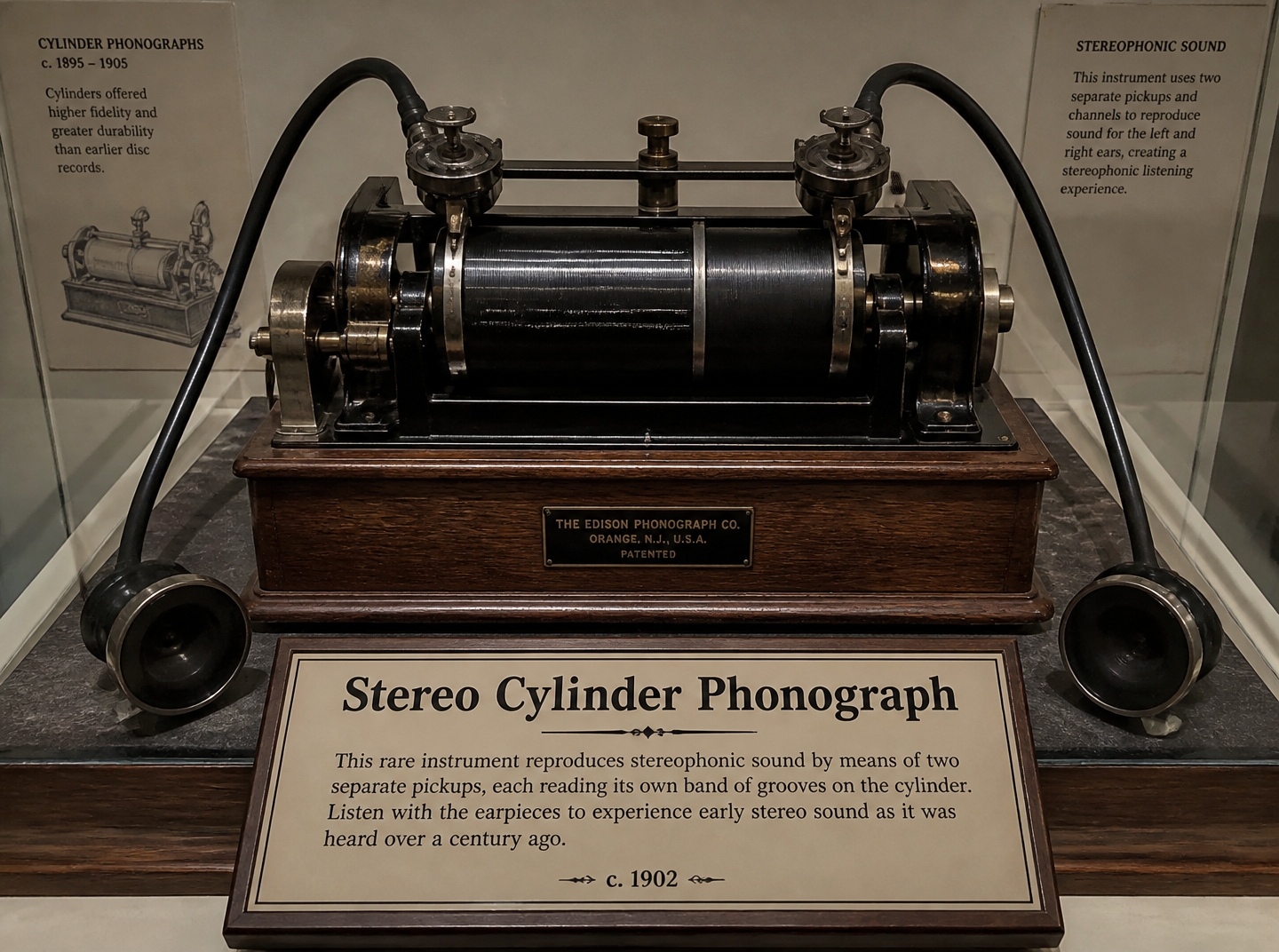
Except that I'm not sure the gap was as empty as that. I grew up in St. Augustine, which had a
museum called the Oldest Store—a turn-of-the-century general store preserved with its
merchandise still on the shelves. Among the exhibits was a cylinder phonograph with two
reproducers, each running by its own rubber hose to its own earpiece, playing a cylinder cut with
two separate bands of grooves. In the sixties it was labeled as a stereo machine.
We weren't allowed to play it, so I can't tell you what it sounded like. But consider what
recording meant before microphones: a horn, and sound loud enough to drive a cutting stylus on
air pressure alone. Two bands of grooves means two styli, which means two horns, which means two
positions in the room. Whatever was on that cylinder, the two bands cannot have been identical.
Stereo wouldn't have been an achievement. It would have been unavoidable.
The Bee In My Bonnet
(That's Boomer for "The Thing Living Rent-Free in My Head.")
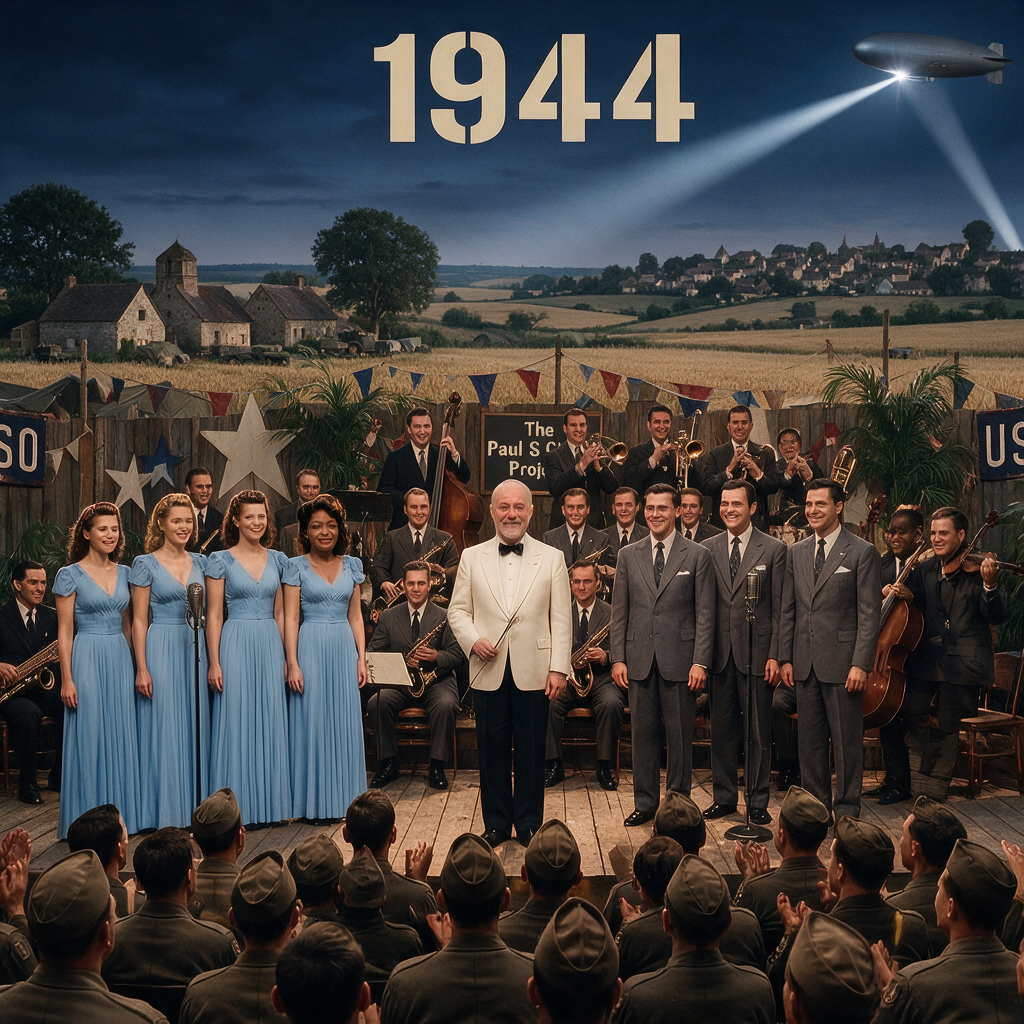
Recently I've been writing and producing an album called
1944, set on an alternate
Earth where I was not only alive in the forties, but leading a big band on a USO tour. Getting the
arrangements right meant getting the sound right, and the sound that came back was a
revelation. Listen to
"Wee Willie Winkie"
and you're hearing a room: a band arrayed across a bandstand, brass to one side, reeds to the
other, a singer standing out in front of all of it, and the hall itself wrapped around the
whole arrangement. I can't swear it's exactly what a 1944 audience would have heard. But it's believable
in a way no surviving 1944 recording is, because the surviving recordings were made through a
single microphone onto a single track.
Which is not a new impulse. Starting in 1970, Time-Life sold a mail-order series called
The Swing Era that attacked this exact problem in the only way then available: they hired
studio orchestras, transcribed the original arrangements off the original 78s note for note, and
had them played again in stereo. Billy May did much of the conducting, while listening to
the original recordings through headphones as he did so; and a good many of the players
had been in those bands the first time around. If you wanted to hear the Swing Era in stereo, somebody
had to go back into a room and perform it again.
The sets sold enormously (including to me), and collectors have been ambivalent about them ever
since. The playing is clean, the stereo is real, the charts are correct—and something is
missing that nobody has ever managed to name precisely. It may be that the recordings are
too perfect. A transcription captures every note a man played and nothing of why he played
it that way; and the men reading those charts in 1970 were thirty years older than the ones who cut
the originals, and a good deal more careful.
In any case, that made me greedy. I've got Glenn Miller and the Andrews Sisters and Harry James in
my library, recorded on only one channel, and I would very much like to hear them the way the
people at the Hollywood Palladium heard them. Which turns out to be a problem the recording
industry has been failing to solve, in escalating ways, for about seventy years…until now.
What Two Ears Are Actually For
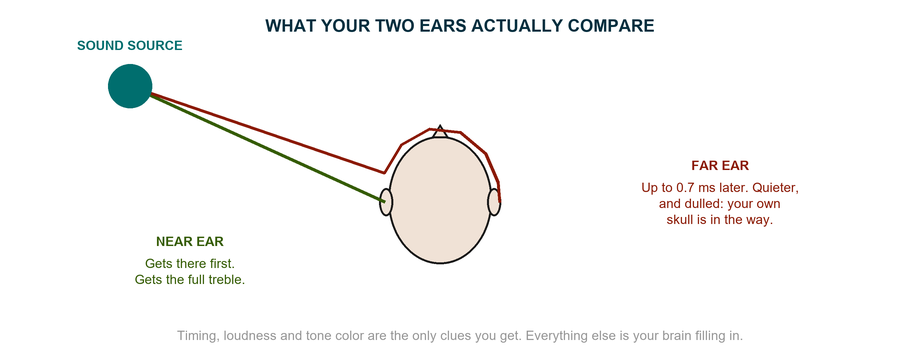
Before we can talk about faking stereo, we should be clear about what stereo is trying to
fake. And the honest answer is: not much. You have exactly two ears, they're about seven
inches apart, and they are pressure sensors. Neither one knows where anything is.
What your brain does with them is compare. There are three clues, and only three:
- Timing. A sound off to your left reaches your left ear before your right ear. The
maximum difference—a sound directly off one side—is about 0.7 milliseconds. Seven
ten-thousandths of a second. Your brain resolves differences down to about ten
microseconds, which is a genuinely absurd degree of precision for a piece of wet
tissue.
- Loudness. The far ear is a little quieter, because it's farther away and because
your head is in between.
- Tone color. This is the subtle one. Your skull blocks high frequencies much more
effectively than low ones, so the far ear hears a duller version of the same sound. And the
folds of your outer ear filter sound differently depending on whether it arrived from above,
below, in front, or behind—which is how you can tell a plane overhead from a truck
behind you, using ears that are both pointed sideways.
Everything else—the sense of a room, of distance, of a stage with depth—comes from
reverberation. The direct sound arrives first; then the reflections off the walls, floor and
ceiling arrive over the following tens and hundreds of milliseconds, and the pattern of those
reflections tells you the size and shape and hardness of the space you're standing in. You do
this constantly and without noticing, and you're good enough at it to hear the difference
between a bathroom and a stairwell with your eyes shut.
What Stereo Actually Is
Two channels. That's the whole definition. Two independent signals, kept separate all the way
from the microphones to your ears, so that the differences between them can do the same work
your ears were already doing.
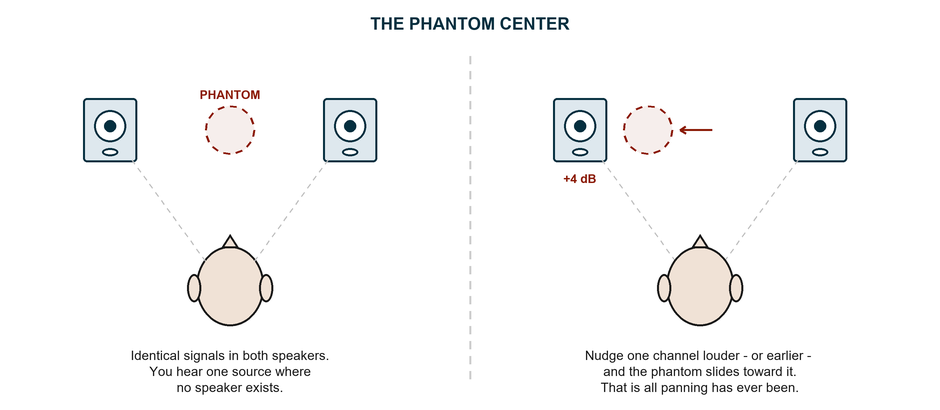
The trick that makes it useful is the phantom center. Put identical signals in both
speakers and you don't hear two sources; you hear one source, floating in the air midway
between them, where there is no loudspeaker at all. Make the left one slightly louder and the
phantom slides left. Delay the right one slightly and it slides left again. Which means that
with two speakers and a pair of knobs you can place a singer anywhere along a line between
them—and if you get the reverberation right, at any apparent distance behind that line
as well.
Headphones, Loudspeakers, and Surround Sound—Oh, My!

Everything above assumes loudspeakers, and loudspeakers give you something headphones can't:
crosstalk. Sound from the left speaker reaches your right ear too, a fraction of a
millisecond later and slightly muffled, exactly the way real sound in a real room would. Your
brain gets the arrival-time and tone-color cues it evolved to use, and the illusion sits out
in front of you where a stage belongs.
Headphones deliver the left channel to the left ear and nothing else, ever. No crosstalk, no
head shadow, no room. The result is that the stereo image collapses into a line running
through the middle of your skull, which is why hard-panned sixties mixes sound so unpleasant on
headphones, while merely quaint on speakers.
The exception is binaural recording, made with microphones in the
ears of a dummy head. It sounds startlingly real on headphones—and oddly flat on
speakers, because the speakers then add a second set of head-shadow cues on top of the ones
already baked into the recording.
Once you understand that stereo is a two-channel trick played on a two-sensor system, the
surround formats stop being mysterious. A 5.1 system has five full-range channels—left,
center, right, and two behind you—plus a low-frequency channel, which is the ".1" and
which carries only the deep rumble your ears can't localize anyway. Dolby Atmos adds height,
and stops thinking in channels at all: the mixer places an object somewhere in the room
and the playback system works out which of your speakers should produce it.
But none of that gives you more ears. Five speakers don't produce five-channel hearing; they
produce five sources, and your same two ears still have to sort out the combined arrival times,
levels and tone colors. More speakers means fewer phantoms and fewer compromises—a sound directly
behind you is very hard to fake with two speakers in front, and trivial with one (or more) speakers
behind. The mechanism never changes. All any of it does is give your existing hardware better
raw material.
Phasers On Stun
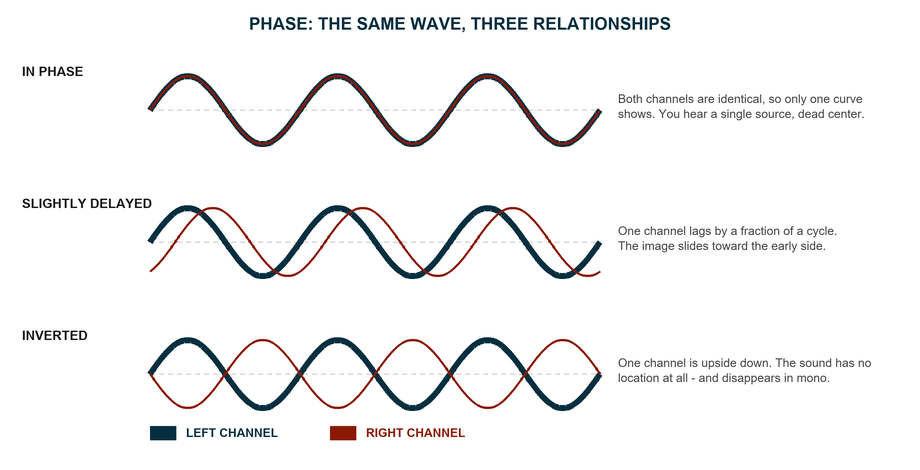
A sound wave is a cycle of rising and falling pressure. Phase is simply where in that
cycle a wave happens to be at a given instant, and the phase relationship between two
copies of the same wave is the difference between them.
Delay is phase. If you take one signal, copy it, and delay the copy by half a cycle, the copy
is 180 degrees out of phase—its peaks land on the original's troughs. Add the two
together and they cancel out to silence. Delay it by a quarter cycle and you get a partial
cancellation. This is why phase is not an abstraction: it's the mechanism by which a delay
turns into a change in what you actually hear.
Now notice what that means. The primary clue your brain uses to locate a sound—the
arrival-time difference between your ears—is a phase relationship. Which is
enormously tempting, and which is where the fakery begins. If a few hundred microseconds of
delay is what makes a trumpet sound like it's on your left, then surely you can take a mono
trumpet, delay a copy of it, and put the trumpet on the left.
You can. Sort of. What you can't do is put the trumpet on the left without doing the exact
same thing to the clarinet, the piano, the drums and the singer, all of which are stuck in the
same mono signal. And because a fixed delay cancels some frequencies while reinforcing others,
what you get is a comb filter—a series of notches carved through the spectrum,
which sounds like the whole band is playing through a length of drainpipe. Worse, the moment
anybody sums your fake stereo back to mono for a car radio or a television broadcast, those
notches become permanent.
Stereo Before Anybody Knew What To Do With It
Two-channel stereo reached the record-buying public in 1958, and I've written about how the
discs themselves worked in
Listen To The Music.
The engineering was elegant. The mixing, for about seven years, was terrible.
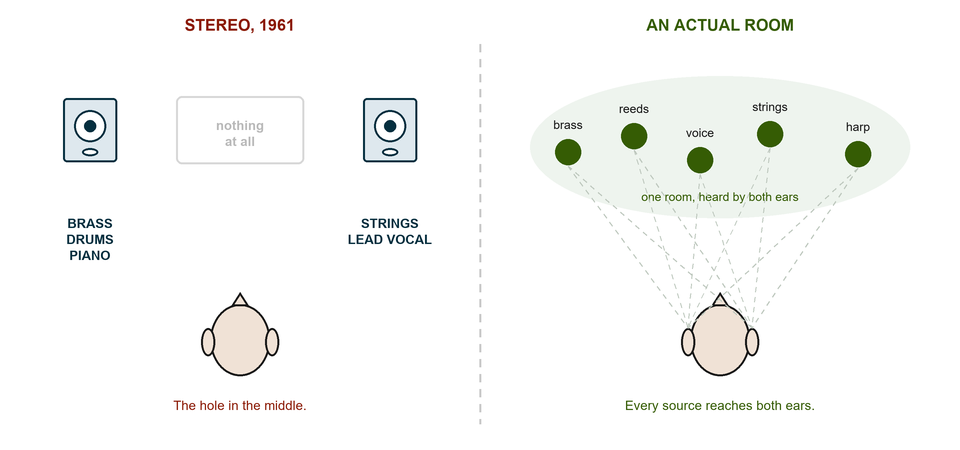
The problem was that stereo arrived as a sales feature before it arrived as a craft. Customers
who had just paid for a second speaker wanted proof that it worked, and the surest proof was
to put something in one speaker and nothing in the other. So early stereo mixes hard-panned:
rhythm section on the left, horns on the right, singer wherever there was room. Early Beatles
albums are notorious for it—an entire band on one side and a lead vocal on the other,
with a hole in the middle you could drive a Volkswagen microbus through.
The purest specimen I own is the Smothers Brothers' Two Sides Of The Smothers Brothers
from 1962. One side of the album is a live club performance; the other was cut in a studio,
and on that studio side the entire orchestra is in the left channel and both brothers are in
the right. Not "weighted toward." In. Tom and Dick are standing in one speaker and the
band is playing in another speaker several feet away, and the two rooms have nothing whatever
to do with each other.
What's missing isn't the panning. Real orchestras really do put the brass on one side. What's
missing is that in a real room, every instrument reaches both of your ears, but not
in the same millisecond, and the
reverberation of the hall is shared by everything in it. Cross-channel bleed and shared
ambience are what glue a stereo image together. Those early mixes had neither, because each
instrument had been recorded on its own track in its own isolated booth and then assigned to a
channel like a seat on an aircraft.
"Electronically Reprocessed For Stereo"

Meanwhile the labels had a catalog problem. Every record made before 1958 was mono but stereo was
what sold, and reissuing a mono record into a stereo market felt like leaving money on the
table. (On the other hand, the number of consumers who actually had two speakers in 1962 was
still small enough that the labels didn't dare release only stereo versions—so they
usually released both monaural and stereo versions of the same record, and the stereo version
was often a different mix entirely, and sometimes even a different recording.)
So they started manufacturing stereo out of recordings that never had any, and printing
a phrase on the jacket—"Electronically Reprocessed for Stereo," "Enhanced for Stereo,"
Capitol's trademarked "Duophonic"—that collectors learned to read as a warning label.
The techniques arrived in roughly this order, each one an attempt to patch the failure of the
last.
1. Delay And Phase Shift
The first idea was the obvious one: split the mono signal in two, delay one copy by ten or
fifteen milliseconds, and sometimes flip its polarity for good measure. This does widen the sound.
It widens it the way a funhouse mirror widens your mother-in-law. Everything smears, the comb
filtering gives the whole record a hollow, phasey quality, and if the polarity was flipped the
record partly disappears when played in mono—which, in 1962, was how most people were still
listening, and another reason why monaural records continued to be made, and sold.
2. Split The Spectrum
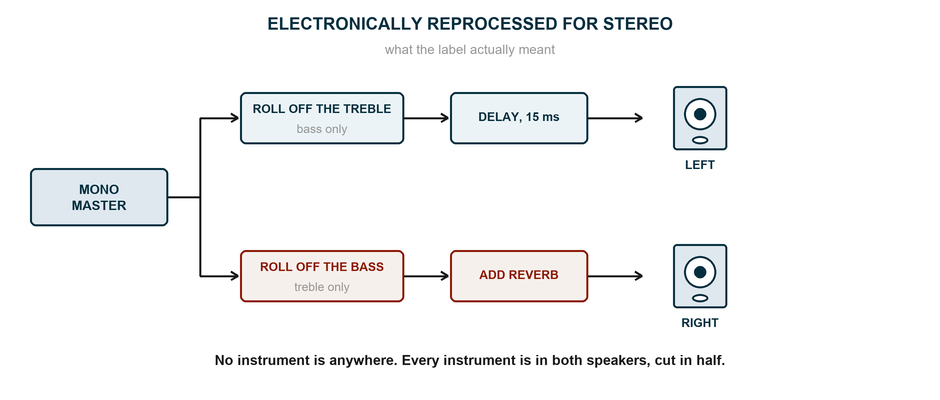
The second idea was to divide the frequency range instead of the time base: roll the treble
off the left channel and the bass off the right, so the two speakers carry measurably
different signals. Capitol's Duophonic did this, usually with a short delay layered on top.
It fails for the same reason all of these approaches
fail: Nothing has been placed anywhere. The bass fiddle isn't on the left; the low half
of the entire band is on the left, and the high half of the entire band is on the right. The
singer's chest tone is coming from one speaker and her consonants from the other. It doesn't
sound like a room in which musicians are playing. It sounds like the sounds of musicians have been
shattered into pieces and glued back together, wrong.
3. Add Reverb
The third idea was smarter, and it's the one that survives in modern plug-ins. Feed the mono
signal into an artificial reverb—a plate, a spring, a chamber, later a digital
algorithm—and generate two different reflection patterns, one for each channel.
Now the two channels genuinely differ in ways your brain recognizes as spatial, because
uncorrelated reverb is exactly what a real room produces.
And it does work, up to a point. The result sounds spacious, which is a real improvement over
sounding like a row of slots. What it isn't, is located. The direct sound—the part that
carries every localization cue you have—is still identical in both channels, so every
instrument still sits in the phantom center. You've built a hall and put the entire band on a
single point in the middle of it. And reverb smears transients, so you buy your spaciousness
by softening every drum hit and every consonant on the record.
By the early seventies most labels had quietly given up. Reissues went back to being
labeled "Mono" or, more often, "Original monaural recording"—which by then had become a
selling point rather than an apology, mirrored a few decades later by "audiophiles"
who happily paid extra for inferior vinyl copies of popular recordings for their
perceived "warmth" and "presence," which were actually the result of the same distortion that had
been driving the early stereo experiments.
What The Curtain Told Us

Starting in the 1920s, researchers began running comparisons in which listeners heard either
live musicians or a recording, with an acoustically transparent curtain hung across the stage
so nobody could see which was which. The early results were humiliating for the musicians.
Audiences routinely preferred the narrow, rolled-off, filtered sound of a phonograph record to
the actual musicians standing eight feet away. Edison had been building marketing campaigns on
the same principle since 1915—his touring "Tone Tests" pitted a live singer against one of
those Diamond Disc phonographs I described earlier, and the company insisted that audiences
couldn't reliably tell them apart.
The conclusion drawn at the time was habituation. People didn't prefer accuracy; they
preferred what they were used to, and by 1930 what they were used to was records,
either played on a phonograph or over the radio.
Harry Olson at RCA went after that conclusion in 1947 and complicated it. He put a live
orchestra behind the curtain and a mechanical acoustic filter in front of it, so that the
restriction was applied to living musicians rather than to a recording. Under those conditions
the preference flipped: listeners wanted the full frequency range. Olson concluded that the
earlier results hadn't measured taste at all. They'd measured distortion—the wide-range
equipment of the day was so nonlinear that extending its range mostly extended its ugliness,
and listeners were reasonably voting against that.
He was probably right. And it still doesn't dispose of the point, because the habituation
effect kept right on showing up every time the technology changed. Audiophiles preferred the
warmth of vinyl to early CDs. Producers spent the nineties adding tape saturation to digital
recordings that had none. A generation raised on 128-kilobit MP3s learned to like the sizzle,
and a generation after that mixes records to sound good on a phone speaker. What you grew up
with is not what sounds accurate. It's what sounds right, which is a different
measurement entirely, and one no engineer has ever been able to argue anybody out of.
The Argument
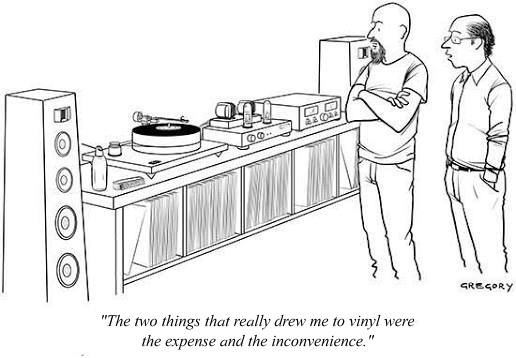
Which brings us to the fight, and it is a real fight, conducted with more heat than the stakes
strictly justify.
On one side are the preservationists. A 1938 recording is a historical document. It was made
with particular microphones in a particular room by engineers making deliberate choices, and
the mono mix isn't a deficiency in the document; it is the document. Every intervention
is a layer of somebody else's opinion between you and the artifact—and the entire history
of "improving" old recordings, from Duophonic through the noise-reduction era, is a history of
confident people destroying things simply because they were old. Once a reissue has been
rechanneled, de-noised and
re-equalized, the label frequently throws out the original it started from.
On the other side are the reconstructionists, and their argument is that the document was never
the point. Nobody in 1938 sat down to make a mono recording. They sat down to make a record of
an event that was in a room, in three dimensions, and the mono was a limitation they'd have
abandoned in a heartbeat if the technology had existed. What you're preserving when you
preserve the mono mix is not the performance. It's the equipment.
My own view is that this stops being a fight the moment you stop insisting on one answer.
Nobody thinks a colorized print of Casablanca should replace the black-and-white
negative. Plenty of people are glad both exist. Keep the flat transfer—that's the
document, and it should never be overwritten, deleted, or "upgraded." It should be
preserved, in the archaeological sense: cataloged, stabilized, and left alone.
Then make whatever else
you want, and label it. The sin isn't the reconstruction. The sin is passing the
reconstruction off as the original.
Stemming The Tide
Which brings us, finally, to the thing that changed: Artificial Intelligence.
By now you may have some vague idea of how A.I. works on text.
Text models work on tokens: a finite vocabulary of word fragments in a sequence, where the
model's job is to predict what comes next. Audio has no vocabulary. A CD-quality stereo
recording is 88,200 numbers per second, none of which mean anything individually, and all of
the structure you care about—pitch, rhythm, timbre, who's playing what—is smeared
across thousands of them at once.
So music models generally don't work on the waveform directly. They work on a
spectrogram: a chart of which frequencies are present, at what strength, at each moment
in time. Turn a recording into a spectrogram and you've turned a wall of numbers into
something with visible structure—a bass note is a stack of horizontal lines at the
bottom, a cymbal is a vertical smear across the top, a voice is a set of harmonics that bend
and wobble together. Which is a problem shaped very much like image recognition, and image
recognition is the thing machine learning learned to do first.
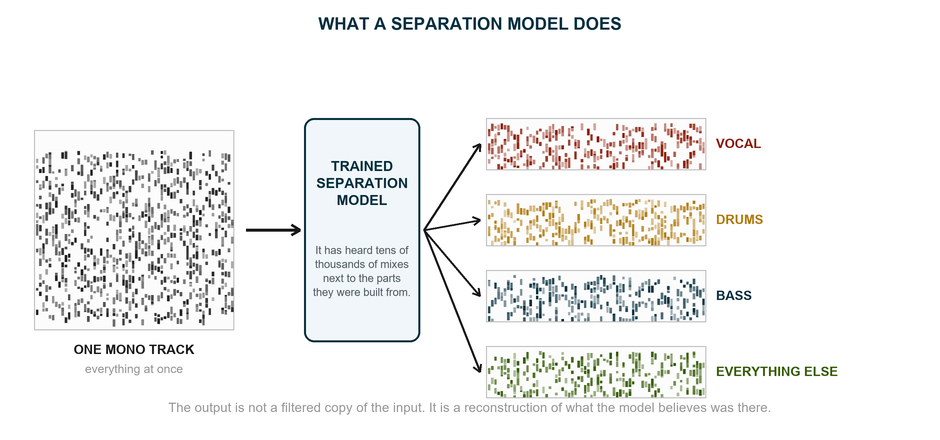
A stem is one component of a mix, isolated: just the vocal, just the drums, just the
bass. In a modern studio they exist by construction, because every part was recorded on its
own track and the finished record is those tracks added together.
What they don't exist as, is a thing you can extract from a finished recording. Once tracks
have been summed, the sum is all there is; there's no more a "vocal channel" hiding in a mono
file than there's a red channel hiding in a bucket of purple paint. Which is why source
separation was, for decades, a research embarrassment. Every filtering approach fails on the
same rock: the singer and the trumpet occupy the same frequencies at the same time, and no
filter can pass one without passing the other.
And yet we humans can pick a voice out of a trumpet solo without the slightest effort, in exactly the
mixture where every filter fails. Psychologists call the problem auditory scene analysis;
the familiar version of it is the cocktail party effect, where a roomful of people all talking at
once arrives at your eardrums as one pressure wave and yet you can follow a single conversation out of it
with little or no effort.
The rules your brain uses have nothing to do with frequency bands. Harmonics that are all
multiples of the same fundamental note get heard as one voice. Sounds that begin at the same instant
get assigned to the same source. Partials that wobble together stay together—a singer's
vibrato bends every one of her harmonics at once, and that shared motion is a signature no
trumpet in the same octave is going to match. Add a lifetime of having heard trumpets, and you
aren't separating the mixture at all. You're imagining what must have gone into it.
The machine-learning approach doesn't filter. It recognizes. Train a model on tens of
thousands of multitrack recordings, where both the finished mix and the individual stems that
built it are available, and the model learns what a snare drum looks like on a spectrogram,
and what a bowed cello looks like, and—critically—what a snare drum looks like
when there's a cello playing at the same time. Given a new mixture, it predicts what each source's
spectrogram must have been. Tools like Spleeter and Demucs will hand you four or five stems
from a finished record in less time than it takes to play it once.
The distinction matters, and it's the source of both the power and the problems. The output is
not a "filtered copy" of the input. It's a reconstruction—the model's best account
of what was probably there. When the model is well-trained it's uncannily right.
When it isn't, you get
artifacts: a watery, underwater quality where it wasn't sure, or cross-bleed where the mix
was too dense to untangle. And on a 1944 recording—made through one microphone, band and
singer and hall all committed to one track at once, with 78 RPM surface noise sitting on top
of everything—the A.I. will be a good deal less sure than it is on a modern pop mix.
For this week, anyway.
Building A Stage Out Of Stems
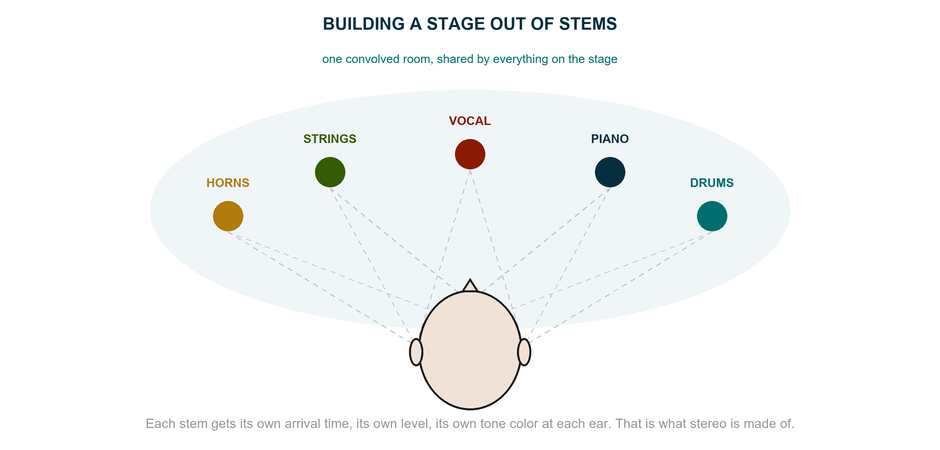
But once you have stems, the seventy-year-old problem simply evaporates.
Every one of those failed analog tricks failed for the same reason: the machine had no idea
what was in the signal. A delay line can't put the trumpet on the left, because a delay line
doesn't know a trumpet from a bass drum. It can only do the same thing to everything.
Separate the recording first, and you're no longer processing a mixture. You're processing
parts. Which means you can do to each part precisely what a real room does to a real
instrument: give it its own arrival-time difference between the ears, its own level
difference, its own head-shadow filtering appropriate to the angle you've placed it at. Then
run all of it through one shared reverb—a convolution reverb, built from an actual
measured impulse response of an actual hall, so every instrument is in the same room as every
other instrument. Then add the parts back together.
The result is stereo in the only sense that matters. The trumpet isn't louder on the left; the
trumpet is on the left, with a full set of the physical cues your brain has been using
since infancy, and the hall is wrapped around the whole band the way a hall is supposed to be.
It is doing exactly what your ears do, in reverse.
It is also, and there's no point pretending otherwise, an invention. The model guessed at the
stems, and somebody—or something—chose where to put them. Glenn Miller had a
seating chart, and my software doesn't know what it was. What comes out is a plausible 1944
bandstand, not "the" 1944 bandstand, and any separation artifact in the stems gets baked
permanently into the result. Feed it a clean 1958 mono master and it's remarkable. Feed it a
worn 78 and it can produce something that sounds less like a big band than like a big band
being described to you by someone who was standing outside.
For this week, anyway.
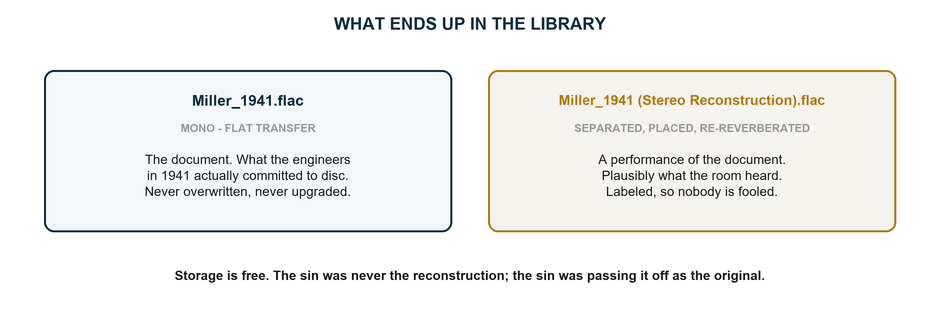
Which is what I would do if I were the Library of Congress. Keep both. The
mono master is the historical record, and it should be preserved.
However, I am more a listener, and I'd rather listen to stereo, good, believable-sounding
stereo, than to the historical record.
The purists are right that the mono master is the historical record and that nobody should be
allowed to overwrite it. The reconstructionists are right that a document of a performance was
never the same thing as the performance. Both of those are true at once, and they've only been
arguing because the technology forced a choice between them. It doesn't any more. Storage is
free, and there's no longer any reason a recording can't be both a preserved artifact and a
living performance, as long as you keep the labels straight.
Meanwhile, now that I've reminded myself of it, it's time to remaster that Smothers Brothers
album's studio recordings, and put them back in front of the orchestra where they belong.