|
By: Paul S Cilwa |
Posted: 2/8/2026 |
|
Page Views: 186 |
| Hashtags: #Metaphysics #Spirituality #MultidimensionalRealities |
| A beginner's guide to understanding multiple dimensions, realities, and timelines. |
| Estimated reading time: 14 minute(s) (3118 words) |

The problem is that religions sabotage themselves by envisioning God as
something separate and apart from His creations (and assign gender to a being
even they claim is genderless, as well). The New Age movement, on the other hand,
is almost entirely self-oriented (as in, "we each create our own reality") and
so misses the framework in which that reality is created. And the students have
already left to snack at McDonald's.
To rectify this, in this essay I intend to present that framework. I promise
that, if you follow this through, any further work you do in metaphysics will
make much more sense.
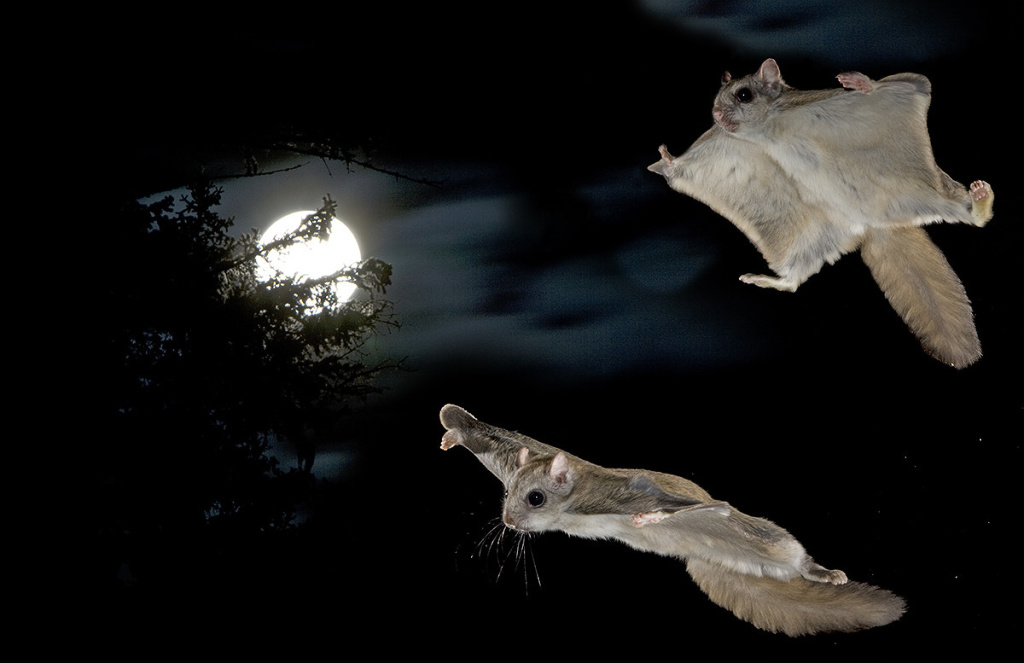
It's safe to assume that animals don't consciously worry about physics,
much less metaphysics. But they use physics constantly, as we do: An
innate understanding of gravity and inertia is essential simply to move about.
People tossed stones to each other for hundreds of thousands of years
before the mathematics describing such ballistic motion and hyperbolic curves
had been developed.
My point is that, one can live an entire lifetime in a gravity field without
considering that one is in a gravity field. Instinctively knowing how to
balance upright in one does not require any conscious acknowledgement of it
whatsoever.
Similarly, most of us have heard the terms "three dimensional" and even
"fourth dimensional" without having any inkling what they mean in a scientific
sense. (Worse, New Agers and bad sci-fi movies often misuse the terms,
further muddying their meaning.)
So let's start with the easy one, and first one understood—at least as far
back as the 16th century. That's the third dimension, familiar to us because it
is (a subset of) the framework in which we live our humdrum lives.
Length, width and height: Those are "the" three dimensions. I put the
word "the" in quotes because, mathematically, any three points that are
at right angles to each other make up three dimensions. But length, width and
height are the ones we use in everyday life.
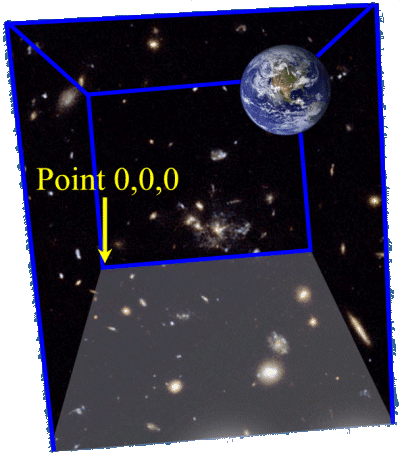
Your living room has a width (the distance from the wall at your left to the
wall at your right), a length (the distance from the wall in back of you to the
wall in front of you) and a height (the distance from floor to ceiling). Once
you've arbitrarily selected a starting point where all three values are zero—say
the corner to your left rear at the floor—and the maximum values (the right
front ceiling corner, for example)—you can locate any spot in the room
with three numbers representing how far to the right, how far from the back, and
how far from the floor.
It doesn't matter that you might not actually want to do that. The
point is, that anything in the room will have those values, whether you
write them down or not. What this coordinate system describes is a
3-dimensional continuum, or what we commonly call a space. And a
"space" doesn't have to be a living room; it can be a forest, or even all
the room in the Universe, which is commonly called outer space. (And now
you know where that term comes from!)
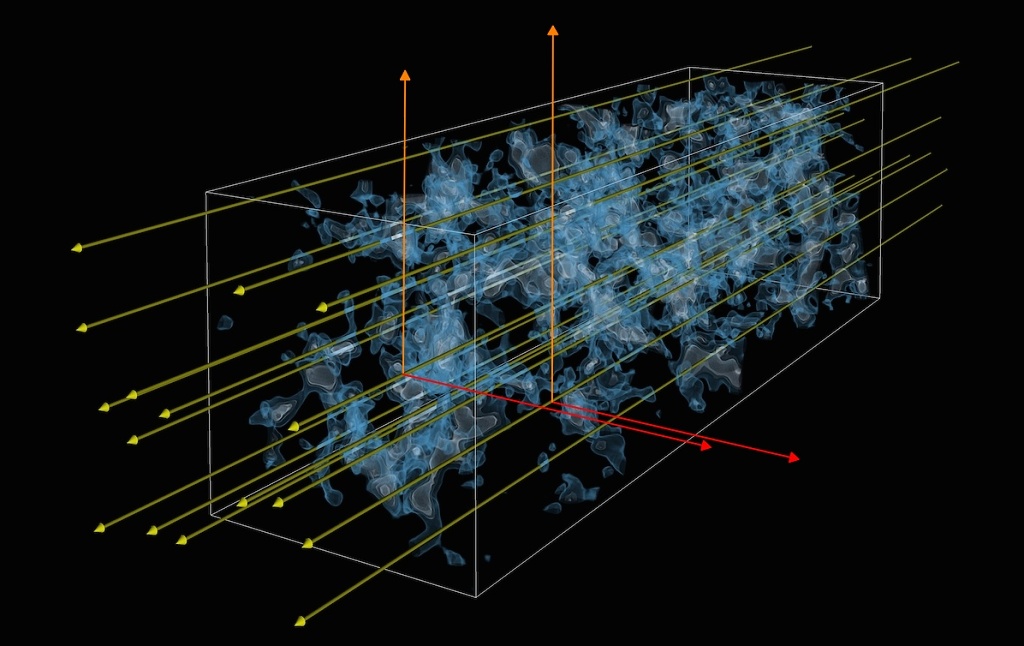
Let's look again at how we derive those three coordinates. A single number
describes one point. One point does not constitute a dimension (or, if you
prefer, it constitutes a zero-dimension). Any direction from that
one point can be considered ninety degrees from it. As soon as you've added a
second point, you have a line—which makes up a 1-dimensional continuum,
or "line".
A coordinate (you can only have one) describes any position on the line. (And
because numbers can be negative, you can even describe a position "before" the
start of the line, which makes the line effectively infinite in length.)
Here's our line:
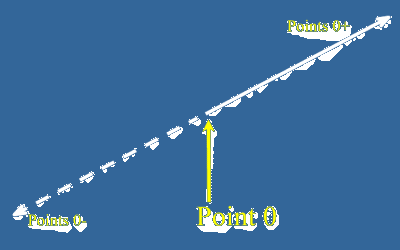
Let's work with the line for a bit. First of all, it comprises a
1-dimensional continuum. (The common name for that is "line". The word
"line" is the one-dimensional analog of "space".)
Secondly, a line can be home to an infinite number of zero-dimensional
points. In fact, that's what it's made of! Could one of those points be
self-aware? Why not?
If a point were self-aware (in other words, a one-dimensional
"person") it would only be able to look "ahead" of itself and "behind" itself,
and of course its "vision" would be blocked by the points in front and behind.
So its sensory life would be severely limited, not that it would know the
difference.
From the point-person's perspective, existence in such a continuum would feel strangely static and
strangely complete. With no up
or down,
and no concept of before
or
after,
its entire life would be a single, unchanging moment—yet that moment would
contain everything it could ever know. It would not move through time; it would be its position,
eternally. What we would call a timeline, it would experience as a single, indivisible fact of its
being. There would be no anticipation, no memory, no sense of change—only the perpetual
presence of whatever now
happens to be along that line. And because it has no frame of
reference for anything else, this frozen completeness would feel perfectly natural, even rich,
because it would have no idea that other beings in other continua experience their existence as a
flowing sequence rather than a single, crystalline state.
In a 1-dimensional continuum, it is a given that nothing can exist that is
not in that line. Anything that is not along that line, is by definition not part
of that continuum even though they may intersect—we'll consider the implications
of that, shortly.
When we started with a point and created a line, we were free to do so in any
of an infinite number of directions. To go from a line to a plane is slightly
more limited. We can only go in a direction that is 90° from the line. That's
still an infinite number of possibilities (a fraction of infinity is still
infinity). When we've done so—and remember, like the line, this figure also
extends indefinitely—we have a 2-dimensional continuum,
commonly known as a "plane".
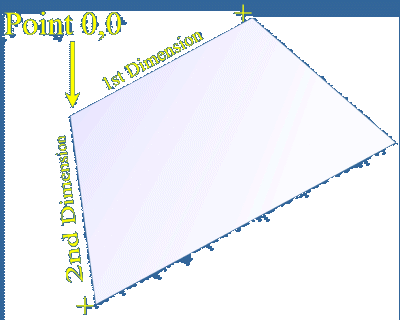

Common examples of planes include tabletops, the Saskatchewan landscape, and Kurt
Russell's hair in the movie Stargate.
In a 2-dimensional continuum, however, as opposed to a tabletop, nothing can
exist that extends above or below the plane. Anything that does, is by
definition, part of a greater continuum although the plane and this hypothetical
object may intersect.
A plane may be home to an infinite number of lines, or of points. In fact,
any number of shapes can exist there, as long as they are flat.
In the 1884 book Flatland
by Edwin Abbott Abbott, the author describes a biology and sociology for
beings who live in such a planar universe. In the book, men are portrayed
as polygons whose social class is directly
proportional to the number of sides they have; therefore, triangles, having
only three sides, are at the bottom of the social ladder and are considered
generally unintelligent, while the Priests are composed of multi-sided
polygons whose shapes approximate a circle, which is considered to be the
"perfect" shape.
Buildings would seem, to us, to be simple rectangles with cutouts for "doors" (because no
Flatlander can pass through a solid line). Furniture is similarly composed of
lines against which Flatlanders can rest or place other objects.
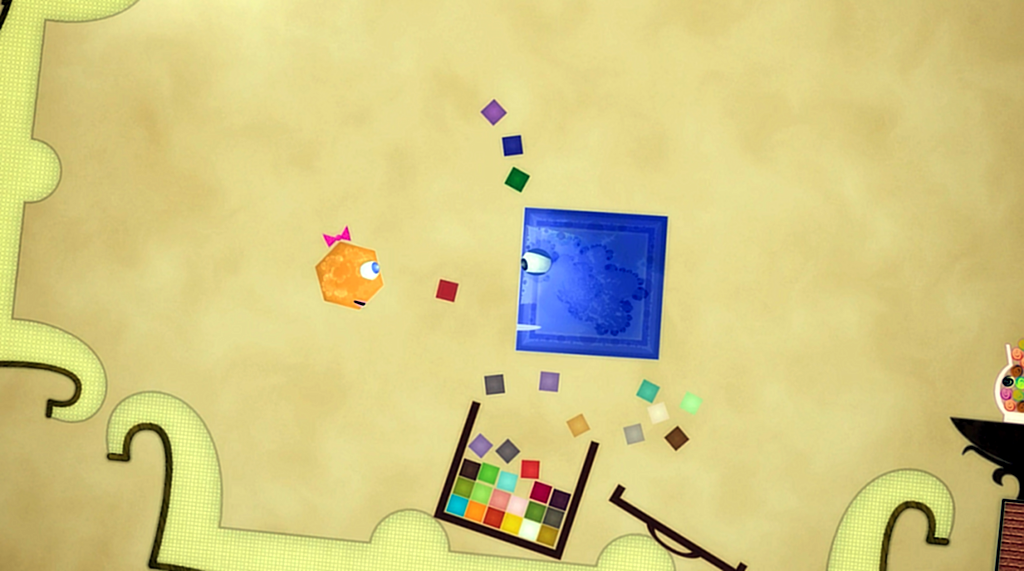
It's important to remember that Flatlanders cannot look "up" or "down" or
even imagine what those words might mean. Left-right and fore-aft are the only
primary directions they can perceive. They are simply not equipped for anything else.
And again, without adding Time to the mix, the Flatlanders can't actually move or do
anything. Without Time, they just are.
And this is why the relatively recent understanding by mathematicians that Time
is a Dimension like Width or Height is so significant. Time can be mapped and coordinates can be
noted. (You've done that if you know your own birthday, for example.)
In order for Flatlanders to be able to experience anything, they need at least one
other, non-physical dimension of Time to dole those experiences out.
—Which brings us to the next step up, the 3-dimensional continuum known as
Space. (The capital 'S' is because we live here.) To define it, pick any four
points on a plane and extend them together at 90° from the plane to create a
cube. As the plane can contain any number of flat objects, the space can contain
any number of 3-dimensional objects (as our Space does).
Now, so far, all this has been rather intuitive—an exercise designed to
provide you with a vocabulary for speaking about continua and dimensions. It's
easy because we have direct experience with points, lines, planes and spaces.
The first real challenge comes with the concept of four dimensions,
because, just as the Flatlanders cannot point up or down, we
cannot point in the direction of a fourth dimension.
Yet, just as up and down exist whether the
Flatlanders are aware of it or not, so do those other directions.
Something I haven't emphasized yet is that any continuum must be contained
in a continuum of at least one greater dimension. That is, a line
(1-D continuum) implies a 2-D container in which it, and other lines like it,
may reside. A square (2-D continuum) implies a 3-D container. And a
space (3-D continuum) implies a 4-D container.
What might that "extra" dimension look like? One possibility is
time. As Einstein brilliantly intuited, and then proved, time is a 4th
dimension that can be treated mathematically the same as length,
width and height. Obviously, we don't perceive time in the same way…but
who's to say, if we were rotated about a 4th dimensional axis, that time wouldn't seem like
distance to us and width like duration? Indeed, "before" and "after"
may well be the means by which we point into this otherwise
inaccessible dimension.
If time is the way we perceive the fourth dimension, that says as much about us as it does about
the dimension itself. A Flatlander cannot imagine up,
not because up
is complicated,
but because their senses and biology evolved to navigate a plane. Likewise, our nervous systems
evolved to track change, sequence, and causality. We feel time as a flow because that is the only
way our perceptual equipment can register movement through a dimension we cannot point toward.
But nothing requires that a fourth dimension must be experienced as time. That is simply the version of
it that our particular sensory apparatus can metabolize. A being with a different perceptual
architecture—an utterly alien consciousness—might experience that same dimension as a
landscape of static objects, or as a spectrum of emotional states, or as something we have no
vocabulary for at all. Before
and after
might be meaningless to them, replaced by
something like adjacent
or resonant.
Their version of the fourth dimension could be
as intuitive to them as length and width are to us.
This is the crucial point: a dimension is not
defined by how it feels to the creatures living inside it. It is defined by the mathematical
degrees of freedom it allows. The experience is local; the structure is universal.
Once we accept that, the next step becomes almost inevitable. If a 3-dimensional space requires a 4-dimensional
container, then a 4-dimensional continuum—ours—implies a 5-dimensional container. And
just as a plane can host an infinite number of lines, a 5-dimensional meta-space
can host an
infinite number of 4-dimensional universes.
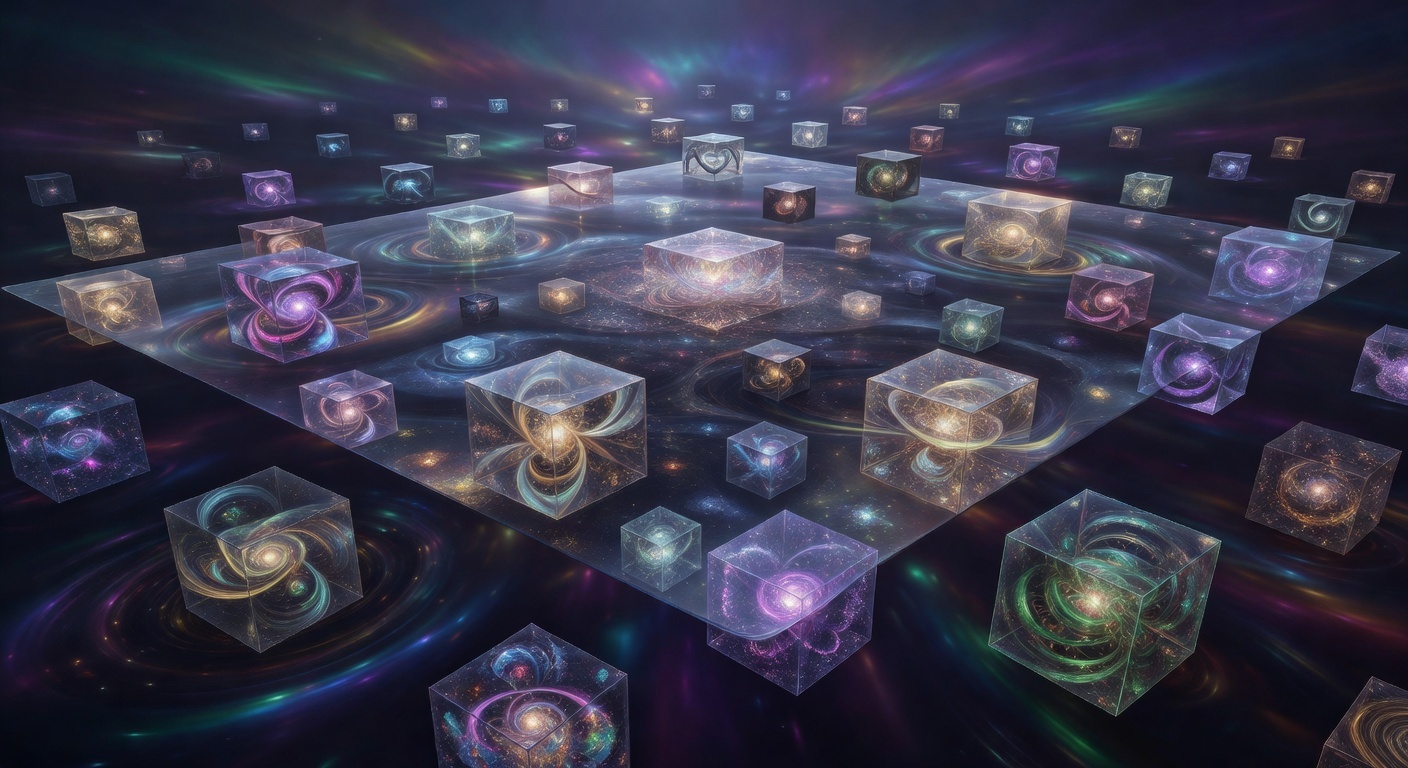
This is one way to conceptualize the multiverse: not
as a branching tree of timelines (though that model may also be valid), but as a vast,
higher-dimensional expanse in which entire space-time continua sit like threads in a tapestry. Each
universe has its own geometry, its own physical constants, its own history—or perhaps no
history at all, if its inhabitants perceive the fourth dimension as something other than time.
And just as a line has no awareness of the plane that contains it, our universe has no intrinsic
awareness of the 5-dimensional structure that contains us. We cannot look sideways
into
neighboring universes any more than a Flatlander can peer into the room above their tabletop. Yet
the existence of the container is implied by the logic of dimensions themselves.
This is where metaphysics becomes both exhilarating and humbling. When confronted with something of infinite
complexity, we simplify. We must. But simplification is not the same as reduction. A complex system
can support multiple valid simplifications that appear contradictory only because our minds evolved
to prefer singular narratives. The multiverse may be simultaneously a branching tree of decisions,
a static 5-dimensional manifold, a quantum foam of probabilities, and a spiritual architecture of
meaning. These are not mutually exclusive if the underlying reality is rich enough.
In that sense, metaphysics is not about choosing the correct
model. It is about recognizing that our models
are shadows cast by a structure too large for any one perspective to capture. A Flatlander can
describe a cube only by the slices that pass through their plane. We describe the multiverse the
same way: by the slices that pass through our consciousness.
And perhaps that is the real invitation. Not to solve the multiverse, but to appreciate that we are already embedded in
something far larger than our senses reveal. The fourth dimension is not exotic; we live in it. The
fifth dimension is not unreachable; it is the quiet architecture that makes our universe possible.
And beyond that—who knows? Every dimension we discover implies another that contains it, an
endless hierarchy of contexts, each as infinite as a line and as real as the room you're sitting
in.
And if all of this sounds dizzying, that's because we're trying to use a three-pound
brain—one optimized for throwing rocks and recognizing faces—to contemplate structures
that may be infinite in scope. The Flatlander has no trouble believing in length and width, but
height
is a philosophical crisis. We are in the same position. Time feels obvious to us only
because we swim in it. A fifth dimension feels impossible only because we don't.
Yet the moment we accept that our experience of a dimension is not the dimension itself, the whole picture shifts.
Suddenly the multiverse stops being a science-fiction indulgence and becomes a straightforward
geometric consequence. A 5-D container holding countless 4-D universes is no stranger than a sheet
of paper holding countless lines. Infinity is not exotic; it's the default.
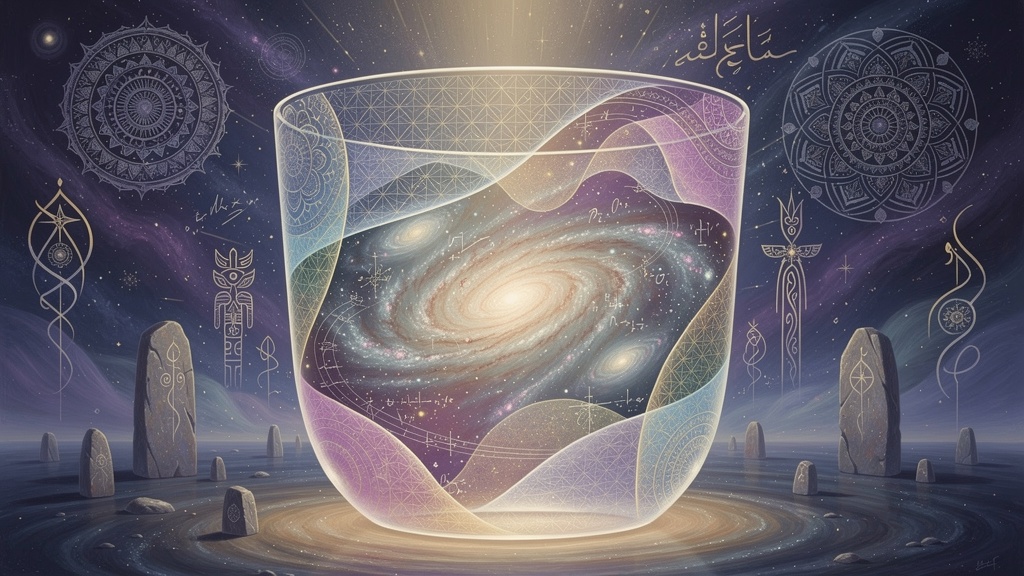
This is where spirituality can enter—not as a contradiction to physics, but as another simplification of
the same underlying complexity. Every culture has tried to describe the larger context
in
which our universe sits. Some call it heaven, some call it Brahman, some call it the Tao, some call
it the quantum vacuum. These may be different metaphors for the same thing: the container that
contains us.
And just as Flatlanders might invent myths about mysterious beings who appear and
disappear without warning—because a 3-D creature can step into and out of their
plane—we might be doing the same. What we call mystical experiences, synchronicities, or
moments of transcendence could be nothing more (or less) than brief intersections between our 4-D
slice and something that touches it from the outside. Not supernatural, just
extradimensional.
This doesn't diminish the mystery; it deepens it. A universe that is one thread
in an infinite tapestry is not smaller or less meaningful. It is part of something vast,
interconnected, and endlessly creative. And if consciousness is itself a dimensional
phenomenon—if awareness is the way a 4-D being feels
its own trajectory—then
perhaps spirituality is simply our intuitive sense that we are more than the slice we currently
occupy.
In that light, the multiverse is not a cold, mechanical sprawl. It is a living
architecture of possibilities. Each universe is a story told in four dimensions. Each 5-D container
is a library of such stories. And beyond that? More containers, more libraries, more ways of being
than any one species could ever imagine.
We don't need to understand all of it. We only need to
recognize that our perspective is one among many, and that the cosmos is always larger than the
frame we place around it. The Flatlander who finally grasps the existence of up
does not
become less grounded; they become more free. So do we, when we allow ourselves to imagine that our
universe is not the whole table, but one drawing upon it.
And maybe that's the real gift of thinking this way. When we picture ourselves as inhabitants of a
single line on a single sheet of an infinite stack of sheets, we stop insisting that our slice of
reality is the only one that counts. We become a little less certain, a little more curious,
and—paradoxically—a little more grounded. The multiverse stops being an abstract
speculation and becomes a reminder that our lives, our choices, and our awareness are part of a
much larger geometry. We don't need to map the whole structure to feel its presence. It's enough to
know that the table is bigger than the drawing, the room is bigger than the table, and the cosmos
is bigger than the room. That sense of scale doesn't diminish us; it situates us, giving our brief
passage through the fourth dimension a kind of quiet, spacious meaning.