|
By: Paul S Cilwa |
Posted: 6/12/2013 |
|
Page Views: 4,829 |
| Hashtags: #Quantumphysics #Metaphysics #Spirituality |
| We look at how quantum particles allow us to create our own reality. |
| Estimated reading time: 8 minute(s) (1752 words) |

People have always used terms from the world around them, to
describe their own lives, bodies and internal experiences. For
example, in the 17th century when mechanical technology was all the
rage, phrases such as, "I'm fit as a fiddle,", or, "I'm running like
clockwork" made their way into every language, to join older terms
such as "getting hammered" as a euphemism for intoxication named
after the common tool.
In the industrial revolution, created by the steam engine, the
terms of the new technology were quickly applied in an analogous
manner to the human experience. Thus, we have phrases such as "he
blew his top!" and "she had a nervous breakdown" that come from
steam technology.
Then computers came along, those mysterious, cranky devices that
could mindlessly process huge amounts of data without understanding
any of it. This gave us phrases such as, "My memory banks are full,"
and "That does not compute!"
Now that we are all surrounded by large-scale HDTV screens, I
think it might be time to use them as analogies for things that are
tricky to understand, such as quantum mechanics and the mechanisms
by which we create a perceptual Universe out of what is, in effect,
nothing more than quantum noise.
To begin with, get a magnifying glass and look closely at an inch
or so of your HDTV screen. You'll see little dots, called pixels,
which flicker on and off. And even though from a distance we see all
the colors of the rainbow, close up there are just three colors:
red, green and blue, each of which can express itself in many
gradations from black to bright, pure color.
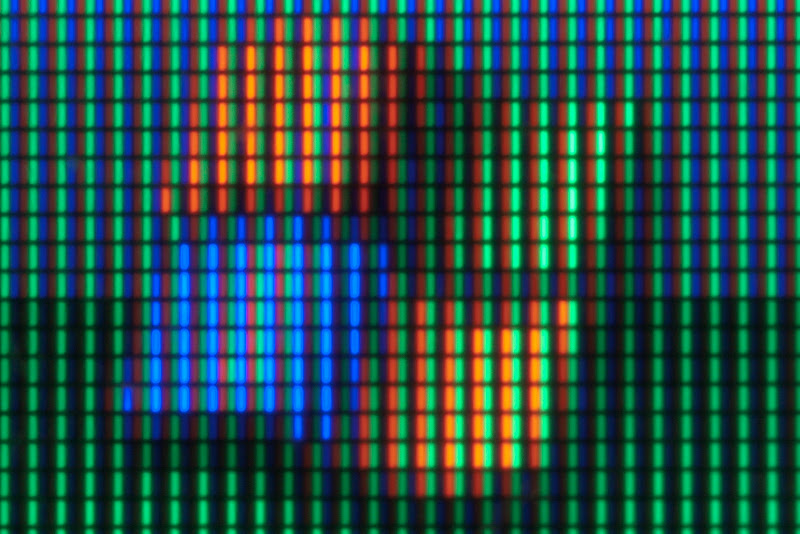
The point here is that, looked at closely, these individual pixels don't tell us much. If you
inspect just one or two of the pixels in the above illustration, you
can have no idea what the complete image is. It's like trying to
guess the end picture from a single piece of a jigsaw puzzle.
And yet, stand back…and the picture you see is startling in its
clarity, almost as realistic as the view outside your window.
By the same token, quantum particles, the teensy bits of energy
that make up all matter in the Universe, also flicker on
and off. Oddly, physicists have discovered that quantum particles
that make up such heavier particles as protons and neutrons, also
flicker into and out of existence.
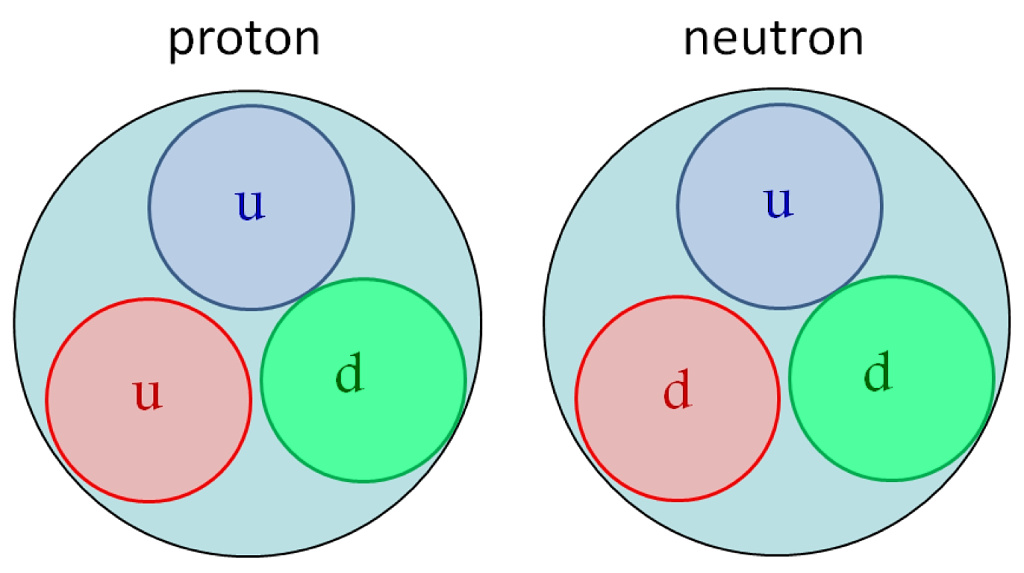
According to the modern "Standard Model" of particle physics,
protons are made up of three quarks (two "up" and one "down" quark),
which in turn are connected by another type of elementary particle,
the gluon. (That's not a joke, by the way!—Or, if it is, it was
made up by particle physicists, not me.)
Only counting the water molecules in our bodies, each of us is
made up of approximately 1.1021425e+97 protons. So examining any
one of them doesn't give you much insight
into the object of which that proton is a component. Not a single
one of those protons is the home of happiness, or regret, or any
other part of the human experience.
But I want to focus on the quarks for the moment. These
elementary particles are not permanent; they flicker in and
out of existence the way a pixel flickers to produce its part of an
HDTV moving image. So an obvious question is, how does the quark
know where to come into existence? But the answer is an even
deeper conundrum; because quantum particles pop in and out of
existence everywhere, not just where a proton or neutron is
supposed to be. At the quantum level, "empty" space is just as alive
with flickering quantum particles, as is the densest piece of lead.
So, in that case—how does a quantum particle know when to act
like a quark in a proton, or a gluon, or an electron, or nothing?
Well, that's the interesting part. Because the quantum particle
doesn't seem to know how to act…until we observe it, at which
point it takes on the characteristics we expect to find!
In other words, quantum particles do not seem to know any more
than a pixel on your TV screen. It appears that they do what
they do, simply because we expect them to!
It is not quantum particles that give shape to our Universe, but
rather, our expectations that do so.
In a very literal manner, then, we create our own
Universe—moment by moment—simply by expecting it to act as it
does.
And that's not just the big things, like the Sun or the ocean,
but small things as well: How your ice cream tastes; why you keep
dating the same miserable collection of losers; why, for some, camping
is a fate worse than death.

The pictures on your TV come from somewhere. Let's say you are
watching an episode of Smallville, one of my favorites. The
pixels on your TV, individually, give no hint as to what the story
or even an individual frame, are about. Backing up far enough to see
the screen allows you to see the pictures, but even then it's not
enough. Your cat can see the screen, too; but few cats have any
interest in watching an episode of Smallville. Oh, if you
have a video of a fly buzzing around the screen that might get a
cat's attention; but of flying superheroes, none at all.
Not even every human may understand the images. For example, an
aboriginal native of some remote tribe could see the images and hear
the sounds, but would have nothing on which to build an
understanding. Forget the superhero aspect; the cars, houses,
cellphones, computers and other aspects of modern city life would be
completely meaningless to our hypothetical native.
(Or to my grandma. In 1980 I took her to see Star Wars: The Empire Strikes Back,
with its small spacecraft whizzing around the larger Imperial craft, all the while trying to
take out the "new, and improved, Death Star!" Afterwards, I asked my grandmother
what she'd thought of the movie. "To be honest, Paul," she admitted,
with puzzlement, "I have no idea what I was just looking at.")
No, it takes years of immersion into our complex and technological
culture, including its myths as well as its science, to be able to
follow even a simple episode of any TV show.
This is why you don't remember the TV shows you saw when you were
an infant. Without the acculturation that would seep in as you grew,
the TV simply displayed pretty colors and noises to your infant
brain.
And a basic, but heretofore unrecognized, aspect of that
acculturation, is apparently the picking up of our group
expectations of what the Universe looks and acts like. Before this
takes place, a baby cannot interact with the Universe in any
meaningful way.
How does the baby start these lessons? From his or her parents'
love. Because, as it turns out (and yes, I am now leaving
physics and entering the realm of metaphysics) all quantum particles are
"Love" and when they appear in our Universe, it's because they've
come from a continuum that creates them.
Some might call that continuum "God."
But you could also simply call it "Love."
There is no difference.
So, to recap:
Does this mean you can change the Universe by changing your
expectations?
In theory, yes. However, changing expectations is a lot easier to
propose than to do. If you've ever had a friend or relative who had
a history of alcoholism and violence, you'll agree that it's not
easy to give them the benefit of the doubt should they stop
drinking. (And psychologists agree that, if you have quit
drinking, it's easier to stay in recovery if you avoid those people
who have negative expectations of you.)
If you want to create a world in which the sky is purple or money
grows on trees, you'll be fighting the expectations of every other
human on Earth. Ours is a shared reality; and it takes time
and a lot of effort to alter an entire population's expectations.
On the other hand, suppose you hate skiing and you would like to
love it. Lots of people love to ski, so you are fighting only your
own expectations, not anyone else's. If you take the time
to meditate, and envision yourself on a lovely skiing holiday,
enjoying yourself and having a wonderful time, and you do this
steadily for a period of time, when you expose yourself to the
reality of skiing, you might well find yourself loving it. You have
just altered your reality. They are the same quantum
particles as before, but the pattern you imposed on them is
different.

The implications here are stupendous. For example, there is the
implication that "miracles" can actually happen—a good thing, since
studies have consistently shown that they do. But a miracle
doesn't require a god's intervention to happen; it just requires an
attitude adjustment on the part of the observer.
Illness and medicine are especially subject to this effect. It
turns out that we give doctors, or faith healers, "permission" to
change our own attitudes about our health. Studies have shown that a
patient's likelihood of healing from an illness, no matter how
severe, increases when the doctor simply assures him that he will
get better. (When doctors tell a patient she has "six months to
live", very often the patient obeys that prognosis to the day.)
Thus, our expectations can destroy or renew our health; our
livelihoods; our social lives. If any of those is not to your
liking, start today envisioning and learning to expect what
you want, instead of what you've been giving yourself.
After all—and this is perhaps the most significant change of
expectation each of us can make—you deserve the best!