|
By: Paul S Cilwa |
Posted: 7/24/2006
Updated: 5/16/2017 |
|
Page Views: 5,626 |
| Hashtags: #Spirituality #ReligiousPolitics |
| Let's examine the connection between abused children and their need as adults to rely on an Authority figure to give their lives meaning. |
| Estimated reading time: 9 minute(s) (2093 words) |

I believe in God. So does my co-worker, Ben. But the similarity ends there;
because the god Ben believes in is as different as the God I believe in, as is
possible. (Yes, I admit it—I'm capitalizing my God, and not Ben's, to
help distinguish them. Really, that's the only reason.)
Ben's god seems to have come from the pages of the Old Testament. Like
Jehovah, Ben's god takes sides (He prefers America to Iraq), smites those who
offend him (both the 9-11 attacks and the tsunami of a few days ago were "proof"
of this), and rewards those who shower him with devotion and admiration. Ben's
god is definitely a "person" with a specific personality, likes and dislikes,
and, of course, Absolute Power. He thinks nothing of condemning those who fail
to meet his standards in this life with an eternity in Hell, no possibility of
parole, no Get Out Of Jail Free card. His rewards are equally lavish, though, oddly,
less well-defined.
My God is not a person. For me, God is the Universe and the
multiverse that contains it. There is a plan but it isn't very personal—death is as much a
part of it as birth and rebirth, and the afterlife just as significant. I see
God as holographic; every part of the Universe is a part of God, and the Whole
of God can be seen in each part—and, as a part of the Universe, that includes
me. Therefore, I can say "I am God" with the understanding that, so are you—and
so is my chair, and my computer keyboard, and the fly buzzing around my
desk…and Ben. As a multidimensional entity, I can best reach God by looking
deeply within; and, paradoxically (though it makes perfect sense with
multidimensional mathematics) by looking deeply enough I can experience Oneness
with all God's other Universal components.
Ben's god can't really be disproved because, unlike a scientific theory,
Ben's god comes with no evidence. I can't prove the Flying Purple People Eater isn't
real, either, for the same reason. Still, the appeal of a vicious, vengeful god
has been lost on most modern audiences (the exceptions being those who've been raised
in authoritarian homes, and, in a new study, those
who have brain damage).
By the same token, my God can't be disproved either. But that's okay,
because I make no claims for it other than that which can be directly
experienced. To deny my God is to deny the existence of the Universe, of quantum
physics, of the reappearance of fractals in all of nature, of the well-recorded
transcendent experiences so many people of varying beliefs, including atheism,
share.
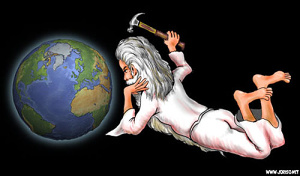
But in that case, why does Ben—or anyone else—believe in such a god, a god
who is no more than the glorification of a typical abusive parent?
And why do atheists so enthusiastically bother to deny him?
Alice Miller, an
author with a PhD in philosophy, psychology and sociology, as well as a
researcher on childhood, has come up with a theory which rings true. She's done
a great deal of research on what kind of person adores a brutal, abusive
god yet insists that such a god is "good". And it turns out—always—that such a
person is the child of a brutal, abusive parent.
So it shouldn't be a surprise when worshippers refer to this Jehovian god as
"Father".
Abuse doesn't have to consist of physical mistreatment. As Dr. Miller points
out,
Humiliations, spankings and beatings, slaps in the face, betrayal, sexual
exploitation, derision, neglect, etc. are all forms of mistreatment, because
they injure the integrity and dignity of a child, even if their consequences
are not visible right away.
Her original studies were in the field of finding out what makes a murderer a
murderer. There seemed to be no common cause until she began examining their
childhoods. But then she stumbled on two facts that showed a statistically
significant relationship, in spite of their seeming paradox:
Murderers were abused as children.
Murderers were either devoutly religious, or devoutly atheistic—never in between.
As she continued her investigations, she theorized that, as an abused child
grows, his or her need for an authority figure increases. Eventually, the actual
domineering parent cannot fill the need; so the child turns to a superhuman
figure—a domineering god—for guidance.
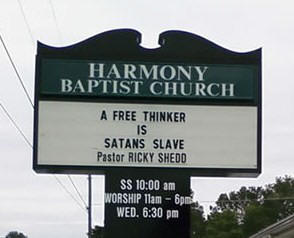
Because that's the key: These people cannot think for themselves. As children, they were
punished when they tried. Like Pavlov's dog salivating when a bell rings, these
people cringe at the thought of thinking independently. They require the
approval of a group, such as their church or a named political party or a
charismatic president or a self-described "jealous god."
They can never perceive themselves as independent, self-actualized
people—indeed, they can't even grasp the concept. When asked, they might define
themselves as "a child of God"—but never as "God's co-creator."
That much responsibility terrifies them.
How about people who are not murderers?—For surely, not every child
of an authoritative parent becomes one.
Well, it's not all nurture—some of it is nature. From a physical
standpoint, certainly some people just have a genetic predilection to perceive
themselves as whole persons in all but the most brutal of environments. And from
my view as a reincarnationist, I can see where some people come into a new life
with enough confidence to resist all but those worst.
Still, you don't have to be a murderer to abuse your own child, in just the
way you were abused.
And is it really not murder to support an unjust war, or even a "just" war?
Asking "Who would Jesus bomb?" doesn't faze these people, because they simply
don't understand the irony of the question. For them, the answer is, "Whoever
defies Him." Because these people simply cannot discern the difference between
one authority and another (which is why they so often confuse Jesus with God the
Father) and that makes god equivalent to Daddy, whose punishment for any
transgression, real or imagined, was so swift and overwhelming.
What about the case of the devout atheist—who is the authority figure for
such a person? Why, 18th-century science of course! By clinging to the
certainties asserted by the last crop of scientists before quantum physics
re-opened the known Universe to the wonders of indeterminism and the ambiguous
experiences of intuition and psychic awareness, these worshippers of the
Clockwork Universe still get to know the rules and face the punishment that will
surely come if they are broken. Global Warming is, for them, the hell the god
of Science will mete out to those who follow the false god of Climate Change Denial.
(That climate change is real is not the point of that paragraph.)
The key to recognizing these people—or to recognizing these traits in
yourself—is in learning to spot the either-or paradigm. Either you accept Jesus
as your personal savior, or you burn in hell forever. Either you accept that we
must impeach Trump, or the Earth will be destroyed. There's never any room for
doubt, no leeway for muddling through.
There's never any room for questioning.
But what if you were abused as a child, yet have not fallen into the
needs-an-authority-figure trap? According to Dr. Miller,
…when I tried to expose the social consequences of child abuse,
I encountered fierce resistance. Repeatedly I was told, "I, too, was a
battered child, but that didn't make me a criminal." When I asked for details
about their childhood, I was always told of a person who loved them, but was
unable to protect them. Yet through his or her presence, this person gave them
a notion of trust, and of love. I call these persons helping witnesses.
Dr. Miller goes on to describe "enlightened witnesses," people who
can help a former victim of abuse find wholeness through
listening to his or her story and providing a context for it.
Without either a helping witness or an enlightened witness, a person
will retain the childhood-induced fantasy that his or her abusive
parent was "good," "perfect," "right." Every childhood attack will
be seen as the child's just due for his or her disobedience,
stupidity, inadequacy—anything to prevent the adult from
acknowledging the parent's faults. Compare this to the healthy
adult, who can acknowledge that his or her parents were imperfect
people who did, or didn't, always do the best they could with what
they had—and love them anyway.
The actualized adult sees his parents as, simply, other adults with whom they
may or may not wish to be friends. The abused child-as-adult can never
see his or her parents as anything but authorities who "know better."
Arthur Silber observed an example of this in an
interview
Diane Sawyer did with Mel Gibson:
Gibson said, several times: "Diane, he's my father. My father. My father."
And the way Gibson said it clearly conveyed that his
father, his father's goodness, the fact that his father was worthy of deep
admiration, and—above all—his father's authority were not to be
questioned; all of these were immutable facts, absolutes beyond all debate or
questioning.
Gibson's inability to question his father extended to his
acceptance of his father's belief that the Holocaust never occurred,
and that the Jews were, in fact, responsible for the crucifixion of
Jesus—in spite of all evidence to the contrary.
Gibson simply couldn't hear the evidence. Like other abused
children-as-adults, the moment a conflict comes up between what the accepted
authority says and reality, the authority wins out every time.
No wonder the Bible tells us that to "spare the rod" is to "spoil the child."
That's the only way it can maintain its power!—Because it is far too filled
with internal inconsistencies to convince anyone of its divinity in any way
other than as unquestioned authority.
So, now we know the difference between the 30%-40% of the population who
still support Bush and his failed war and who still do not question his
lies—and the rest of us. Same for that fast-diminishing set of Trump supporters
about the same percentage of the population, which actually proves the validity of the premise.
Were these supporters of presidential pretenders all abused as children,
without either helping witnesses at the time or enlightened witnesses to assist later?
(And I can guarantee none of them have succeeded in reading this far!)
I can only promise that, like Mel Gibson, there will be adult survivors of abuse who
still think their childhood was "normal."

I propose that we are doomed to fail if we focus on trying to enlighten these
unactualized people with facts and figures. They can't hear anything that
contradicts the words of their accepted authority figure, the president who
talks to Jesus in between "grabbing women by the pussy". But we might
have some luck if each one of us adopts a
conservative and volunteers to be an enlightened witness for him or her. Ask
about his or her upbringing. Lead the topic to the way he or she was abused. And
help them to see they didn't deserve it; that it wasn't their fault.
When they begin to see their parents for the violent abusers they really
were, their healing, and ours, in the present can begin.
I'll start with Ben.