|
By: Paul S Cilwa |
Posted: 8/30/2006 |
|
Page Views: 21 |
| Hashtags: #Science #Conspiracy #History #HumanOrigins #Nibiruans #Sumerians #ZechariaSitchin #Astronomy #Pluto |
| Pluto is demoted. Mickey and Minnie are not amused. |
| Estimated reading time: 9 minute(s) (2062 words) |
Yes, I know everyone who's gone through 5th Grade had to memorize the planet
names to a mnemonic that no longer works, such as
My
E
R
C
U
R
Y |
Very
E
N
U
S |
Educated
A
R
T
H |
Mother
A
R
S
|
Just
U
P
I
T
E
R
|
Sent
A
T
U
R
N
|
Us
R
A
N
U
S
|
Nine
E
P
T
U
N
E
|
Pizzas
L
U
T
O
|
But get a grip. There will be new mnemonics, and it's been how
long since you left 5th grade, anyhow? With such a brouhaha, you'd
think Pluto had been implicated in the
JonBenét
Ramsey case.
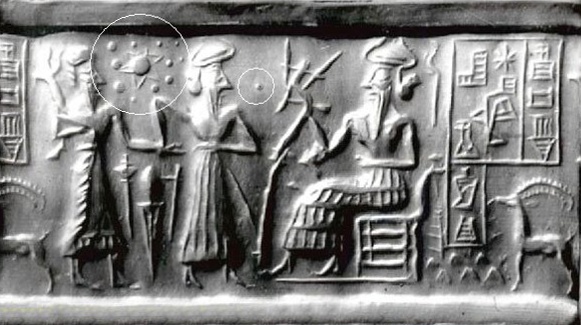
Of course, the Sumerians aren't supposed to have had telescopes. So
how could they have known all this?
Well, the only people we can ask are the Sumerians. Sure, they're all dead;
but they left thousands of tablets containing a treasure of written information:
Everything from shopping lists to histories. And they said that visitors
from another planet gave them all that astronomical information. The "other
planet" was called NI.BI.RU—"planet of the crossing"—commonly written
"Nibiru" in English. The Sumerians claimed this planet was the most distant from
the Sun, a member of our Solar System but with a wide, elliptical orbit that
took some 3600 Earth years to complete.
For some reason, those who inherited the Sumerian culture soon lost the
meaning of these texts and talked about only the planets that could be seen by
the naked eye. The nature of the Solar System was forgotten until the coming of
the Enlightenment, and even then it was exposed with all the deliberation of a
Charlotte Brontë novel.
At the turn of the 18th century, the notion people had of space was an
empty place—hence the name. They pictured the whole Universe as containing a few
million suns and a handful of scattered planets. The existence of meteors was
not acknowledged; every now and then folks would report the falling of one, but
people as educated as Thomas Jefferson thought that the idea of "rocks falling
from the sky" was preposterous, and
wrote that people would rather "believe that Yankee professors would lie,
than that stones would fall from heaven."

When Isaac Newton (who, I think, is unjustly canonized more for his
mathematics than his delicious recipe for fig cookies) presented his theory of
gravity, he did so by using mathematics to show that planets like Mercury, Venus
and Mars, whose appearances in the skies had been carefully documented for
hundreds of years, could be perfectly predicted by the simple equations he'd
concocted. And, of course, the predictions continued to be right on target,
which is why we now refer to gravity as a "law" instead of a theory.
Jupiter nearly spoiled the whole thing for Newton, because the math for a
"two-body system" (Sun and Jupiter) didn't quite work out for it. But when
mathematicians took the influence of massive Saturn into account, Jupiter's
movements through the heavens also fell into line.
Because Jupiter is also massive, they understandably expected the influence
of Jupiter to explain the irregularities of Saturn's orbit. However, decades of
attempts failed to do so. The only possible explanation, was that there was
another planet—an unknown one—beyond Saturn.
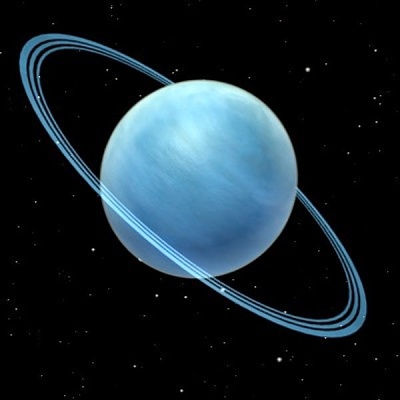
Lost since the Sumerians' descendents misplaced it, Uranus was identified by
Sir William Herschel in 1781—though first, erroneously, as a comet. By 1827,
though, its classification as a planet and its modern name (Herschel named it
after his King George) were widely accepted.
The math was then applied, and Saturn's irregular movements were explained.
However, as years of tracking the new planet mounted up, it turned out to sport
irregularities of its own. Eventually, the conclusion was reached: There must be
yet another planet beyond Uranus.
Galileo, inventor of the telescope, had actually spotted even-more-distant Neptune in 1612; but
it was so far away and moved so slowly that he thought it was a star. Several
mathematicians, working on Uranus' orbit, figured out where the missing planet
would be in the sky, and asked a number of astronomers to look for it. For some
reason there seems to have been reluctance to do so. However, a student at the
Berlin Observatory thought to examine recently-completed star charts of the area
in which the new planet was thought to be lurking. Sure enough, there it was.
The year was 1846.
So now, Uranus explained the irregular motions of Saturn, and Neptune
explained the motions of Uranus. Surely, the Solar System would now be
well-behaved and function with the precision of the clockworks that were the
height of eighteenth century technology!
But the Solar System didn't cooperate. Neptune also showed orbital
perturbations, proof that there was yet another massive world even
farther away than Neptune. The same procedure was followed: Mathematicians
figured where to look for the missing planet, and astronomers were asked to look
for it.
And yet, still again, there was a reluctance on the part of astronomers to
actually hunt for the thing—odd, considering the fame and speaking fees
that would go to the lucky stargazer who found it. That prize went to Clyde
Tombaugh, at the time a young researcher, who found Pluto in 1930.
But was the excitement premature? Even by the gut-based, twentieth century
definition of "planet," Pluto barely qualified. Yes, it had its own orbit around
the Sun; but Pluto turned out to be smaller than our own moon and certainly
was not responsible for perturbing Neptune's orbit.
And yet, the media conveniently ignored all that and fussed over the little
world with headlines like "Long-Sought Ninth Planet Found!" Most people were
unaware that there must be yet another planet, a large one, orbiting out
there, in the darkness of the outer Solar System.
It was not unreasonable to call Pluto a "planet." It had its own orbit around
the Sun and there weren't many known bodies that did. Although Galileo had
spotted four "minor planets" that most people ignored—they were really the four
largest asteroids—to most people, a planet was something that orbits the Sun,
while a moon is something that orbits a planet.
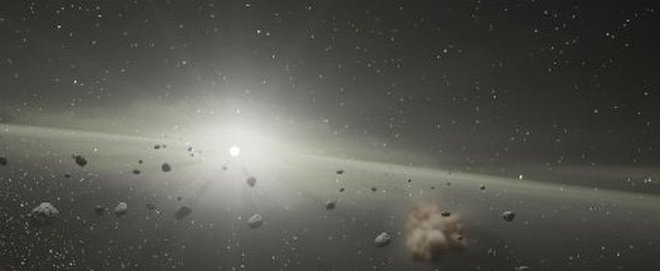
But as the twentieth century progressed, the Solar System began to seem more and more
crowded. It turned out that there were thousands of asteroids, some the
size of houses and tractors, with the implication that there might also be a few
millions the size of Fig Newtons, most occupying the orbital space
between Jupiter and Mars. School kids no sooner got used to the asteroid belt,
when a number of bodies were also discovered in the newly-named Kuiper Belt
beyond Neptune. Annoyingly (at least to Pluto's publicists), at least one Kuiper
Belt body, designated UB 313, is larger than Pluto. Since it also has an
independent orbit around the Sun, if Pluto is a planet, why shouldn't UB 313 be
one, too?
The problem was, no one had ever bothered to define the word "planet." It was
one of those things that was simply understood, like "sky" or "fig". But then
we got better at measuring worlds at a distance, and found out how small Pluto
really was, and the pressure began building, among astronomers, at least, to
refine the classification used for all these objects they were compelled to
catalog.
The meeting of astronomers last week in Prague was intended to define
"planet" and they did that, giving us a definition that is pretty close to our
gut feeling: Big, round, orbiting the Sun, may or may not have satellites of its
own. A new classification was created that rather replaces the old term "minor
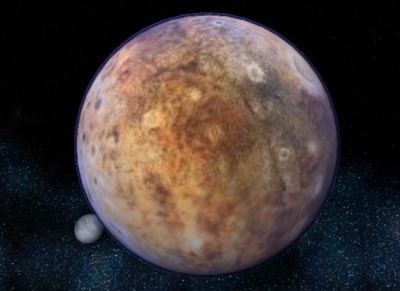
planet." Pluto, like the asteroid Ceres and UB 313, is a "dwarf planet."
In addition to its small size, Pluto shares another characteristic with most
asteroids and Kuiper Belt objects: An elliptical orbit. In Newton's time,
astronomers were certain planetary orbits would be perfectly round because they
thought of God as the "Master Clockmaker" and if God couldn't make
perfect circles, who could? Nowadays we know that all the planets' orbits are
slightly off the mark, the result of the gravity of each one influencing the
others. But some orbits are notably off. For example, the asteroid 433 Eros
swings from the main part of the asteroid belt to within 17 million miles of
Earth—far closer than Mars ever gets. Similarly, Pluto's eccentric orbit brings
it periodically closer to the Sun than Neptune, and also swings above and below
the plane of the ecliptic (the invisible disk on which the other planetary
orbits are drawn). Modern astronomers do not believe that Pluto was ever a
satellite of Neptune, even though it crosses Neptune's orbit. They assume it was
captured by Neptune some time in the past, but cannot explain how or why.
The Sumerians knew both answers. According to them, GA.GA was originally a
moon of Saturn. When Nibiru, a rogue planet that drifted into our Solar System
and was captured by the Sun some three billion years ago, made a pass into
the inner Solar System on its elliptical orbit, its gravity dislodged GA.GA and
sent it careening around until it was temporarily captured by Neptune. Another
Nibiruan pass-by broke it free and it achieved its own "destiny," which was the
Sumerian word for independent orbit.
In fifth grade, we learned to
number the planets from the Sun outwards, making innermost Mercury the first
planet. But the Sumerians numbered from the outside, as the orbits would
be ticked off by a traveler from Nibiru. That made Nibiru the first planet, and
Pluto—which they also considered a planet for the same reasons we used to—the
second. Neptune was the third; Uranus the fourth; Saturn the fifth, Jupiter the
sixth.
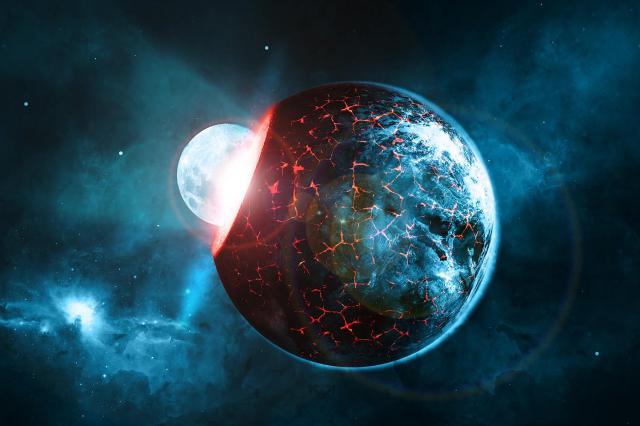
At that point it gets tricky, because the Sumerians also knew about the
asteroid belt, which they called the "hammered bracelet" (firmament).
However, they claimed the asteroids were the remains of a planet they called Tiamat, planet number
seven. Tiamat had also been hit on one of Nibiru's forays into the inner Solar
System—literally, because it was split in half by one of Nibiru's moons. While
the shattered half became the asteroids, the other half spun closer in to the
Sun, past Mars (planet eight), to a point where it became Earth (planet nine).
They considered the Earth-Moon system to be a dual planet, as do modern
astronomers; our moon was Planet Ten to them. Venus was eleven, and Mercury made
twelve.
No matter how you count them, and whether Pluto is a planet, a
dwarf, or just Mickey Mouse's dog, the fact remains that there is something
big past Neptune that is affecting Neptune's orbit. You could say that this is
an unimportant matter, especially compared to the war in Iraq or even the price
of gasoline.
And yet, I can't help but wonder…why did the civilizations that
evolved from Sumer forget about the outer worlds? And why, after we had realized
that the mathematics proved the existence of outer, massive planets were
astronomers so reluctant to look for them? Why have we, as a culture, allowed
ourselves to be distracted from the fact that a massive outer planet is still
there, waiting to be found?
'Cause you know, we've sent probes to every planet in the Solar System. If we
find Planet X (Nibiru?), a probe is sure to follow.
What is someone afraid we'll find?