|
By: Paul S Cilwa |
Posted: 9/25/2025 |
|
Page Views: 350 |
| Hashtags: #BlackDeath #PopeGregoryIX #CatMassacre #MedievalSuperstition #BlackPlague |
| How a paranoid pope's war on cats helped unleash the Black Death. |
| Estimated reading time: 5 minute(s) (1125 words) |
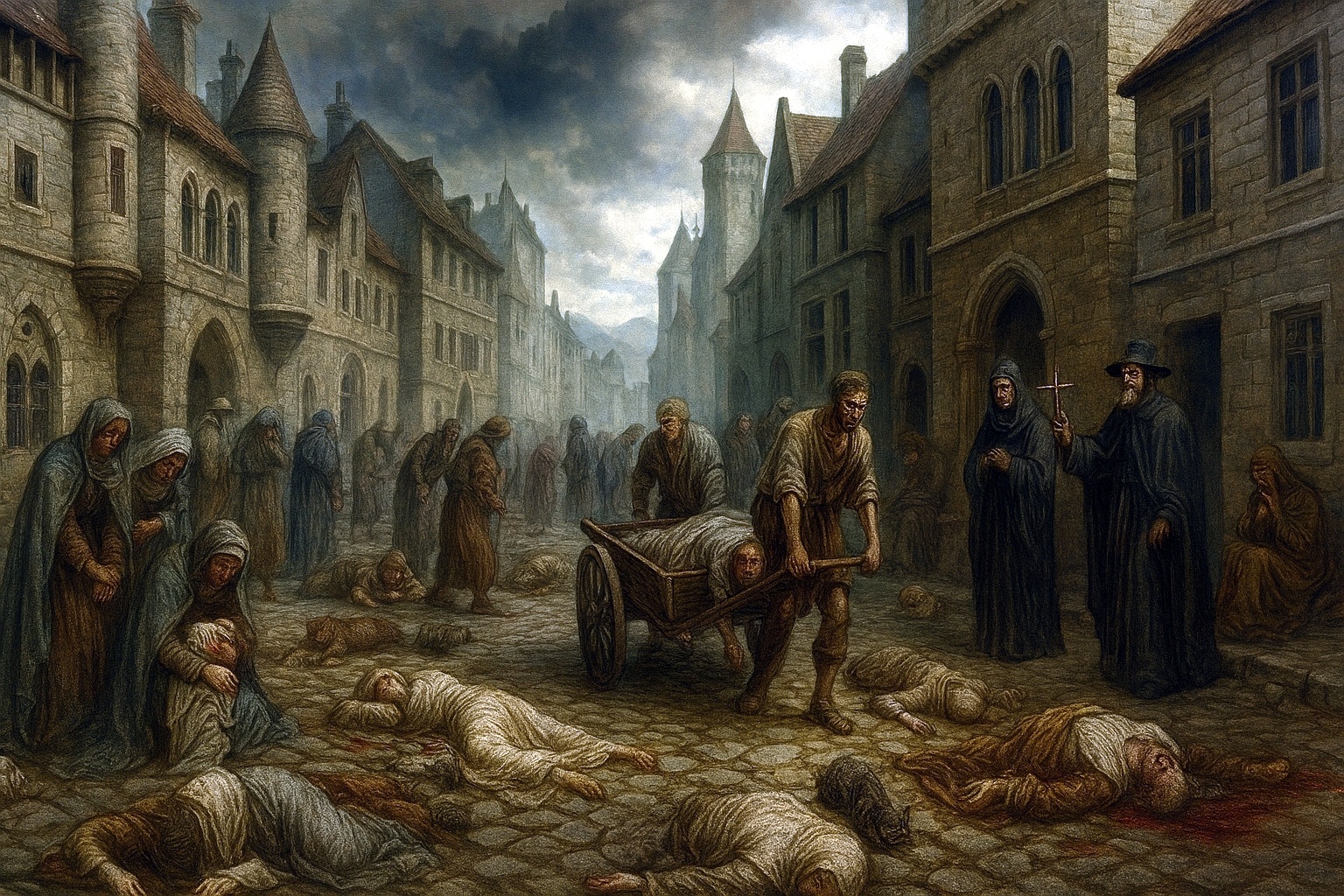
In the year 1347, Europeans began falling sick in increasing numbers. The
symptoms were swift and terrifying: high fevers, chills, splitting headaches,
and overwhelming fatigue gripped the body within days of infection. Soon after,
painful swellings—called buboes—erupted in the groin, armpits, or neck, often
growing to the size of eggs and turning black with infection. Victims sometimes
vomited blood, developed black spots across their skin from internal bleeding,
and struggled to breathe as the disease ravaged their lungs.
Whether it was the bubonic, pneumonic, or septicemic form, death often came within a week,
leaving little time for prayer, preparation, or escape.
The origin of the Black Death is still debated, but the strongest evidence points
to Central Asia, possibly near what is now Kyrgyzstan, as the initial source.
Genetic studies of Yersinia pestis—the bacterium responsible—suggest
it evolved thousands of years ago; but the specific strain that triggered the
14th-century pandemic likely emerged in the early 1300s.
From there, the disease spread along Silk Road trade routes, reaching China,
then moving westward through the Middle East and into Europe via Crimea.
A pivotal moment came in 1347, when the Mongol army besieging the Genoese
port of Kaffa reportedly catapulted plague-infected corpses over the city walls.
Genoese merchants fleeing the siege carried the disease by ship to Sicily,
and from there it radiated across the continent.
But then came the accelerant: a papal decree that turned cats into demons.
Pope Gregory IX and His Peculiar Obsessions

In 1233, Pope Gregory IX issued Vox in Rama, a papal bull that didn't just
wag a finger at heresy—it painted cats, especially black ones, as literal
companions of Satan. Now, Gregory wasn't exactly a paragon of restraint. He was
a man who saw heretics under every bed and witches in every shadow. He also had a
flair for the theatrical: lurid descriptions of satanic rituals involving cats,
orgies, and devil worship poured from his pen. It reads less like sober theology
and more like medieval tabloid fodder.
Some historians suggest Gregory's fixation on cats may have been less about theology
and more about politics—demonizing symbols of independence and feminine power. (Cats
were often associated with women healers and midwives.) Others note his personal
vendettas: he was locked in bitter struggles with the Holy Roman Emperor Frederick II,
and his bull may have been as much about consolidating control as about stamping
out "evil." Whatever the motive, the result was the same: cats were slaughtered
across Christendom.
When the Cats Were Gone, the Rats Danced
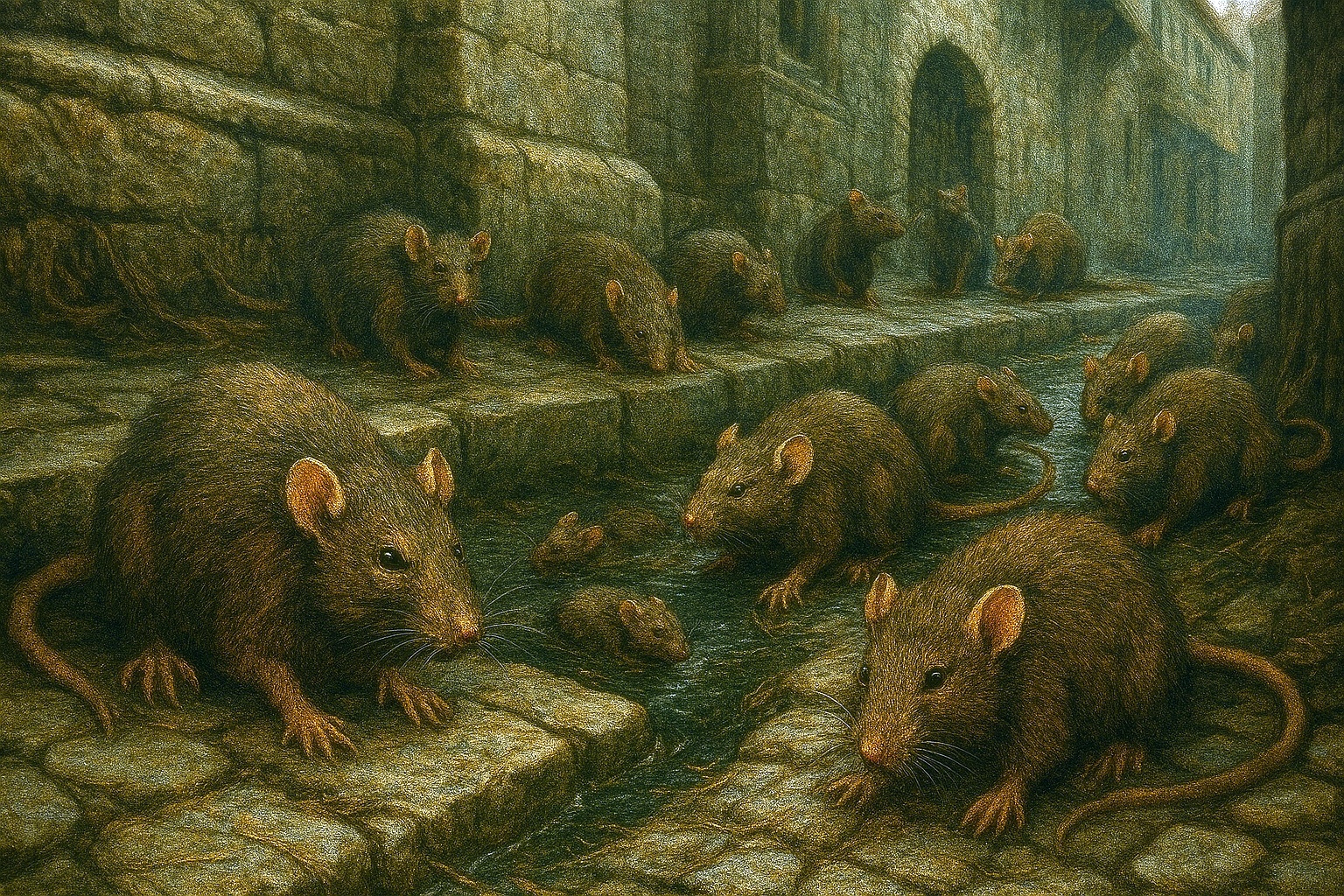
With their natural predators decimated, rats multiplied. And rats, of course, carried fleas.
And the fleas carried Yersinia pestis. When the plague arrived in Europe in 1347,
it found a continent primed for devastation: filthy cities, weakened immune systems,
and now, thanks to Pope Greg, a booming rat population.
The irony is almost too neat: in trying to purge the Devil, Gregory and his followers
literally cleared the way for Death himself.
Beyond Catholic Borders
Was this just a Catholic problem? Hardly. The Black Death did not respect denominational lines.
It swept through Orthodox lands, Islamic caliphates, and even reached as far as China.
But it didn't hit them as badly. Compare it to the COVID pandemic. Catholic countries
had similar levels of death as the proportion of unvaccinated people who died of COVID,
compared to non-Catholic countries, with a proportion similar to the number of vaccinated
people who died.
But the intensity in Catholic Europe was arguably worsened by the feline purge.
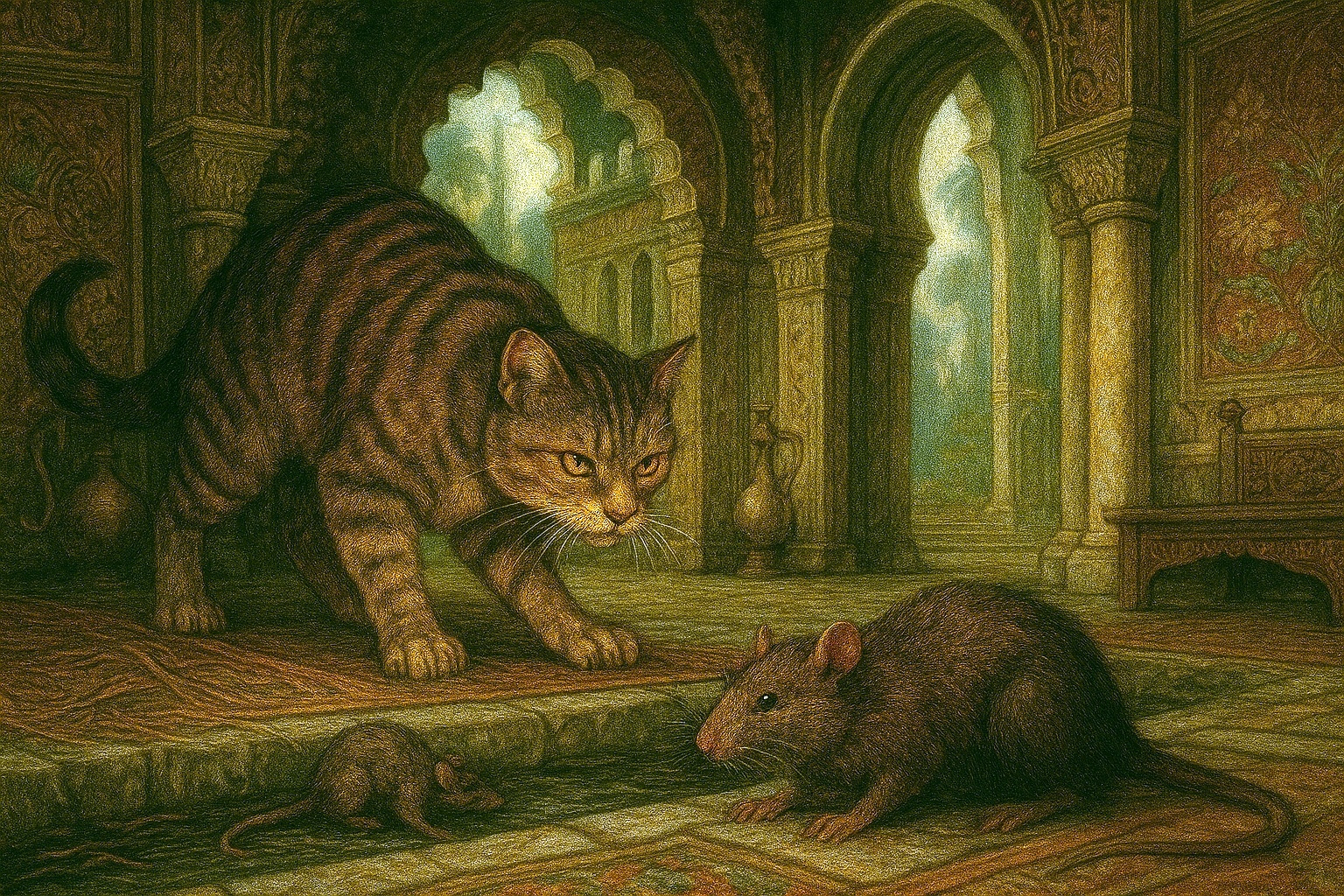
Other regions, while still devastated, often retained a healthier respect for cats. In
the Islamic world, for instance, cats were considered ritually clean and even
admired—Muhammad himself was said to have loved them. It's not that Muslims or
Orthodox Christians were spared, but their cats weren't systematically exterminated,
which eliminated the rat explosion. There still were rats; they still had fleas.
But their numbers were kept in check by the not-killed cats.
The Devil in the Details

So yes, poor sanitation and ignorance of microbes were the tinder. But Gregory IX and
his cat-hating crusade were the spark. Without his lurid imagination and papal authority,
Europe might not have had one-third of its population wiped out.
It's a reminder that sometimes history's greatest catastrophes aren't just "acts of God"
or "forces of nature." Sometimes they're the result of one man's paranoia, dressed up
in holy robes, with a quill in his hand and a vendetta against cats.
Pope Gregory IX died on August 22, 1241. He didn't go quietly. In fact, his death came
during a period of intense political gridlock. Gregory had convened a papal conclave
to elect his successor, but the process was so contentious that the cardinals were
literally imprisoned in the Septizonium by Roman officials to force a decision.
Greg died before the conclave could resolve anything, leaving the Church in chaos
and the papal throne vacant for nearly two months.
He's remembered for codifying canon law with the Decretales, expanding the Inquisition,
and—of course—for demonizing cats and thus unleashing the Black Death. He was austere,
brilliant, and deeply committed to the Church—but also impulsive, combative,
and prone to paranoia. Even his allies sometimes found him hard to love.
One-third of Europeans died, compared to about a quarter of the populations of non-cat-killing
countries in Asia and Northern Africa. Sudden abandonment of urban centers in West Africa,
such as Ife in Nigeria, and cultural shifts in East Africa, hint at a possible plague event
but there is insufficient archaeological evidence to be certain.
Lessons

It's been rightfully said that those who don't study history are doomed to repeat it.
In 2025, we can replace Pope Greg with RFK, Jr., the brain-wormed, whale-beheading,
bear carcass-dumping, former heroin addict who has no medical training whatsoever
but is nonetheless inexplicably our nation's Secretary of Health and Human Services,
who is trying to exterminate decades-proven vaccines as fervently as Pope Greg went after cats.
The results will be the same, as that's always what happens when the lessons of
history are ignored.
Filthy, overcrowded cities, ignorance of the causes of disease and a cat-hating pope seem
to be unrelated components; but when they came together it resulted in a deadly, perfect storm.