|
By: Paul S Cilwa |
Posted: 7/19/2010 |
|
Page Views: 6,097 |
| Hashtags: #Toxins #NaturalHealth #EnvironmentalToxins |
| I get the lab results detailing exactly how toxic I am. |
| Estimated reading time: 8 minute(s) (1818 words) |
Almost a month ago,
I was tested for
several types of environmental toxins: Pesticides and heavy metals.
This morning I got the results.
The doctor in charge of all this is Walter Crinnion, who teaches
at the Southwest College of Naturopathic Medicine. He is probably
the foremost authority on environmental medicine in the
world. I am actually seeing his students, as the clinic I go to is
the student clinic of SCNM. However, today was my second visit and
both times I got to see Dr. Crinnion in person.
My husband, Michael, is also a student at SCNM. He is just
starting his third quarter, and is assigned to the clinic on
Mondays. His shift started at 8 AM, and my appointment was 8:30 am;
so I brought him to the clinic and then waited to be seen.
It being a new quarter, there's a new crop of students. Normally
that doesn't matter, as my charts would carry on. However, my main
charts had been misplaced, possibly because I had switched to Dr.
Crinnion from another doctor at the clinic. In any case, since my
part of the paperwork (my residential
and exposure history, and list
of complaints) were all here in my blog, I was able to locate
them and the new docs, a guy named John and a woman named Hadassah,
could print them out.
Fortunately, my lab results were not missing.
To understand them, though, requires a brief trip to the year
1874, where in Strasburg, Austria, a young chemical student named
Othmar Zeidler performed an experiment that produced a new chemical
which he recorded in his notes as dichlorodiphenyl trichloroethane.
But he saw no use for it, and the formula lay dormant in the records
of the Chemical Society for sixty-five years.
In 1939 Swiss farmers were bothered with an unusual number of
insects and since there was a great shortage of the usual
insecticides the Geigy Chemical Company of Switzerland began to look
around for substitutes. One of their young chemists, Paul Mueller,
resurrected Zeidler's old formula and tried out some of the
dichlorodiphenyl trichloroethane, abbreviated D.D.T.
Now, there's a lot of unanswered questions at this point. Did
Mueller go through every useless chemical, trying them all as
insecticides? If not, what made him guess that DDT would have that
effect? In any case, the new substance showed amazing promise. It
was instantly lethal to all insects—not just the ones
attacking Swiss crops, but flies, lice, and mosquitoes. And when the
war broke out, and soldiers began dying of malaria more than from
bullets, DDT was rushed into mass production and used as a miracle
cure for the "scourge of insects".
Paul Mueller won the Nobel Prize in 1948 for his discovery—not
of DDT, but of its use as an insecticide.
DDT works by opening sodium ion channels in neurons, causing them
to fire spontaneously, which leads to spasms and the eventual death
of any insect encountering this molecule, whose effects are intense
and long-lasting. Very long lasting: DDT molecules resist
degrading; they maintain their integrity for a very long time; and
even then, when they do degrade, it is into the form
Dichlorodiphenyldichloroethylene, or DDE.
What people of the 1940s didn't realize, is that anything that
kills insects can't be good for other species. And of special
significance are compounds that are not biodegradable, such as DDT.
By the late 1950s, some environmentally-aware scientists began to
notice that something was changing: In the previous twenty years,
eggshells were becoming more brittle, resulting in fewer baby birds
being hatched. Not just those of chickens, but of all birds,
causing an unexplained endangering of entire species, such as the
bald eagle. Naturalist Rachel Carson reported meticulously gathered
data on this phenomenon, finding a link between the widespread
spraying of DDT and the reduced numbers of birds in her 1962 book
Silent Spring.
Carson was violently assailed by threats of lawsuits and
derision, including suggestions that this meticulous scientist
was a "hysterical woman" unqualified to write such a book. A
huge counterattack was organized and led by Monsanto Company,
Velsicol, American Cyanamid—indeed, the whole chemical
industry—duly supported by the Agriculture Department as well
as the more cautious in the media.
Despite the worst efforts of the chemical industry however, in
1972 DDT use was banned in the United States.
But in the 1960s, it was being spewed from the backs of mosquito
control trucks in places like Florida, where I lived, and where kids
like me thought it was fun to run behind the trucks and inhale the
fumes.
When DDT does break down, it becomes DDE. DDE is a fat
soluble molecule; it is also toxic in its own right. Because it is
fat soluble it finds its way into our body stores of fat, where it
simply stays. Mother's milk is a fatty substance, of course; mothers
with a toxic burden of DDE pass it on to their nursing babies. But
unless something heroic is done, it tends to remain in the body,
just as it persists in the environment.
According to my lab results, I carry a significant load of DDE,
as revealed by gas chromatography and mass spectrography of lipids
(fats) contained in the blood sample they took from me.
In addition to contributing to body fat directly (the body fills
in adipose tissue with fat specifically as a go-to place for fat-soluble
toxins), DDE is associated with diabetes and low-testosterone, both
of which conditions I have. I don't have Alzheimer's (I think!) but
that is also a condition associated with DDE. I don't have
Alzheimer's (I think!) but that is also a condition associated with
DDE.
Another pesticide, that was banned in 1983, is Chlordane. It was
used primarily on crops, but also was used against termites by
tenting houses and filling them with Chlordane gas. And in 1973, I
worked as a pest control technician. Although I didn't personally
tent houses, the office from which I worked was used to store the
tents; and the guys who did tent came in and hung around,
still wearing the uniforms they'd worn while working with the
pesticide.
A breakdown chemical of Chlordane is trans-Nonaclor. I also carry
a significant amount of that.
I predicted that I was going to be oozing every heavy metal in
the heavy metal test, but actually I wasn't that bad. Of significance were:
- Cadmium, probably accumulated from the shrimp I love to eat.
- Lead, probably from the lead water pipes in our old house in
Vermont when I was a kid, plus the fumes of all those leaded
gasoline engines on the road before 1978.
- Mercury, from the kids' toys I played with in the 1950s and
early 1960s. We used to break the toys apart to play with the
mercury drops within. Plus, I have had a lot of mercury
fillings in my teeth.
- Uranium, which as an amount didn't seem to cause so much
concern but I have no idea where or when I was exposed to
any.
So, how do we get rid of this stuff?
Not all at once, to be sure. I've had nearly six decades to
accumulate these toxins and they won't disappear overnight.
One of the body's primary methods of detoxing itself is a substance
called glutathione. To understand what it does, you have to know
what a "free radical" is.
Basically, a
free radical is a type of toxin. It is an atom with a missing
electron (another name for this is "positive ion") that roams the
body, stealing electrons from any place it can, thus turning healthy
cells into slightly defective cells, and even damaging our DNA. The
word for this is "oxidation". The antidote to free radicals are thus
antioxidants, which are big in the news (and on food labels) these
days.
Glutathione is the most powerful, super-duper antioxidant there is.
But the act of scooping up a free radical destroys a molecule of
glutathione. Fortunately, we can make our own. Any cell in the body
can create glutathione. However, the liver produces most of
it.
What can happen though, and may have happened in my case, is that a
serious toxic burden can both impede the liver from producing enough
glutathione, and also of course neutralize what is made.
Moreover, glutathione cannot be taken as a supplement; studies have
investigated this but the glutathione is simply digested and broken
down into its component amino acids.
So, what I was told to do was to take supplements that would boost
my liver's ability to create glutathione, and others that would help
usher out any loosened toxins.
I also gave another blood sample, from which to obtain a "baseline"
reading of my glutathione levels. I'm not sure how baseline it will
be, really, since I've been taking glutathione-boosting supplements
for a month now. But we did it, anyway.
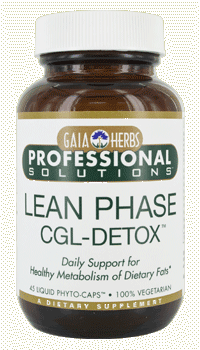
And then I picked up, from the clinic's medicinary, the supplements
aimed specifically at the toxins and metals I tested high in.
-
Clean Phase CGL-Detox, a daily fiber supplement to support
elimination of persistent toxins. I am to take a tablespoon of
this stuff in a small cup of water before each meal. That's
probably not going to happen with lunch, but before breakfast
and dinner is easy. (The label says 1-3 times a day, so skipping
lunch should be okay.) I've had my first dose, and it doesn't
taste bad—faintly of cinnamon, which is one of its ingredients.
-
Green Phase CGL-Detox, which promotes the production of
glutathione and the scavenging of fat-soluble toxins. The
ingredients of this include turmeric, milk thistle, and
broccoli, all of which I was taking already; but also several
other herbs. I take three capsules about an hour after dinner.
-
Lean Phase CGL-Detox, which helps to to properly metabolize
dietary fats. This is one capsule with each meal.
- NAC,
also known as N-acetyl-L-cysteine, a
naturally-occurring substance that is a powerful supporter of
the liver production of glutathione.
Interestingly, nothing was said—yet—about intravenous or
hydrocolonic treatments. But my instructions did say to
follow the nutritional advice from Dr. Crinnion's book, which means
I may have to cut out those mini-churros I've been getting from
Jack-In-The-Box every morning.
But…we'll see.