|
By: Morey Bernstein |
Posted: 7/20/2007 |
|
Page Views: 6,237 |
| Hashtags: #MoreyBernstein #BrideyMurphy #Hypnosis #MassMedia #Metaphysics |
| Why Isn't Hypnotism More Widely Used? |
| Estimated reading time: 11 minute(s) (2507 words) |
The unfortunate fact about hypnotism is that the "dangers" have been
dramatically overplayed, while the benefits have either been glossed over or
entirely concealed. I have read scores of articles, the headlines of which
glaringly proclaim the horrors of hypnotism. Boiled down, however, these
commentaries usually constitute a simple statement: Hypnotism can effect amazing
cures, but maybe it's dangerous!
But just what are these dangers? The subject, far from being a helpless
automaton, can break the trance whenever the suggestions are sufficiently
adverse to his fundamental principles. Obviously, then, he is not nearly so much
at the mercy of the operator as a person under an anesthetic.
Nobody would consider doing away with the science of medicine simply because
there are each year a number of unfortunate results engendered by inaccurate
diagnoses or improper treatment. Nor would anyone advocate the prohibition of
surgery owing to the few cases in which lack of knowledge or skill aggravated,
rather than improved, the condition of the patient. Quite the contrary. Indeed,
we find a full measure of literature describing the progress, contributions, and
miracles of modem medicine and surgery, just as these fields so decidedly merit.
This printed material does not dwell upon and exaggerate the dangers; instead,
it justifiably points up the benefits.
Now hypnotism deserves the same break. It is time that the "scare articles"
taper off and be replaced by clear-cut exposition of the truth. This wonderful
science of the mind has been too long buried under superstition,
misunderstanding, and neglect. Within the next few decades we may at last, there
is good reason to believe, see hypnotism take its rightful place as one of the
most important sciences.
At this stage, then, a logical question appears: if hypnotism is entirely
safe in the right hands, and if it has such an extensive application, why is it
not more widely used? Some of the answers have already suggested themselves. Now
let's consider still other salient factors.
To get the proper perspective, let's survey a segment of the historical
outline, The first thing that strikes us in the story of modem hypnotism is its
cyclical nature; it has bobbed up and down like a yo-yo. There has been a high
point of interest roughly every thirty years, followed by a decline.
Time magazine (March 30, 1953), in its usual pithy style, takes a
broader look at these peaks and valleys:
Hypnosis has been a hard-luck kid among medical techniques. A
century ago it was just beginning to win acceptance as a pain
killer when ether anesthesia was discovered, and hypnosis was
discarded. It was making a comeback sixty years ago when Freud
hit upon the idea of psychoanalysis, and the experts again lost
interest in hypnosis. Now, the third time around, it is once
again winning the support of reputable men in both the physical
and psychic areas of medicine.
During all these ups and downs of hypnosis bitter battles were incessantly
being waged. Franz Anton Mesmer, the
grandfather of modern hypnosis, published his discoveries regarding "animal
magnetism"—his name for what later was to be known as hypnosis—in 1779. As a
result, he was ultimately forced out of Vienna and then out of Paris.
John Elliotson, one of
the most brilliant men in the history of medicine, was compelled to resign his
position at London's University College Hospital because he would not give up
his interest in mesmerism.
The Lancet, a British medical publication, summed up the feeling of
Elliotson's opposition in 1846 as follows:
"Does he himself [Elliotson] treat the harlotry, which he dares to call
science, with any respect?"
A young Scottish surgeon practicing in India,
James Esdaile,
performed three hundred major and thousands of minor
operations with patients under hypnosis. Yet he was criticized by the Calcutta
Medical College; medical journals refused to print accounts of his findings, and
the Medical Board never even so much as acknowledged his letter on the subject.
Lafontaine,
a Swiss magnetizer (hypnotist) traveling in Italy, was ordered by King Ferdinand
to leave Naples unless "he made no more blind people to see nor deaf ears to
hear." But Pope Pius IX was more enlightened; he commented, "Well, Monsieur
Lafontaine, let us hope that, for the good of humanity, magnetism may soon he
generally employed."
(Hypnotism was then known as magnetism.)
James Braid, who coined the word "hypnotism," offered in 1842 to read a paper
on the subject before the British Medical Association. His offer was rejected
and his reports of cures termed ridiculous.
A French doctor, Liebault, who was obtaining excellent results with hypnosis,
was attacked as a quack by Professor Bernheim. And when one of the latter's
patients was quickly cured by Liebault, it was too much for the professor!
Bernheim went to investigate Liebault with the intention of exposing him once
and for all. Instead, he was so astounded by what he learned that he himself
promptly undertook the study of hypnosis.
In 1886 Bernheim published a book, Suggestive Therapeutics, and hypnosis
reached the zenith of its glory. But now the scene was set for a man in Vienna who
was to send it skidding downward once again. The man was
Sigmund Freud.
In order to study hypnotism Freud visited Bernheim and Liebault at Nancy,
France. Freud learned, as have all hypnotists, that not every patient can be
hypnotized. He was aware, however, that there was one thing every patient could
do—talk about himself. He reasoned that, via this "talking out' process,
satisfactory therapeutic results could be obtained, given plenty of time,
without hypnosis. And on this psychoanalysis was born.
Regarding Freud, let us not forget the fact that, whatever its other merits,
psychoanalysis is a huge moneymaker. Freud himself created that. As
Exiles In History puts it:
"Freud ingeniously tied the fee to results. If the fee is very low, he
warned, the value of the treatment will be denigrated in the patient's eyes.
Free treatment is an analytic disaster, he insisted. Without the 'corrective
influence' of money, the patient is supposedly deprived of a 'useful
incentive to exert himself to bring the cure to an end'.
"Only in a
few areas does the modern analysis so slavishly follow Freud. The bill for
the month's analysis (some $1000 at $50 an hour) is not mailed. It is
presented, eyeball-to-psyche, to the patient at the end of the month. If
payment is not forthcoming in time, there is an automatic reminder in the
next bill. The next step is medicine's most effective collection system: the
analyst injects the unpaid bill into the analytic work to find the
unconscious reason for the resistance."
There has never yet been a full-scale truce in the dispute involving
hypnosis, and the dissension continues even today. And out of this hodgepodge of
misunderstanding, acrimony, fear, charges, and countercharges, there has emerged
a genuine problem of semantics: Hypnosis has become a distasteful name.
Perhaps, therefore, if hypnosis is to be fully accepted, it must make its debut
under a new name.
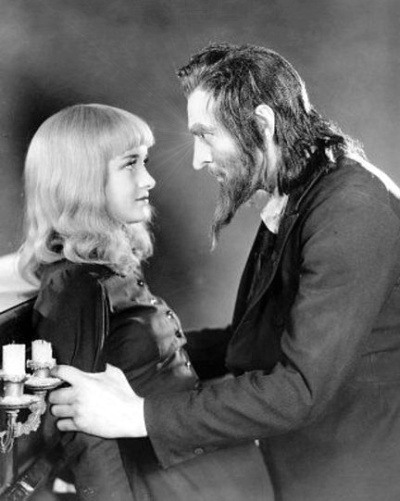
The very word "hypnosis" is a signal for a train of prejudices in the public
mind—misconceptions, absolute traditional beliefs, propaganda. There are some
subjects about which we can never think clearly because we are blinded by the
negative connotations called forth by certain words. In this case the mind is
immediately influenced by pictures of the hocus-pocus variety:
Svengali (a character from
the 1894 novel Trilby); the
ridiculous antics of stage performers; witchcraft and sorcery.
With these delusions infecting the public mind, should a doctor be blamed if
he shuns any association with this word? He runs the risk of arousing suspicion
and damaging his own practice. And can the fault be attributed entirely to the
public if this word is genuinely misunderstood? The real problem is semantic mad
psychological; the old worn-out word should go!
A word like "tranceology" (the science of the trance) would be somewhat more
palatable. It goes down without regurgitating the old unsavory connotations.
So the name "hypnotism" itself embodies most of the objectionable elements.
It is tied up with all the old taboos, a battle-scarred background, popular
misconceptions, stage demonstrations, and with fear.
In this respect, the name is also related to objections put forth by some
religious sects. Their opposition is understandable in view of the general
impression that the hypnotist usurps the free will of the subject, that one mind
completely dominates the mind of another. Far from depriving subjects of their
free will, hypnosis can actually be instrumental in "giving back" a healthy
power of will to those who have become so distressed, so burdened by worry, that
they have lost the ability to assert their normal will.
Here again misconceptions need to be eradicated through reeducation. And this
new education would be much more easily ushered in behind a new name. Indeed,
full enlightenment might even be impossible under the shade of the hoary scare
word "hypnotism."
As far as doctors and psychologists ace concerned, there are two other
obstacles in the way of their professional use of hypnosis, One concerns the
fact that their medical qualifications, however imposing, have little bearing on
their ability to became proficient hypnotists. The qualities essential to a
skilled hypnotherapist are somewhat different from those demanded of a good
doctor. In short, an excellent doctor might turn out to be a poor hypnotist.
This is, to be sure, a field for specialization.
The other factor is the possibility of embarrassment. Doctors and
psychologists are, after all, human beings; as such they can hardly relish the
possibility of failing to make a favorable impression during the first meeting
with the patient. They well know the import of the doctor-patient relationship.
Until an easy, sure-fire technique is developed, the best professional
hypnotherapists will be stopped cold in some cases. Understandably, a dignified
doctor cannot be expected to welcome the prospect of assuring his patient, while
inducing a trance, that he cannot possibly open his eyes—and then suddenly find
himself looking into the patient's wide-open eyes. This is brand of
embarrassment to which doctors and psychologists need not submit in their
ordinary practice.
This objection, however, can be obviated to a considerable extent by avoiding
all direct challenges and utilizing only positive, curative suggestions. Even
so, a few patients will remain unimpressed by a light trance and may therefore
lose interest. So, regardless of how this problem is approached, there is still
a need for an unfailing, more effectual method of trance induction.
A further obstacle is exemplified by a personal experience. A man with a
speech difficulty asked whether I would accept him as a subject. I explained
that, in the first place, I was taking only those eases which were referred to
me by doctors; and secondly, since I made no charges of any kind, I usually had
more to do than I could manage. I suggested, however, that he see a medical
hypnotist or psychologist, as he was soon to spend several months in a large
city where professional therapists were available.
Almost a year later I encountered the same man, and I immediately observed
that his old speech difficulty was still very much with him. "Did you ever see a
medical hypnotist?" I asked.
"Well, no," he admitted. "I telephoned my doctor and asked him what about
this hypnotism business and he answered in no uncertain terms, 'Stay away from
hypnotism. It's dangerous! Besides, I don't know anything about it."
Aside from the obvious fact that anyone with no knowledge has not the right
to make the charge of "dangerous," it is clear that the semantic problem pops up
even in the professional field. Some medical men, including those who have
never even witnessed hypnosis, will unhesitatingly condemn it. And since the
very first act of a layman, before submitting to hypnotherapy, often is to ask
his doctor's advice on the matter, the upshot sometimes takes this pattern: Both
the doctor and the patient erroneously regard hypnotism as "dangerous"; the
patient never submits to hypnotherapy; the patient retains his affliction.
Fortunately, though, many medical men now recognize the merits of hypnosis.
In summing up the current status of hypnosis, these points tell the story:
There are numerous complaints for which hypnosis is the ideal treatment; and
in an even greater number of conditions it is a powerful adjunct to ordinary
medical methods.
Already the list of what hypnosis has actually accomplished is imposing in
length and equally impressive in content. It must be admitted that it was long
ago forgotten that this science was supposed to be confined to functional
disorders; time and again it has been applied in the field of organic disease
with extraordinary results.
What may finally be achieved by hypnosis once science has turned its full
attention to it can only be surmised. Even now there are indications of its
potentials—such as the fish-scale
disease (ichthyosis) cure, eases of organic changes, and the electrifying
possibilities of age-regression work. But if the nervous system actually has the
faculty for "listening" to direct suggestion, then where are the boundaries of
this science?
Despite wondrous attainments, hypnosis is still forced to fight for
existence.
Just as soon as a quick, universal method of inducing a trance of impressive
depth is developed and the most antagonistic, unyielding subject can be rapidly
and decisively hypnotized, then hypnosis will automatically become a therapeutic
instrument of paramount importance.