|
By: Paul S Cilwa |
Posted: 4/18/2006 |
|
Page Views: 7,821 |
| Hashtags: #AlienAbductions #Nibiruans #Sumerians #ZechariaSitchin |
| There is an impressive amount of evidence supporting the idea that extraterrestrials have been behind Human advancement since the birth of our species. |
| Estimated reading time: 15 minute(s) (3433 words) |
Michael quit his job for Solomon Brothers in World Trade Center Building 7,
and moved in with me, in March, 1997. We made a trip
together to Arizona and put down a payment on property in Snowflake in July, then drove
a trailer full of our stuff across the country in September. The
Snowflake property had an old single-wide mobile home on it that we'd been told
was habitable. After four months we had to admit it wasn't, and moved into a
rental home a few miles away. We also rented office space in town, since there
wasn't room in the house for desks, computers, books, and so on. And, most every week,
Michael drove me to Phoenix to catch a flight for wherever I was teaching that
week, or to pick me up when I arrived from my previous week's class.
All this time, I was very jumpy. Every time I got a "strange
feeling" I would blame it on aliens. Every time something was missing, I would
suspect aliens. But the fact was, nothing unambiguous could be pinned on them.
There was no evidence they'd been around since they'd
said goodbye.
Michael owned hundreds of books on most every subject, but particularly
on metaphysics. He hadn't even read all of them, though he generally knew the
gist of their contents. Among them was a full set of Zecharia Sitchin's "Earth
Chronicles" series.
The only reason I'd heard of the first book in this series,
The 12th Planet, was that it had been recommended to me by several of my
friends in the Support Group. Nevertheless, I'd never read it. Now, I took it
with me on a flight and read it through that week.
Sitchin was an expert in Hebrew and other Semitic languages, who had committed
the unforgivable sin of doing scholarly work in a field in which he held no
university degrees. (His degree, from the University of London, is in
economics.) However, most linguists will grudgingly admit that only an outsider
could do the work he had done.
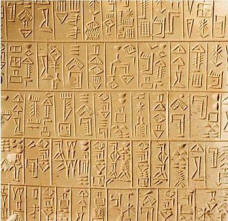
In 1835, archeologist
Henry Rawlinson
discovered a number of ancient, written tablets in the country now
known as Iraq. These tablets were eventually identified as being from the
Kingdom of Akkad, and were translated. The script used to write these tablets
was called cuneiform, and was written by pressing reed styluses into mud. When
dried, the tablets were remarkably durable—they'd been buried almost 2500 years.
Subsequently, Rawlinson dug up tablets from a different, older site he
identified as being a city of the Kingdom of Sumer, or Sumeria. Those tablets
were also written in cuneiform, but the language was different. Akkadian was a
syllabic language (meaning the cuneiform characters were strung together to
represent sounds and syllables); Sumerian was agglutinative, meaning that its
letters created words by tying together morphemes via meaning, not sound.
When linguists translate an ancient language for the first time, they need a
"Rosetta Stone" as a tool. (The original
Rosetta Stone bore an
inscription in Greek and two variants of Egyptian. Since Greek and the
Demotic variant of
Egyptian was well-understood, it was a simple matter to identify the meanings of
the corresponding hieroglyphic
Egyptian words.)
But a Rosetta Stone is just a starting point, unless by unimaginable luck it
is actually a dictionary. (No such Rosetta Stone has ever been found. It would
be a big stone.) So what linguists do, is map the words on the unknown
language side to the known language, and then look for another document that has
a lot of the same previously-unknown words. You then replace the unknown words
with their guessed-at meanings. That gives you a tablet containing some words
you think you know, and a lot of words you don't know scattered between them. You now,
using nothing but guesswork, fill in the blanks with words that seem to make
sense, given the words you do know.
That gives you a document that contains words you probably know, and others
you may know. You now go to another document, and again fill in the
blanks. Some of the words you guessed at will still make sense, so your level of
confidence that this is, in fact, the actual meaning of that ancient symbol
rises. Others will not make sense, so you erase them and make a new guess.
When a tablet was discovered that contained both Akkadian and Sumerian
writing, that was the long-sought Sumerian Rosetta Stone and translators went to
work. The majority of translation work was completed by 1908.
Or was it? Linguists who trained in Sumerian were now handed a Sumerian
dictionary and a "correct" translation that agreed with the dictionary, with no way
to verify whether it was accurate or not. Sitchin, coming in fresh, was
quick to see that certain translations made no sense. One was the Sumerian word
mu. This word, according to the official dictionary, means "name".
Sumerians, we are told by their own tablets, built a structure so they could
send their "names" to heaven. Yet, in other passages, Sumerian gods climb
into their "names" and ride them to other planets.
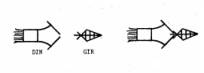
A significance the original translators couldn't have known, is the very
appearance of the cuneiform symbol for
GER: it looks just like the nose cone of a modern multi-stage rocket.
Moreover, the symbol "fits" atop another symbol that the traditional Sumerian
dictionary claims means "stones that rise". The combination looks like a sketch
made at NASA back in the 1970s, when the lunar flights were taking off.
Now if Sitchin had made these statements and shut up, he'd have merely been
ignored. However, he didn't stop there. He retranslated the Sumerian tablets
using his new dictionary and came up with an easy-to-read and perfectly coherent story of
interplanetary colonization by aliens, and the subsequent creation of our
species, Homo sapiens, by those aliens to serve as their slaves.
Lots of people have come up with cockamamie theories and nothing ever becomes
of them—a book appears, people read it, and it's forgotten within a decade.
However, Sitchin inspired an unbelievable amount of debunking. The only time I'd
ever seen the trashing of a man's reputation taken to this level was in the
books falsely debunking UFO sightings and abductions. That made me think that:
1) Sitchin's interpretation was likely to be true, and 2) there might actually
be some kind of conspiracy trying to keep the entire alien connection to mankind
secret.
After all, isn't the most certain way of preventing a slave revolt to
convince the slaves they are already free?
In any case, reading this book—which I had not expected to convince
me—brought me into contact with the word "Nibiruan" that I had first heard
during one of the night classes given by aliens. I had never heard the word
before and, in 1997, was unable to find it defined anywhere…but I hadn't
looked in Sitchin's books. There, I discovered that the "gods" of the Sumerians
had claimed an origin from a world they called Nibiru, which is Sumerian for
"planet of the crossing."
Looking outside the book, I found that there were definitely mysteries
regarding Sumer and its rapid (and unexpected) rise as a civilization. These
people had, apparently, invented language, cities, agriculture, architecture,
metalwork, medicine, law, religion, literature, and astronomy. It's essential to
picture the world before Sumer as seen by conventional paleontologists: A
natural world in which our ancestors were in the middle of the food
chain, living in caves or perhaps huts, wearing animal skins and clinging
precariously to the edge of extinction. Then, suddenly, out of nowhere—the
Sumerian cities of Ur, Nippur, Eridu and others sprung up, with the complex
infrastructure of farming, trade, trade routes, kingship and merchants to
support them.
In conventional histories, you can read the author exhorting us to "remember
the Sumerians" and give them their due for creating virtually everything we have
today. But is it reasonable to credit the Sumerians with all this, when the
Sumerians themselves credited visitors from the skies who, they say, taught them all these things?
The premise that the Sumerians were, indeed, given knowledge by advanced
aliens can easily be tested. If true, that knowledge should be more correct than
otherwise possible…and, sure enough, their astronomical tables include
accurate orbital information for all the planets, including Uranus,
Neptune, and even Pluto—the three planets of our Solar System that are not
visible to the naked eye. (They were not re-discovered until 1781, 1846, and
1930, respectively.) Even the major moons of Jupiter, re-discovered by Galileo
in 1610, were known to the Sumerians!
This proof of their scientific knowledge demands that we take their other
stories, if not at face value, at least with an open mind and willing attitude.
The Sumerians' Story
According to the Sumerians, the "gods" were
beings who looked much like us (we were created "in their image")
but came from a world far from the Sun that they called Nibiru. In
Sumerian, NI.BI.RU means "planet of the crossing;" they named their
world that because, every 3600 years, it crossed from the outer
depths of the Solar System into its inner reaches—it had, in other
words, an extremely elliptical orbit, like that of a comet.
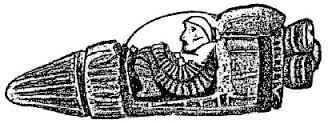
Some 450,000 years ago, according to the Sumerians' timeline, a
Nibiruan fled from his home world to Earth. Nibiru was having some
sort of environmental crisis, which required finely ground gold dust
to rectify. When this Nibiruan, called Alalu, discovered that Earth
was rich in the yellow metal, he put aside past differences and
contacted his home world.
Within five thousand years, the Nibiruans (who are extremely long-lived and
make decisions with glacial deliberation) were able to mount a massive space
program and send 500 astronauts to Earth to extract gold from the waters of what
is now the Persian Gulf. These astronauts, called the Anunaki (meaning, "Those
Who To Earth From Heaven Came"), are the "giants" of the Old Testament, the
"Sons of God" who married the "daughters of men." However, that is getting way
ahead of the story; for, according to the Sumerians, mankind had not yet been
created.
By 416,000 years ago, it became evident to the Nibiruans that extracting gold
from seawater was too inefficient a process to save their home world in time,
and the order came to mine it instead. (There are, in fact, the remains of
extremely ancient gold mines in
South Africa, whose age defies analysis.) The Anunaki, hired to be spacemen and
lab techs, found themselves pressed into service as miners. The work was hard
and intolerable to them; still, in true Nibiruan fashion, they endured it for
well over 100,000 years before mutinying.
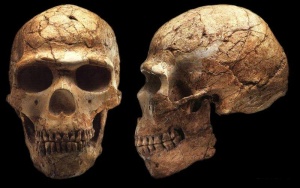
In response to the mutiny, a Nibiruan named Ninhursag used genetic
manipulation to combine the genes of "ape-woman" (probably Homo Erectus) and
Nibiruans to produce Man (Cro-Magnon, or anatomically modern, humans). This
happened, according to the Sumerians, about 300,000 years ago somewhere near
Africa's Rift Valley. Until recently, this date would have sounded much too soon
for the appearance of modern humans; but recent finds of extremely old
anatomically-modern human skeletons have made it plausible.
At first, the genetically altered humans were sterile and had to be
artificially carried to term by Nibiruan "birth goddesses," chosen from among
the Anunaki, who apparently found that type of labor preferable to working in
the mines. Obviously, though, this means of producing workers was inherently
inefficient. Enki, the Nibiruan whose idea all this was, broke ranks and
secretly further manipulated the genes of the workers, making it possible for
them to procreate.
An amazing aspect of this story is that the first workers were given the task
of tending a garden. Where was it? The Sumerian name was E.DIN. (Yes, Eden!) What's more,
the "Tree of Knowledge" takes on special significance when we remember that
"knowing" is a Biblical euphemism for sex…and when we find out that Enki's
"trademark" or symbol was…the serpent!
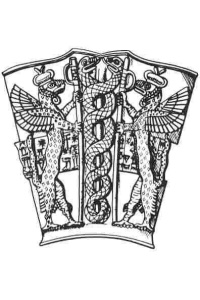
Symbolism of Enki, the Nibiruan genetics expert in charge of the ADAM Project.

The modern symbol of medicine, derived from Enki's symbol.

Representation of DNA, the building blocks of all life on Earth.
By 100,000 years ago, mankind's place in this colony world of Nibiru seemed
secure. Many of the Anunaki—called nefilim in Hebrew,
translated "giants" in the King James Version of The
Bible—took for themselves wives and husbands from among the humans; the job of
genetic manipulation had been so thorough that the mixed couples could even bear
children. This practice was looked upon by the Nibiruan leaders with alarm,
however. Some also doubted the use of another species for service was good for
the Nibiruans' own long-term welfare. Some Nibiruans began to wonder if it might
ever be possible to close this particular can of worms.
The Flood

By 75,000 years ago, the most recent ice age gripped Earth.
It was fourth in a series, but the first in the Nibiruans'
experience. Sea levels fell; once-lush areas became deserts;
temperatures dropped. The glaciers of the world grew, and grew, and
grew. By about 13,000 years ago, the seas had fallen to 200 feet
below their present level, and the glaciers covering Antarctica had
reached critical mass. Almost any celestial jiggling could send them
plunging into the oceans; and one was on its way: Nibiru,
approaching from its eccentric orbit, was about to pass near Earth
on its 3600-year orbit, carrying with it an entourage of displaced
comets.
It was not hard for Nibiruan scientists to calculate
that the collapsing ice shelves of Antarctica would produce a
world-wide tsunami, or even when; the Nibiruans were hastily called
into orbit, forced to leave their human husbands and wives, even
prevented by oath from warning them of what was about to befall. One
Nibiruan, however—our friend, Enki—told his favorite human anyway.
That human, known as Ziusudra to the Sumerians and Noah in Hebrew,
and who was, in fact, Enki's son,
was instructed to build a submersible vessel and to wait there with
his family and genetic samples of all Earthly animals and pairs of
animals of various genera to serve as surrogate parents so that
Earth's fauna could be restored after the global inundation.
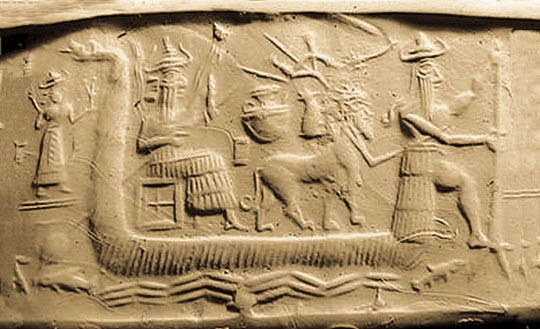
Sumerian tablet depicting the Great Flood.
The igigi, Nibiruan astronauts who maintained an orbiting
space station, were not prepared to support hundreds of displaced
Anunaki; food supplies ran low and it was a hungry group of
Nibiruans who landed on the soggy Earth after many weeks of flood.
They might well have been upset to find surviving humans…if the
humans hadn't had food with them. The Anunaki, and even Enki's
nemesis and half-brother Enlil, grudgingly acknowledged that the
Nibiruan/human alliance was here to stay.
Nibiruans could only commute to and from their home world when it was near the
Sun—otherwise, it was just too long a journey. That happened about every
3600 years. In each of the next few of these Nibiruan years,
according to the Sumerian sources, humans were "given" new
technologies: First, agriculture; then, domesticated animals that
provided humans with servants as humans served the Nibiruans.
Finally, cities were introduced as support for armies of Nibiruans,
and individuals fought for control and position.
The Sumerians recorded the loosening of buried gold by the Deluge, so
that placer mining could be conducted in South America (and South
American records document the visitation of bearded white men from
the East with a fascination for gold). They recorded the Pyramid
Wars, and even described the granite plug found in the Great Pyramid
and explained why no mummies were ever found in these supposed
"tombs." They described the result of nuclear fallout on the cities
of their civilization (and the remains of cities have been found
there that were "chopped off at the foundation," all walls smashed
in the same direction, as would happen in a nuclear blast).
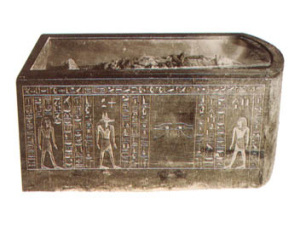
The Egyptians were very much "into" death, and decorated their sarcophagi with images and instructions for getting on in the afterlife.
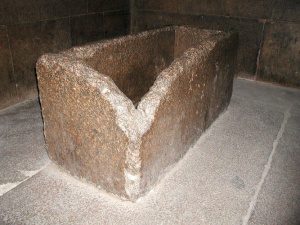
There were no decorated sarcophagi in any of the Great Pyramids tubs. They were only assumed to be sarcophagi because the pyramids were believed to be tombs.
But the lack of decoration proves they are not sarcophagi, and therefore the Great Pyramids are not tombs. (Other pyramids, built millennia later, are.)
By 2023 BCE, the winds carried the radioactive cloud to Sumer.
People died a terrible death; animals perished; the water was
poisoned; the soil became barren. Sumer and its great civilization
lay prostrate. Its legacy passed to Abraham's seed as he begot—at
age 100—a legitimate heir: Isaac.
Consider, however, that mu—the word that Sitchin insists means "rocket ship"—could
also refer to the people who flew the ships. The Sumerian
word mu is equivalent to the Hebrew word shem.
According to the Bible, Abraham was descended from Noah's (Ziusudra's) son,
Shem, who was presumably a pilot, since people used to name themselves after an accomplishment.
Abraham was the ancestor of the people who include the Jews
and Arabs, the Semites. "Semite" is derived from "Shem." This would
identify the Chosen People as the people chosen by the makers of the
rockets.
Is there any evidence that Homo sapiens differs in some significant, genetic
way from other creatures on Earth?
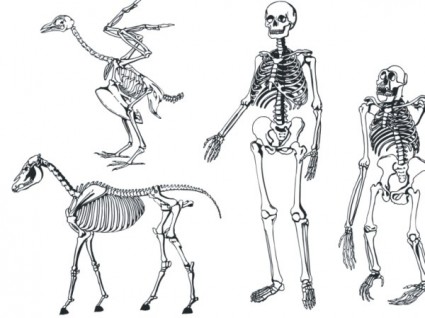
Certainly our bones do not. All earth species with backbones, have skeletal
structures based on the same basic plan. Our hands and feet are amazingly
similar to fishes' fins, horses hooves, and seals' flippers.
However, in 2001 Science magazine formally announced the conclusion of
the Human Genome Project,
a study designed to identify the makeup of every gene in human DNA. Originally
it had been expected that this mapping would take centuries; but the unexpected
advances in computers—combined with the fact that humans don't have as many more
genes than a flatworm as the original researchers had supposed—brought it to
completion at the start of the 21st century.
Meanwhile, the same techniques had been rapidly cataloging the DNA of dogs,
horses, monkeys, and other species; so that when the Human Genome Project was
completed, it was possible to put what scientists on the project had learned in
context.
And what did they learn?
That most species differ from other, similar species by just one or at most
two genes…but humans differ from our nearest relatives by no fewer than 223 genes!—What's more, all 223 of those genes are concerned with human brain growth and
psychology.
It was clear to me that those 223 genes represented the difference between
our immediate ancestor, Homo erectus, and our own species, Homo sapiens. I was convinced when the
spinners came out of the woodwork and announced the number of 223 was "wrong".
There weren't that many new genes, they said, and most of them had been
"transferred" by means unspecified, from bacteria (also unspecified) to us. Note, this information
didn't come from the scientists who made the original report. This was nothing
less than spin, disinformation distributed for no other purpose than to mislead
us.
But, if the Nibiruans spent so much time manipulating the affairs of humans,
literally half a million years…where did they go? That was the next mystery to
solve.