|
By: Paul S Cilwa |
Posted: 4/5/2006 |
|
Page Views: 5,104 |
| Hashtags: #AlienAbductions #GrandCanyon #WhitewaterRafting |
| The layers of people's personalities peel back just as Grand Canyon reveals its layers of geology. |
| Estimated reading time: 25 minute(s) (5831 words) |
On the expedition's eighth day, we arrived at Phantom Ranch and said goodbye
to the passengers who could only be with us for the first eight days.
The trip from Lee's Ferry to Pierce Ferry at Lake Mead is 280 river miles,
and the rafts have to make the whole trip. However, the passengers don't;
and many people can't spare the time for an eighteen-day trip—or the money. So
O.A.R.S. divides the journey into three segments. The first is the "Upper
Canyon" and runs from Lee's Ferry to Phantom Ranch, about eight days downriver.
The second is the "Lower Canyon" and picks up where the "Upper Canyon" left off
at Phantom Ranch, going another seven days to Whitmore Wash. The remaining three
days is called the "Canyon Sampler" and runs the rest of the way to Lake Mead.
The Canyon Sampler is
the trip I had made with my daughter in 1992.
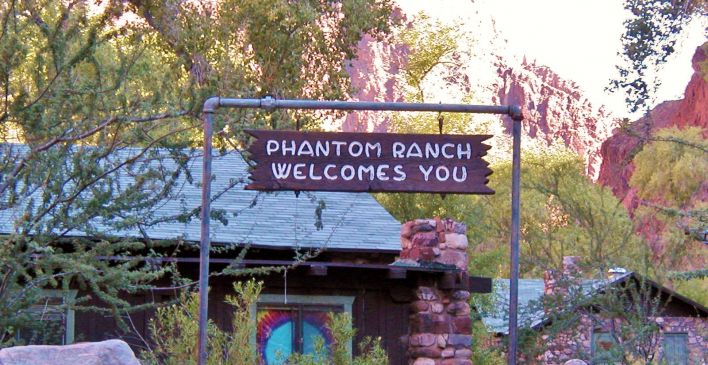
Phantom Ranch lies near the bottom of the Canyon on the Bright Angel Trail.
Mules and humans travel that trail; no mechanized vehicles can traverse it.
Phantom Ranch itself is a quaint, century-old lodge with a communal dining hall
and dorm-like facilities. As the closest we'd come to civilization in a week,
none of us passengers chose to remain with the boats rather than have a
"civilized" lunch in the dining hall. We could also send letters and postcards
that would be marked "MAILED BY MULE".
The fifteen passengers who were leaving would actually spend the night in the
dorms, and begin their nine-mile hike up Bright Angel Trail before dawn.
Meanwhile, as we all ate lunch, replacement passengers were hiking downward to
the river. We expected them to arrive by noon.
Liz and Kathleen hugged me goodbye and I shook hands with a few of
the departing guys. Even the gay doctors politely said farewell. Judy, on the
other hand, ignored me as studiously as I ignored her. Anne had accompanied us
to the Ranch to check her and Tony's mail; I noticed she
walked stiffly, as if she were in pain. She couldn't bring herself to look Judy
in the eye, either.
Wearing my new Phantom Ranch T-shirt, I returned to the rafts to find a few
new passengers had already arrived. There was Larry, a stand-up comic from Los
Angeles, and Matt, a fireman from San Francisco. There was, however, no sign of
Rusty's generals.
"They'll be here soon," Rusty assured me. "They were all roommates at West
Point."
"How do you know that?" I asked. "I don't remember a place on the reservation
form for 'biography'."
"It's in the trip notes," Rusty explained. "O.A.R.S. must have talked on the
phone with whichever one of them made the reservation."
I couldn't say he was wrong. My reservation had been made by my travel
agent, so there'd been no reason for me to talk with O.A.R.S. at all.
About an hour later, a lone hiker, not one of the passengers, appeared on the
bluff above us. "Hey, are you missing three old guys?" he called down.
"Yeah!" Robby answered. "Have you seen 'em?"
"Sure have. They're about four miles back on the trail. One of 'em is in
bad shape." So Robby sent Tony and Rusty, our burliest boatmen, running up
the trail. After another hour or so they reappeared with one of the West
Pointers limping between them. Yes, these guys may have once been power walkers
but now, after twenty years of holding down the desk they were not in such good
shape. Butch, the guy whose legs gave out on him, was only 63 but he looked like
he was gonna collapse any minute, and the other two weren't much better. I
wanted to start a betting pool on which day of the trip Butch would die, but
Robby talked me out of it.
In fact, he tried to talk Butch out of staying at all. Tony and Rusty had
carried him to the river only because a helicopter couldn't land on the slope of
the trail; and taking him down to be picked up made more sense than dragging him
up to the rim. But both boatmen had assumed he would be flown out. Crippled,
Butch would have no way to get to the latrine, much less in and out of a rubber
raft.
But Butch's personal doctor was one of the other generals; and he
vouched for Butch's rapid recovery. In the meantime, both of his companions
would be glad to carry him to the latrine, and in and out of the rafts,
as needed. So Robby relented and Butch stayed.
"Where's Schwarzkopf?" I asked Rusty.
"He couldn't make it," Rusty said, with a hint of disappointment. "I guess
there's a war or something. But now's your chance. Go talk to those guys about
UFOs." I just glared at him in return and made myself available to any of the
new passengers who needed assistance closing their dry bags or fitting into
their life jackets.
Another new passenger had special concerns. Her name was Virginia, and she
was blind. I showed her by feel how to work her dry bag; she caught on more
quickly than many of the sighted passengers. "I hope they don't make special
allowances for me," she said. "I've done a lot of adventure traveling and I
really don't need any." I decided to take her at her word.
When we were all packed, I rode with Larry, Matt, and a woman named Carol in
Mike's boat. We went just a few miles downriver before stopping to hike. The new
passengers, already overwhelmed by the beauty of the canyon, lined up eagerly to
start out. Soon we were following Tony (and trailed by Brian), climbing several
hundred feet above the river on a trail that followed the softly rounded edge of
an overhang. Each of us tended to walk at a different pace; soon Tony was out of
sight ahead of us and Brian was somewhere behind.
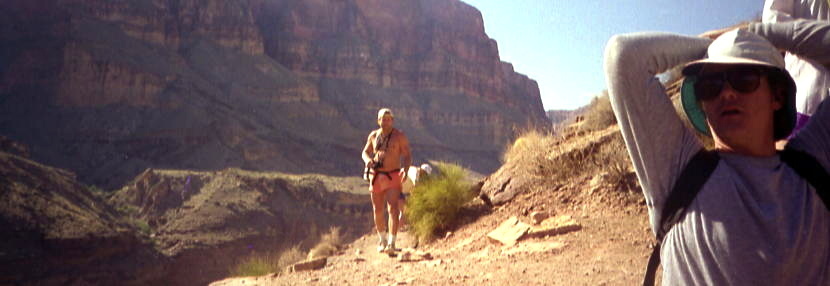
Suddenly, Larry slipped on loose gravel and fell, sliding down toward the
edge of the overhang and a fatal drop. I had been right behind him, and threw
myself to the ground so I could grab the strap of his day pack. That halted his
slide, and Matt held my ankles firmly so I could pull Larry back to safety
without slipping off myself.
Larry was furious. "This is dangerous!" he cried. "Why isn't there a
guard rail? Why doesn't someone clean loose gravel from the trail?"
I burst out laughing. "This is a wilderness, Larry!" I said. "If you
wanted a safe stroll, you should have taken your vacation in Disneyland."
Tony came jogging back. "Is there a problem?" he called, then, seeing the
scrapes on Larry's knees, added, "Are you all right?"
"Yeah," Larry growled, "no thanks to the Park Service, who should have put in
guard rails here."
"Guard rails?!" Tony snorted. "Oh, you're one of those guys who thinks
there should be mile markers posted along the river, too, aren't you?"
"It would make the map easier to follow," Larry pointed out, aware
that Tony was gently ridiculing him.
"Look, man," Matt interjected, "I'm a fireman. And I've got to tell you, you
will never be completely safe, anywhere you go. No matter what you do.
There can always be an earthquake."
"Or a meteor could hit you," Carol pointed out. When everyone stared at her,
she said, "Well, I'm from Kansas, and at home a meteor is about as likely as an
earthquake—and less likely than a tornado."
"Or you could be having a harmless little fling with a White House intern and
be exposed by a busybody reporter," Tony added. "The point is, 'safety' is an
illusion. One of the gifts of Grand Canyon is helping you come face-to-face with
that illusion, so you can see it for the lie it is. Once you do, you'll be a
better person for it."
"If I live," Larry grumbled, but I could see he was beginning to
understand.
"Follow me," Virginia, the blind woman, suggested. "If anyone is going
to slide it will be me; and that can serve as a warning that the path is
slippery." We stared, not certain whether or not she was kidding.
When we resumed rafting, I decided to take Larry, Matt and Carol into my
confidence. "Look," I said. "In that baggage boat. That's Rusty."
"What about him?" Larry asked.
"Well, there's this thing. See, he's going to tell you anyway. I'm an alien
abductee."
Larry laughed out loud. I took it good-naturedly.
"Yeah, yeah," I said. "The point is, that's all Rusty wants to talk about.
Every single night. So, I was thinking that, if you guys hang out with me
tonight while we eat, when he tries to bring up aliens, you guys could,
like, change the subject."
My three new friends agreed to help, and Mike the boatman added, "Give me a
high sign if he gets stubborn. I'll take the pressure off you."
"How will you do that?" I asked.
"Oh, I have a trick or two up my sleeve."
When Phil handed out the tents that evening, the generals politely declined.
"We have our own tent," one of them explained.
"That big old thing?" Cathy, the other baggage boatman, asked. "That heavy
canvas thing I've been rowing around all day?"
"Are you sure you wouldn't like a modern backpacker's tent? We have a spare
or two."
"We're sure," said Butch, who still couldn't walk. "We used that tent in
Korea, and we used it in Vietnam. It's certainly good enough for Grand Canyon!"
As I predicted, Rusty joined Larry, Matt, Carol and me for dinner. He
introduced himself and sat down on the beach with his plate of tortellini
Alfredo. He hadn't taken three bites before announcing, "Paul's an alien
abductee."
"Oh, puh-lease," Matt begged. "I'm from San Francisco. Alien abductees are a
dime a dozen. Straight guys like me are rare."
Rusty refused to be deterred. "Have you ever seen a UFO related to one of
your abductions, Paul?" he asked.
"I have a stand-up routine about UFOs," Larry remarked. "What's the
difference between an intelligent man and a UFO?" We looked at him blankly, and
he gave us the punch line. "I don't know. I've never seen either one!" We
laughed, but he wasn't done. "Hey, where do dumb aliens go? Area 52!
Y'know why cats hate flying saucers? It's too hard to reach the milk."
"Do you know how men are like UFOs?" Carol asked suddenly.
"How?" Larry responded.
She sighed. "You don't know where they come from, or what they intend to do.
All you know is, just when you've gotten used to them being around, they take
off!"
Larry laughed. "That's good! You can tell a joke!"
"I date Kansas men," Carol said primly. "Being able to tell a joke is the
only way a Kansas woman can survive."
"But, seriously, Paul," Rusty insisted. "Have you ever had an anal probe?"
Matt snorted, "Most of my friends have. Some of them will even pay extra!"
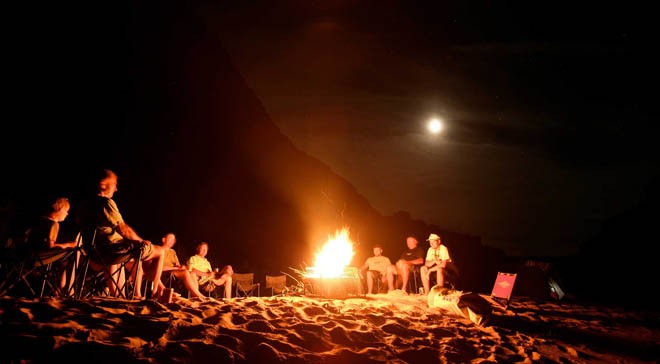
It was clear that Rusty wasn't going to give up, so I caught Mike's attention
across the campfire. He stood and banged on a saucepan. "Okay, folks, time for
tonight's entertainment!" Everyone quieted down and gave him their attention.
"Some of you know I come from Alaska," he said. "Now, I don't know many Grand
Canyon stories, but I do know an Alaskan story about the Cremation of Sam
McGee." He put down the saucepan and began to recite—no, to perform—the
Robert W. Service poem:
There are strange things done in the midnight sun
By the men who moil for gold;
The Arctic trails have their secret tales
That would make your blood run cold;
The Northern Lights have seen queer sights,
But the queerest they ever did see
Was that night on the marge of Lake Lebarge
I cremated Sam McGee…
Everyone was spellbound. The story of the hapless Tennessean who
found himself freezing in the long Alaska night only made the
coolness of this night seem to penetrate to our bones. I
gazed past the rapt faces of Matt and Carol and Larry to Rusty, who
was frowning at me. I gave him a smirk and a wink, and returned my
attention to my new best friend, the boatman from Alaska.
Rusty rose during the recitation; I saw him a little later with the generals
as they put up their tent.
Mike finished and an enthusiastic round of applause reverberated between the
canyon walls. When the echoes had died away, Mike said quietly, "Y'know, I
really have seen a UFO."
"So have I!" Carol whispered in surprise. "I've never told another soul. What
did yours look like?"
"Just a translucent disk or sphere," Mike said. "I was hiking in Yosemite and
it flew overhead very fast, but at an irregular pace."
"Mine was more solid than that," Carol confessed. "I was just a little girl,
maybe eight years old, when I saw this—thing—zoom overhead, just a dozen
feet above the cornfield. Funny thing, too. I went to sleep after that, right
there. When I woke up it was dinner time."
"Oh?" I voiced, eyebrow raised.
"Oh, no!" she replied vehemently. "I'm certain I'm not an abductee."
"That's what I said. After all, you wouldn't remember it."
"I'm certain," she said so intensely that I decided not to challenge her.
"And even if I am," she added, "I'd rather live with the belief that I'm not."
"Shit, I haven't thought of UFOs in years," Larry suddenly announced. "I saw
one of those, too!" Then he laughed. "Just kidding!"
After awhile the four of us said goodnight. I passed Tony coming back from
the porta-potty. "How's Anne's back?" I asked.
"She's in pain," he replied. "She's got some pain medication but at this rate
she'll use it up before we get to Lake Mead."
"I thought Doctor Warren said it wasn't serious?"
"Him." Tony snorted. "You know what I caught him and his friend doing
the last night before Phantom?"
"What?"
"Remember, we were up on a bluff. I went down to the river take a leak," Tony
said, "and almost tripped on the two of them. Fucking."
"Oh, really."
"No shit. Could you ever think of anything more disgusting?"
"Uh, sleeping with Judy comes to mind."
Tony shook his head. "They should be shot. I can't think of anything more
disgusting than one man sticking his dick in another man's ass."
"You usually seem so tolerant," I observed.
"Not about that, I'm not."
If I'd had any temptation to "come out" to the new passengers, that put a
damper on it.
The evening quieted down; most of the passengers were in their tents and the
bonfire had burnt down to embers and the boatmen were asleep on their boats. I
stretched out in my sleeping bag in front of my tent, not in it, so I could
watch the stars wheel slowly overhead. I was just dozing off when I felt a warm
pressure over my collarbone.
Good evening, Arcadia, I greeted, though I knew the words wouldn't
carry to her. Where the hell were you last week? I had no way of
knowing. But I counted on my fingers and realized it was, indeed, Tuesday night
back in the real world. I wondered how the Support Group was doing without me.
Before I knew it, it was morning. We had breakfast and set off down the river
in our rafts. This time I shared a raft with blind Virginia and two others; Tony
rowed. We had occasion to run a couple of sizable rapids that morning; I noticed
that Tony ran them on a different route than the other boats took. Our run was
more sedate; we didn't get splashed so much. I didn't say anything then, but
when we stopped for lunch I asked Tony about it.
"I thought I'd better take it a little easy on Virginia," Tony admitted.
"But she didn't want that," I reminded him. "She said she didn't want special
treatment."
"Sure, she said that," Tony agreed. "But that's because she has the
illusion she doesn't have a handicap."
"Or perhaps you have the illusion that she does?" I suggested
mildly. I really liked Tony for his humor and sometimes brutal honesty; but I
was beginning to see he had a few hang-ups of his own.
We had enjoyed perfect weather so far and the day was gorgeous as we tied up
the rafts at the mouth of a wide stream. The canyon walls at this spot were
steep, and granite pillars created a faux gateway through which the stream
poured into the river. We had to tie the rafts to fallen rocks, as there was no
beach onto which to pull them.
Robby gave us permission to wander freely. So I found a little spot with a
big rock and stretched out to enjoy the sun. Before long I was asleep.
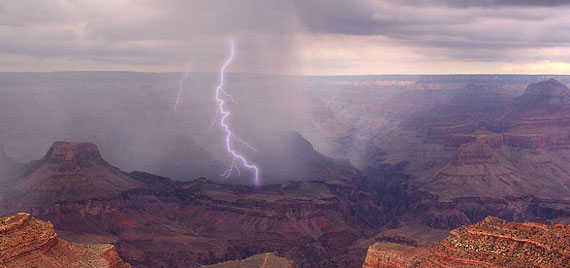
I was awakened by the crash of thunder. A storm had moved in; the sky was
heavy with rain. I knew that in these side canyons, flash flooding is likely;
so I hurried back towards the rafts. In a couple of minutes the sky
opened up, a torrent of rain coming down so hard I could hardly see. The smooth rock trail
became slippery. Every now and then I encountered another passenger caught by
the storm; we helped each other over the slicker stretches. Finally we
were back at the river.
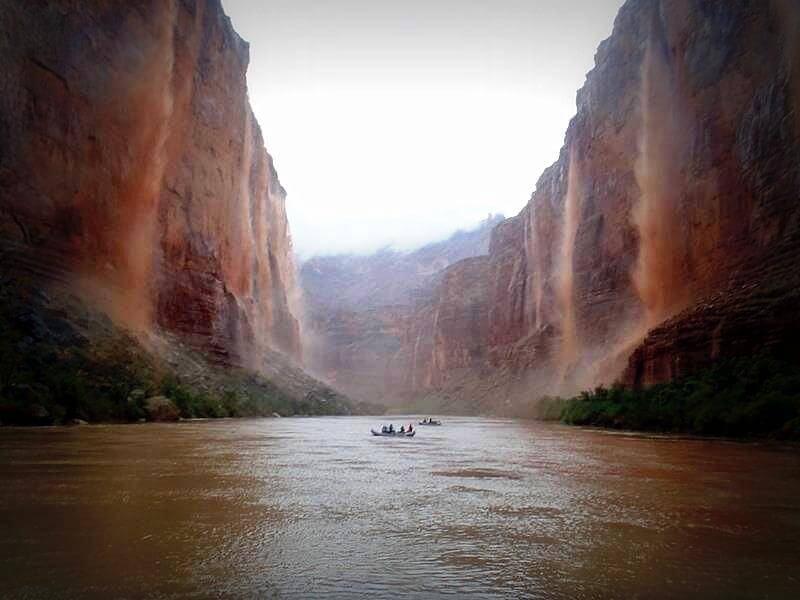
The walls of the Canyon looked like they'd sprung leaks. A dozen waterfalls
gushed out of what appeared to be solid rock. Robby made a head count and, once
we were all present, he directed us to jump into the nearest raft—not to worry
about whether it was the one we'd arrived in. Carol and I jumped into one raft
along with Turtle, who set it free. Immediately the current of the side stream
increased, flushing us out into the Colorado. We hadn't gone far when a wall of
brown water gushed out of our rocky little side canyon. The stream had
flashed after all—but we were safe, on the main river.
But Carol didn't seem to realize that. She was crying, and every time a
thunderbolt rocked the canyon, she cried and recoiled as if shocked.
"Are you all right?" I called over the din.
She shook her head. "I know it's silly," she wailed, "but I'm afraid of
thunder!"
I tried to be helpful. "But, listen to it!" I begged. "The canyon corridors
each have their own resonant frequency and the noise of the thunder is
selectively amplified."
She stared at me as if I'd just been speaking Hindi.
"It sounds like the deepest notes of an organ, doesn't it? Isn't that cool?"
To her credit, she tried to hear it as I described. The thunder did,
indeed, sound like the foot pedals of a church organ. She nodded, but then
another thunderclap hit and she screamed again.
Not knowing what else to do, I put my arm around her. It didn't much help,
but it kept us a little warmer. Later Turtle found a narrow beach to pull onto,
and we located our own boats and put on our rain gear before continuing
downriver.
The rain continued into the evening. The first suitable camping place we came
to was on a vast slab of granite that lined the river's south side. The West
Point guys insisted on putting up their heavy canvas tent and I assisted. "So,
where do you know Rusty from?" I asked.
"Who?" Ted, Butch's personal physician, asked.
"Rusty, the baggage boatman. I saw him talking to you last night."
"Oh, the baggage boatman," the general repeated as though I had said, "the
insignificant private." "Yes, he helped us put up our tent last night."
"We don't know him, though," Will, the third general, corrected me.
"We wouldn't need any help putting it up, if it wasn't for my damned legs,"
Butch complained from the side. "We put up this tent all through the Korean
conflict, and Vietnam, too."
"Technically," Ted corrected, "we didn't put up the tent in Vietnam. We had
aides, remember?"
"You have AIDS?" I blurted, astonished.
"Not AIDS. Aides. Assistants," Ted corrected. He nodded in the direction of
the boatmen, who were busily engaged in tying up the rafts, putting a tarp over
the kitchen, and setting up the porta-potty. "Damnedest thing I ever saw," he
said.
"What's that?" I asked.
"I've been watching closely. And I cannot see how Robby gives orders
to his men."
"Orders? Robby?" I laughed. "He doesn't give orders. I mean, he's the trip
leader but they all just know what to do. Each person just looks to see a job
that no one else is doing, and he does it. Nobody has to order anyone."
"Trust me, young man," General Butch advised. "Any operation that runs
smoothly has a chain of command. We've known this since the days of Alexander
the Great—the first great human discovery, more significant even than fire."
The sides of the canvas tent were sodden. "Is this going to keep you dry?" I
asked doubtfully.
"Of course!" General Butch assured me. "It kept us dry in Korea and Vietnam,
two places that really know how to rain. For six months of the year it
never stops! A little drizzle like this is no problem."
"And even if the tent does leak a little," General Ted added, "it won't
matter because our sleeping bags are waterproof."
As it turned out, the sleeping bags may have been waterproof; but they
no longer were. In the morning all three generals were shaking with cold and
absolutely drenched. Robby, Rusty and I peeled the men from the soggy bags and
poured hot coffee into them while Tony and Brian started a fire. Robby said they
should strip; it was just a suggestion but they obeyed his every word as if it
were a command from President Clinton himself. After the fire had warmed them,
they donned dry outfits and their rain gear. It took ten of us to strike the
soggy canvas tent and get it onto Cathy's baggage raft, weighing it down. Cathy
glared at the generals and lashed it tightly to her oar frame.
The rain had stopped before dawn but the day remained cloudy and damp. To
keep warm I asked to row more than I had previously. By now I was allowed to run
rapids up to level 4 on the Canyon scale. This day Robby let me row eight miles,
rapids and all, while he napped in the back of his raft. Virginia was one of the
passengers, and she got a wetter ride with me than with Tony, since I had neither
the skill nor the intention to find "drier" routes. We went where we went, and were damned
lucky to come out upright, I thought.
That night clouds hung heavily overhead, seeming to swallow the beams from
our flashlights. The passengers ate quickly and most retired to their tents.
Even Rusty had disappeared. Carol, Matt, Larry and I remained on a damp bluff,
our rain gear keeping our butts dry. In the distance we saw Virginia and
her cane tapping about the beach.
Matt sighed. "I don't think it's right," he said, "to allow someone like that
to come on a trip like this."
"She seems to be handling it all right," I pointed out.
"Not for her," Matt corrected. "For us. Whatever raft she's in,
the boatman holds back. I want to get wet, I want to be scared. But my
experience is diminished because she's with us."
"If it's the boatmen who hold back, then it's not her fault—it's
theirs," I pointed out.
"She's coming this way," Carol whispered. And true enough, Virginia
unerringly made her way to where we were sitting.
"Do you mind if I join you?" she asked.
"Please do," Carol urged.
Virginia plopped herself onto the sand and collapsed her cane down to the
size of a pen. "Turn off your flashlights," she asked.
"Excuse me, but—how did you know they were on?" Matt queried.
"I can see glows," she replied. "Light and dark." We turned our lights off.
"Now, wait," she directed. Puzzled, we did as she asked. At first,
the night was utterly impenetrable; I couldn't see my hands in front
of my face. Within a few minutes, though, I became aware of a faint
grayness surrounding us.
"Talk about spooky," Larry said in a
whisper. "This is almost as bad as a smoggy day in L.A."
"Look
up," Virginia suggested. "What do you see?"
Above us the clouds
were slightly lighter. Immediately above us, though, was a circular
brightness—not very bright, but distinct enough that one
couldn't deny its presence.
"A full moon above the cloud?" Matt
guessed.
"No, the moon is new," I argued. "It set about the time
the sun did."
"Venus?" Larry offered.
"Venus is never more than
28 degrees from the sun. You can't see it in the Canyon because the
walls get in the way."
"What then?" Carol asked.
Virginia
hesitated. "Do you believe in UFOs?"
"You're kidding," Larry said, as I asked, "Have you been talking to
Rusty?"
"No, and no. When I was on my way to my tent I sensed it
overhead."
"Sensed?" Larry asked, eyebrow raised.
"I know you've
heard that blind people develop compensatory skills," Virginia
stated.
"You mean, psychic skills?"
"In some cases. When
I was a girl, I had normal vision. I was walking on our farm in
Washington when I came upon a landed craft. I hid, and got as close
as I could. When they took off, I was almost directly beneath it and
got severe radiation burns. My parents found me and took me to the
hospital. I healed except for my eyes. By the time the week was
over, I could only see dark and light. But I began to develop
other ways of seeing. And I always know when another craft is
near."
"How do you know you know?" Matt asked, practically.
"By verifying it with others, such as you," Virginia replied.
"I'm
not saying I believe in them," Larry said. "But if they're real,
what are they here for?"
"I don't know," Virginia and I answered
together.
"So," Matt said after a pause. "What you're saying,
Virginia, is you're not really blind…you only present the
illusion of being blind."
Virginia nodded slowly, her pale
eyes reflecting the subtle glow from above. "I guess you could say
that."
"And the boatmen are taking it easy on you because they've
bought into that illusion."
"Have they?" Virginia demanded,
suddenly incensed. "I suspected as much!—Except for you,
Paul. When you were rowing I really felt as if I was in danger!"
"Greater praise no boatman could hope for," I responded wryly.
"So, there's—maybe—a flying saucer overhead," Larry said. "So
what do we do about it?"
I shrugged. "What can we
do? Just add it to the mystery that seems to be the lot in life for
an abductee."
"I am not an abductee!" Carol insisted. Just
then a crack of thunder split the night. There had been no lightning
preceding it; we all jumped—and Carol screamed.
"Funny," I said,
when she had calmed down. "The one night we get into a
legitimate UFO conversation, and Rusty's nowhere in sight."
"Yeah," Larry agreed with mock suspicion. "And we can never find Clark
Kent when Superman is around! Do you suppose…?" Mike groaned and
Carol laughed shakily.
"Rusty isn't what he seems," Virginia
announced. "I've only met him once, but that was my impression."
I kept my jaw set. I couldn't reveal my suspicions about Rusty without
spilling the whole story about Arcadia.
There was another
lightning-free thunderbolt and raindrops began to thud into the
sand. A bobbing flashlight from the vicinity of the boats came
closer and resolved into Robby and General Ted.
"Hey, Paul," Robby
said. "I gave our spare tent to Butch and Will. Since you're the
only passenger in a tent alone, I wonder if you'd mind sharing with
Ted."
"Not at all," I said. "I'll show you where it is. I'm ready
for bed anyway." I said goodnight to the others, led General Ted to
my tent and crawled in ahead of him. He stuffed a sleeping bag
through the opening—one of O.A.R.S.' sleeping bags, not his soggy
Korean war model—and followed. After he'd wriggled in, I said,
"So…how do you like the new sleeping bags?"
"They're amazing,"
General Ted replied. "I'm really astounded that the camping industry
has gone so far past what we have in the Army."
"When I was in the
Navy," I remarked, "I had the job of repairing radio equipment with
parts that cost hundreds of dollars—but the radio itself could have
been replaced for $20 by a unit from Radio Shack. Forget the defense
industry; what you guys really need is good shoppers."
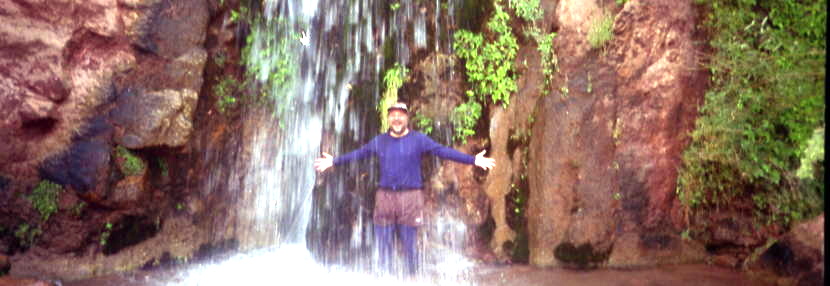
By day we continued downriver, playing in waterfalls, hiking the edges of sheer cliffs
and in general doing everything our inner 12-year-olds desired.
Ted and I shared a tent for the remaining nights to Whitmore Wash. He generally hit the sack
before I did; I spent the evenings with Matt, Larry, Carol and
Virginia discussing metaphysics, perception, illusion and reality.
Rusty kept to himself.
One night we discussed hypnosis. When I
mentioned that I knew how to hypnotize people, Virginia suggested I
hypnotize Carol.
"Why me?" Carol asked.
"Because you have a
bizarre fear of thunder," Virginia promptly replied. "Something must
have happened to you to cause it."
Carol took a heavy breath. "I'd
rather not know," she said.
"But knowing what it is could free you
from it!" Matt pointed out. "Just think—you could go through the
rest of your life, not fearing thunderstorms at all."
"It is tempting," Carol admitted. "But, in the end—I would have to recall
whatever it is that's so awful my mind has suppressed it. Storms
don't last. That memory, whatever it is, would. I'd just rather not
know."
The last day before we reached Whitmore Wash, I rode with
Tony. The canyon had opened up at this point, far-ranging vistas of
rising hills having replaced sheer walls. Tony pointed to one of the
hills. "It used to be," he said, "that whenever we came to this
point, we could see the sun glinting off some kind of metal. So we
used to say it was a plane wreck. One day, a group of government
scientists reserved an entire expedition for themselves. No
civilians, and we boatmen weren't allowed to talk to them."
"That must have been boring," I remarked.
"It made for a quick trip,"
Tony replied, "because we didn't do any hikes—just rowed. When we
got here, the scientists told us to wait for them. They went hiking
toward the metal. A few hours later, a helicopter flew overhead and
landed in those hills. Only one of the scientists came back to
the boats, and he told us to leave, that they were all flying out.
We'd been rowing hard so we took our time. Just as it was getting
dark, the helicopter took off with some kind of cargo lashed under
it, wrapped in a black tarp."
"A flying saucer?" I guessed.
"I have no idea," Tony insisted. "I only know what I told you."
"Was Rusty on that trip?" I asked.
"Rusty?" Tony sounded surprised. "He
doesn't really work for O.A.R.S., you know. He's just friends with
George, the owner."
"But was he on that trip?"
Tony's brow furrowed. "Y'know…he might have been, at that."
That night Tony and Anne played some '60s rock 'n' roll on their cassette
deck while we danced. Turtle, who usually spent evenings in his
personal space on his raft, drank a six-pack of beer and suddenly
showed up on the "dance floor"—a level section of beach. To our
surprise, he started break dancing! Whirling around and around on
his forearms, spinning on his back, flipping over and over. The rest
of us just got out of his way and stared in amazement. When the
music ended we applauded. It was quite a display of strength, skill
and talent. He staggered away from us, stood at the edge of the
river, threw up, then returned to his raft.
We followed the dance with an impromptu talent show, featuring Mike's
recitation of The Shooting of Dan McGrew and Larry's stand-up routine. I
recited my mother's poem
Pa And The Camera.
Then General Butch, who had regained use of his legs, stood and praised Robby for
his "outstanding leadership qualities."
"It's one thing," General Butch said, "for a man to
direct his men by shouting instructions at them. It's quite another,
and a rare trait this is, for a man to have so carefully trained his
crew that they know what he wants them to do without having to say a
word. So, 'General' Robby, we salute you!"
That night in our tent, I asked General Ted if he still thought that Robby "led" the boatmen
in some sort of chain of command. "I listened to what you said the
other night," he replied. "And I've watched. I think you're right.
They all know what to do so well and they're so motivated that they
truly don't need direction. But you'll never convince Butch of that.
The chain of command has been his whole life. Real or illusion,
he'll never see the world in any other way."
Just like Carol, who preferred her traumatic memories hidden. Just like Tony, who
preferred the fantasy world in which everyone is heterosexual. Just
like Virginia, whose illusion of blindness affected others no more
than her own illusion of capability influenced her.
We all have our illusions, and they effectively screen the reality that lies
behind them from us. Was my being an "abductee" also an illusion?
And, if so—what reality was the illusion hiding?