|
By: Paul S Cilwa |
Posted: 3/21/2006 |
|
Page Views: 6,900 |
| Hashtags: #AlienAbductions |
| All the thoughts that go through one's head the morning after their first conscious abduction. |
| Estimated reading time: 9 minute(s) (1980 words) |
Every abductee I know divides his or her life into two parts: The part
before the night they realized they were being abducted, and the part after.
In my case, I couldn't sleep for three days, and then it was only with
the aid of a prescription my doctor gave me. And I had suspected, thanks to my general research
on the subject, that this was happening to me. How badly does this shatter folks who did not
have any suspicions in advance?

Whenever a paradigm shift hits a person, the usual pattern of processing it
is: denial, anger, bargaining and acceptance, just as we
experience with terminal illness or the realization that
Ugly Betty has been canceled. Although most people cannot remain in
denial once that first conscious contact has taken place, some do. Most,
however, advance quickly to the anger stage.
How dare they? you ask. Break into my home? Violate my body? How
can they be "advanced" aliens and have such horribly bad manners?
The key here is that they are aliens. It's unrealistic to expect them to have read
Miss Manners' Guide to Excruciatingly Correct Behavior prior to their
visit.
I enjoy the various Star Trek TV shows and movies
as much as anyone more than most;
but the "aliens" portrayed in this franchise are misleading. For starters, they are
virtually all portrayed by human actors in costumes and makeup; so they can't look that
very different from us. Secondly, none of them behaves in a truly
alien way. The differences they display are portrayed as cultural
differences, and mild ones at that. The most severe example I can think of was a
species visiting the Enterprise that would only eat live prey…and
Commander Riker refused to supply it, insisting that they settle for food from
the "replicator" that tasted "freshly killed". I wonder how he'd have
dealt with a species that was compelled to remove and examine his eyeballs?
It turns out it's really hard for most people to put themselves in a
mindset where they can see things from an alien point of view. And yet,
our only hope of understanding what their visits mean, is to do just that.
Try putting yourself in the position of a lion in the jungle. Every once in a
while, while hunting, you feel a sharp bite in your shoulder or hip, but when
you look, there's nothing there. Well, except for that one time last year you
found a small shiny twig that looked like frozen water stuck there. Moments
after each of these mystery bites, you get dizzy and can't stand or even move.
You are terrified, but there is nothing you can do. You get sleepy and things
seem like a dream. As you are falling asleep (still terrified!) you think you
see several oddly-skinned two-legged creatures advancing on you. When you awake,
they are gone, but now your ear feels funny and when you feel of it with your
paw, it is sore and there is something stuck to it that has never been there
before.
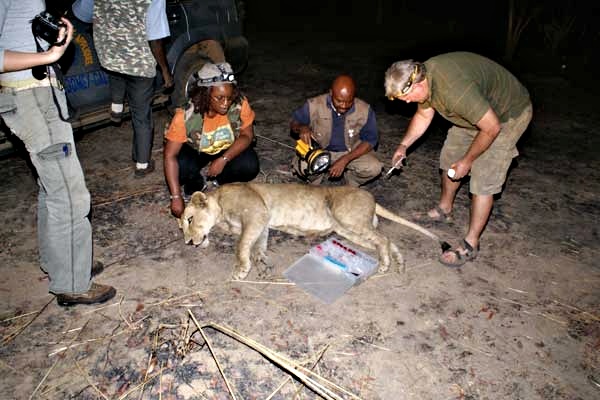
You, a human reading this, understand that the lion has been tagged and is
probably part of a program designed to prevent his species' extinction. But not
only doesn't the lion realize that…he cannot realize that. Ever. I'm
not saying that lions are stupid, just that the entire concept of species
extinction is probably too far beyond his experience and world view for him to
comprehend. All he knows is that he was attacked in some strange way, by strange
creatures, and he would have fought back if he could.
Which leads us to the next, inevitable question: Why don't the aliens just
ask? We'd be happy to cooperate if they'd only explain and ask!
But these are aliens. Can they ask? Perhaps the lion would cooperate,
too, if we would just ask. But I know of no zoologists who speak lionese.
But, surely the aliens can see that we're intelligent! They
must understand we'd listen if they talked to us!
This question shows how deep our human-centric view is. It assumes
that any intelligent species—our own, or space-faring
aliens—must communicate verbally. And it assumes the technology
we've built must be interpreted as a sign of intelligence, in spite of the fact that our technology
has all but destroyed the ecology of our own world, and that other earth
creatures have technologies of their own that we refuse to recognize. For
example, African termites build cities that include central heat and air
conditioning. And every time you catch yourself saying something like, "Yeah,
but they're only bugs," remember that the aliens might be saying, "Yeah, but
they're only mammals."
Now, I'm not saying we cannot communicate with the abductors, or that they
are not attempting to communicate with us. What I am saying is that, for
us to communicate with another species, we must understand that they are
another species. Genetically speaking, you and I have less in common with your
average extraterrestrial than we do with an ear of corn. So be aware that their
methods, their messages (if any), and their manners are simply not likely
to correspond to anything you ever heard of before. Anger based on the fact that
they didn't knock or send an engraved invitation, therefore, is fruitless and
misplaced.
There are two kinds of people in this world: victims and rescuers. Victims
are the ones who expect government assistance, alimony, inheritance, and divine
intervention. They always react to situations; they never make things happen.
Their idea of building for a better future is buying a lottery ticket twice a
week. Rescuers, on the other hand, provide assistance to victims and are
generally proactive instead of reactive. They make things happen, or
respond so quickly to unexpectedly changing situations that it seems like
they made them happen, too.
Some rescuers are prodded into victimhood by circumstances so overwhelming
that not even they could turn it to their advantage. But this is rare. As the
saying goes, "What doesn't kill you makes you stronger," and that applies to the
abduction experience as well. While some people will promptly use the abductions
as an excuse for every problem in their lives, most abductees I've met consider
that there's got to be a way to turn this situation into one that is
advantageous. Let's figure out what that might be.

Of all the species on Earth, there is just one thing at which we humans do
truly excel, and that is interacting with other species. We have domesticated
more different species than any other beings on Earth. Sure, there are some bee
species that keep pets and ants have their herds of aphids. But we have tamed
bees and dogs and cattle and horses and pigs and on
and on and on. We've even tamed some species of bacteria! So if any species on
Earth stands a chance of "domesticating" the aliens, it is most likely us.
To figure out a way to "tame" the aliens, we should look at how we've tamed
other species; and it all boils down to this: we never teach them anything truly
new; we just learn to take advantage of (and perhaps trigger on demand) their
natural behaviors. For example, wolves are social animals; and it just happens
that human society is structured much like wolf society. So dogs (the human-bred
descendants of wolves) behave in a pretty normal fashion with us. Successful dog
owners know they just have to demonstrate "who's boss" when the dog is a puppy.
In dog terms, the human is setting him or herself up as "alpha dog" in the
family "pack". But there are people in Indonesia, for example, who've discovered
that when baby geese are hatched, they accept the first thing they see as their
"mother". So the farmer makes sure he is the first thing they see. As
they grow the goslings follow him anywhere. Since their natural following
behavior requires "mother" to have a tail, as the farmer walks the geese to the
field in which they will be feeding that day, he carries and waves a leafy
branch behind him to serve as a fake tail. It works perfectly and the goslings
happily follow "mother" to the field. When the geese have grown, they still
allow the farmer to lead them to eat the leftovers from his rice paddy.
And, later, I should add, to market.

I deduce from this that we must learn what we can from the aliens' behavior,
and then see if there are any clues we can use to get their attention.
Their treatment of us has been compared to the treatment of lab rabbits by
technicians. The technicians are as gentle as possible as they do their work,
which may include putting perfumes or detergents in the rabbits' eyes. Then they
put the rabbits back in their cages. They do this because rabbits are, well,
"just" rabbits. With the exception of Bugs Bunny, we don't hold rabbits in much
esteem. But you can bet that if a rabbit started whistling "Dixie", or sculpting
a picture of Paris Hilton out of its Purina Rabbit Chow, that that rabbit
would get the technician's attention.
Dealing With Fear

A totally separate issue is the terror of an
abduction. This is real and seems to be a physical effect of the
aliens' presence. Fortunately there is a fairly simple method of
dealing with it.
First let me tell you how I did it. (Another abductee has passed on a
better method, which I'll share in a moment.) My technique (which the other
abductee says is too scary for most people) was to lie in bed, recalling the
aliens coming through my walls. At first I was, indeed, uncomfortable, as I had
been originally. Okay, I'll admit it: I was terrified. My heart pounded and I
developed a flop sweat just at the thought. But I "played back"
the mental tape repeatedly, until it was no longer frightening…just boring.
The better method is to add a level or two of indirection: in your mind, instead
of reliving the event directly, imagine watching yourself watching a movie
of the event. In your mind, you do not see the event itself; you are just
watching yourself watching it. It was a surprise to me that this technique
works at all; but it does, and with no discomfort. It removes the emotional
content from any memory—not just bad memories; so don't practice on one
of your happiest moments! But it will take the terror out of alien encounters as
well as it will defuse your feelings about the time your mother-in-law walked in
on you and your spouse just after you had fastened the chains and were emptying
the can of whipped cream.
Part of your fear may stem from the fact that you know something's
been happening to you, perhaps for years—but you don't know what. That implies a
lack of control that pretty much anyone would find frightening. You may feel a
great need to get those missing memories back, as I did, and that's what we'll look at
next.