|
By: Paul S Cilwa |
Posted: 10/25/2011 |
|
Page Views: 7,636 |
| Hashtags: #OCD #Jason |
| in which I discover Jason has OCD. |
| Estimated reading time: 16 minute(s) (3755 words) |
I originally wrote this with all the gory details; but that's not
really fair to Jason. So let me cut to the chase: Jason has OCD
(obsessive-compulsive disorder), and his obsessions revolved around
me.
It's been about a year since Jason and I met.
Any time two people become a couple, there are bound to be
disagreements and jockeying for positions on important topics. The
first that I recall with an odd aspect was when Jason told me we
had to have a joint bank account. Only a joint account.
Now, there's nothing odd about a person having an opinion on this
subject. My opinion was formed by being burned more than once by a
spouse who couldn't manage finances, so that I wound up being
responsible for hundreds of dollars a month in overdraft
fees. And I explained this to Jason. But the thing is, and this
became clearer to me in retrospect, although we seemed to be
having a discussion, it really wasn't one. In a discussion, people
share viewpoints, offer alternatives, compromise, and come to an
agreement. But Jason wouldn't budge an inch. Not even my suggested
compromise that we keep individual accounts and a joint
account for common expenses was accepted or discussed. And not even
agreeing to disagree for the time being was permitted. Jason simply
wouldn't stop hammering at me that we must have a joint
account, and only joint accounts. Moreover, he put the
ultimate threat on it: He claimed this was a core value to him, like
monogamy; and if I didn't share this value, he would have to leave.
So I asked myself, since Jason obviously feels so strongly about
this, do I? And I decided it wasn't that important to
me. So I gave in.
Other issues came up in subsequent days. Some were big; some were
(in my opinion) silly. Not yet seeing a pattern, I treated each as
an independent event, yet each time there was no compromise and no
letting up until Jason got his way, even when the argument extended
over a period of hours. And each time I decided that this particular issue
wasn't, after all, worth losing him over, so I gave in.
Now, the weird thing is, Jason wasn't always like this. We
could have normal conversations about where to eat, where to camp,
what movies to watch. It was just that, out of the blue, Jason would
announce that there was some specific thing that I had to do, or
swear not to do, or he would leave. And I loved him so much, and
wanted to please him; so I kept surrendering to his increasingly
irrational demands.
Then, in January I contracted
necrotizing fasciitis (flesh-eating bacteria) and nearly died.
Jason stood by me, though we'd been together less than two months;
and remained with me loyally afterwards, despite my resulting
disfigured leg. However, my illness (and near death) traumatized
him, and he started drinking again, a habit he'd broken before we
met. Jason was not a pleasant drunk; he would say cruel things to me
and not remember them in the morning. Finally, I had to send him to
an addiction recovery program for 30 days. That was the first time
I asserted what had to be, or I would have to leave. Jason went into recovery and completed
the program; and in celebration we took a vacation to Maui.
I've described the
good parts of the trip,
but I left out the arguments over odd things,
like the time I watched a guy on a boat try to make his way up a
ladder with a tray of coffee cups. I was sure he would spill at
least one. But Jason was certain I was "checking that guy out." And, again, he
wouldn't stop fighting with me about it for at least an hour. And
this sort of thing happened every day we were there. And
almost every day afterwards, as well.
So, why did I stay with him? Because I still loved him, but also
because he'd stuck with me through my (at that time, so far) three months of
hospitalization, and afterwards took care of me by changing my
dressings, maintaining my Wound Vac, giving me injections and oral
medicine, and so on. So I figured I owed him, and was also convinced
that it was just an aftereffect of getting sober, something we'd
been warned about at pretty much every AA meeting we attended. We
were told that most alcoholics suffer about six months of severe
mood swings after they stop drinking, and I decided I could tolerate
that if it meant getting back the man with whom I'd fallen in love,
at the end.
Once in a while there'd be a day that was wonderful. But
few days passed without at least an hour's fuss, and many days the
fuss lasted more like eight hours.
The rules I had to follow became voluminous. I could shower with
Jason when he got up for work at 3:30 in the morning, but not by
myself. I could not go to the apartment pool or Jacuzzi without him,
even while he was at work. I was not allowed to refer to "his" car
or even "my" kids. Everything had to be "ours", even my
children, the youngest of whom is older than he is.
And then there was the texting. It was continuous, starting from
the time I woke up (or earlier, if Jason got upset when he
got up; if he was upset, I had to remain awake to "reassure" him).
On most days he would text me every time he went on break; and if I
did not respond within a minute or two, he would become convinced I
was having an affair while he was at work. As a result I couldn't
get a thing I wanted to do, done. I gave up even trying to
write blog entries.
Then there was Facebook. Being in love, I would post little notes
to him, like "Jason is my one, true love!" But
every time I tried to do this, Jason would become incensed over the phrasing. In
that example, he would complain that I hadn't added "and will be,
forever!" As a writer, I resented being told my words were
inadequate. But unless I changed them, Jason would continue to
argue, first via text, and then in person when he got home from
work. And often, even when I did change them to his
specifications, he would then complain bitterly that he shouldn't
have to tell me what to write! He also complained about the
captions I put on photos, and any time I commented on or "liked"
something anyone else said or did. As a result I mostly withdrew
from Facebook activities and thus, from my friends and family, since
we'd been using Facebook as a primary means of keeping up with each
other.
Yet, after every fight, Jason would apologize, crying, explaining
that because he was an orphan, his big fear was losing me. And the
one time I pointed out that this kind of behavior was driving me away
was followed by a fight lasting eight hours, which ended
only when I swore that I would never leave him.
The swearing was also odd. I couldn't just say, "I swear" or even
"I swear to God." It had to be, "I swear to God and on Zach,"
the name of my (excuse me, our) grandson. The argument could
not end until I had done so. I was required to make this oath at
least 30 times a day.
One day (after an embarrassingly long time of enduring this), it
suddenly occurred to me that this rigidity of phrasing suggested
some kind of compulsion. I had heard of something called
obsessive-compulsive disorder, usually abbreviated OCD, whose
victims were compelled to check light switches repeatedly, or could
not step on a sidewalk crack. Somehow I made the connection, and
asked Jason, "Are you sure you don't have OCD?"
It turned out he had been diagnosed with OCD about four
years before. His then-partner had come down with a serious illness,
as I had; and Jason had nursed him back to health, as he had me. But
in addition to his nursing chores, Jason became obsessed with
checking the stove, the door locks, and even the aquarium hoses. He
was convinced that the hoses were loose and would flood the house
while he was away. Even after checking them, he was still
convinced there was danger and he would have to check them
again. It rapidly got to the point where he
couldn't leave the house unless his partner did the checking while
Jason waited in the car.
Jason had seen his doctor (neither a psychiatrist nor psychologist),
who prescribed a drug called Lexapro. Although Lexapro is not
approved by the Food and Drug Administration for treating OCD, there
have been reports of its being used with success. And Jason's
symptoms were relieved. He no longer felt compelled to check
and recheck the aquarium hoses. He was still taking the Lexapro when
we met, but simply told me it was for "anxiety", as his doctor had
told him OCD is a manifestation of clinical anxiety.
The doctor was wrong, as I learned as I started to study this issue in
books and online. Jason and I had seen a therapist (for couples
counseling) who did not recognize Jason's symptoms as being
those of OCD. However, when I
suggested it in our last meeting with him, he recommended a book
that turned out to be a Godsend:
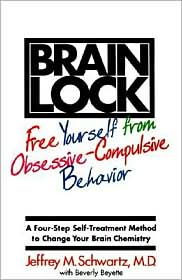
Brain Lock by Dr. Jeffrey Schwartz of UCLA. The book's
subtitle is "Free Yourself From Obsessive Compulsive Behavior", so
we ordered a copy from our library, which had to get it from an
interlibrary loan.
The book, which is a surprisingly easy read despite the serious
subject, explains in clear detail how OCD works and how it can be
dealt with without drugs, using
a simple four-step behavioral modification technique.
Dr. Schwartz uses an automotive analogy to describe how an OCD brain works, but I will
use an analogy of my own which is clearer to me, at least.
Deep inside the brain is the amygdala, sometimes called the
"reptile brain" because it is a structure we inherited from our
reptile ancestors; in them, it is the whole brain. Its job
is to identify dangers and pass them on to the neocortex (another
structure mammals possess but reptiles do not). Think of any thought
as being analogous to a paper form you might fill out, for example
to apply for a driver's license or on your first visit to a new
doctor. Each field on the form might have a label such as
"Description", "Suggested Response", "Urgency Level", "Fear Level"
and so on. If you are driving and the traffic light you are
approaching turns red, the message from the amygdala might look like
this:
| Description: |
Red Light, danger of getting traffic ticket |
| Suggested Response: |
Step on brake quickly |
| Urgency Level: |
5 (out of 10) |
| Fear Level: |
3 (out of 10) |
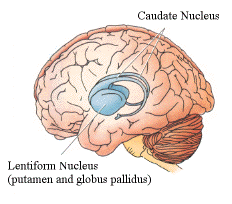
This message is handed over to a structure called the
caudate nucleus, which
is basically an error-checking device that makes sure the message is
valid before passing it on to the neocortex, the part of the brain
that actually thinks. In most cases, the neocortex will
follow the suggested response; but suppose you were rushing to the
hospital because your wife was in labor. You'd have the option of
overriding the suggested response, especially since the urgency and
fear levels were relatively low. In addition, you'd have
another message with a higher urgency level, that you needed to
get to the hospital, pronto; that not doing so would actually be
more dangerous than getting snapped by a traffic camera. It's all
very logical and well-designed, and it's a mechanism that works
perfectly (in most of us) thousands of times a day.
However, in persons with OCD—most estimates are around 4% of the
population—the caudate nucleus does not work properly. Like
any signal-producing mechanism, the amygdala produces a more or less
constant level of noise, which can only be distinguished from a
valid thought by the caudate nucleus, in the way that you could tell
the difference between a doctor's new patient form filled in by a
new patient, and one scribbled on by a deranged monkey. When the
caudate nucleus fails to perform its function, the garbage "thought"
is passed on to the neocortex, which has no built-in mechanism to
error check on its own.
The message might then look like this:
| Description: |
XXXXXXXXXXXXXXXXXXXXXXXXXXXXXXX |
| Suggested Response: |
XXXXXXXXXXXXXXXXXXXXXXXXXXXXXXX |
| Urgency Level: |
288726374823 (out of 10) |
| Fear Level: |
665748347237377384 (out of 10) |
Thanks to the ridiculously high urgency and fear levels (which
alone, in a healthy brain, would have been enough to declare this
thought garbage and throw it out), the neocortex drops everything
else and devotes itself to trying to identify the presumed danger
and deal with it. The neocortex knows the details of your daily life
and uses these to fill in the noise in the description and response
fields, so the thought might become
| Description: |
I left the stove on; the house might burn down |
| Suggested Response: |
Check the knobs |
| Urgency Level: |
288726374823 (out of 10) |
| Fear Level: |
665748347237377384 (out of 10) |
It's hard for a person with a healthy brain to appreciate the
agony an OCD sufferer feels with such high urgency and fear levels.
No normal person could experience this, because no healthy caudate
nucleus would ever allow such a "thought" to get through. But the
OCD sufferer can literally not ignore the thought, or indeed have
any other thought while this one is being processed. The
world comes to a standstill as the sufferer checks the stove knobs.
And since checking them, for a normal thought, would reduce urgency
and fear by, say, at most a value of 10, in this case the knobs must
be checked over and over and over, until finally the fear and/or
urgency are reduced to zero. Only then can the sufferer continue
with the real concerns of the day, like driving to work.
Each time this happens, pathways in the brain form to anticipate
it; and this causes the neocortex to continue to fill in the
description and response fields with the same invalid values. So the
OCD sufferer continues to check the knobs on the stove every time
a garbage thought passes through the defective caudate nucleus.
But what if the sufferer is looking at an aquarium when the garbage
thought arrives? The neocortex might then believe the aquarium is
about to flood the house, and be compelled to check that, instead of
the stove.
And what if the sufferer, a person who has actually lost his
father, mother, and grandmother—who has, literally, been abandoned
by everyone he ever loved—falls in love with someone? The real fear
he might lose yet again someone he loves dearly, provides the
context for the next garbage thought that comes in:
| Description: |
My husband is going to leave me |
| Suggested Response: |
Get a list of everyone he's ever slept with |
| Urgency Level: |
277623722388888 (out of 10) |
| Fear Level: |
444444242424242 (out of 10) |
Note that this description and response bear no logical
relationship to each other. This is common in OCD. A frequently
reported obsession, for example, is that the OCD sufferer will
somehow cause the death of children in some faraway place if he or
she doesn't perform some ritual, like avoiding the cracks on the
sidewalk or washing their hands. Virtually all OCD sufferers know
that the description and response are irrational; yet the fear level
is so high they simply cannot resist performing the ritual, anyway.
Since in extreme OCD, obsessions ("garbage thoughts") get through
a thousand times a day, and each one brings life to a halt until the
compulsion defuses them, the tragedy of OCD is that it literally
blocks the sufferer from living his or her own life. Hours of every
day spent checking locks or making irrational demands of an innocent
loved one, not only suck the life out of the sufferer, but from his
or her family when they are co-opted to assist in performing the
compulsions.
It is, of course, inevitable that the uninformed partner respond,
when obsessions occur, by saying, "Well, just don't think that!"
But they don't understand the real, intense, desperation and physical pain
the sufferer must endure until the compulsion is satisfied.
Now we come to the secondary damage associated with this disease.
Any OCD sufferer who isn't a hermit, inevitably gets those around
him or her to participate in performing the compulsion. Since the
sufferer's friends and family want peace, they usually give in. But
every time they do, they reinforce the brain pathways that fill
in the garbage thought's fields, thus making the problem even
worse. And that's what I was doing when Jason demanded a list
of everyone I ever slept with, or that I change my Facebook posts,
or that I not shower without him—and I complied.
Yet I felt resentful; and my resentment mounted each time another
part of me was whittled away to quiet Jason's outbursts.
Finally, last Thursday, I reached my limit. At 3:30 in the
morning, as Jason and I were snuggling together in bed waiting for
the alarm to go off, Jason suddenly began making more demands. He
would not let me go back to sleep, still yelling at me as he left
for work.
I finally realized, with horror, that I was the one making
Jason worse, due to my inability to "just say no" to his demands.
I was Jason's obsession. It was as if Lois Lane were made of
Kryptonite. It wouldn't matter how much she loved Superman; if they
tried to remain together, Superman would die.
There is nothing harder for me to admit, than that I
cannot fix something.
Sobbing, I called my daughter, Jennifer, who sacrificed a day of
work to come to my rescue. She enlisted my son, John, a friend, Joe, and my
ex-husband and current friend, Michael, to come and move me out of
the apartment Jason and I shared. By this time I was so emotionally
battered I didn't feel strong enough to face him.
We had gotten just about all my clothes and computer stuff packed
when Jason arrived at the apartment. He saw Michael and Jenny; he
saw my expression, and instantly the realization that I was
leaving brought him to tears and apologies. "I'll change!" he swore.
But I knew he cannot just "change", any more than I can
restore my damaged leg just by willing it. In order to be happy with
himself, not to mention a partner, he would have to devote months to
learning and practicing the techniques described in Brain Lock.
And, even then, there's no guarantee. Dr. Schwartz claims 80% of his
patients can be restored to a normal, obsession-free life. They will
still have a defective caudate nucleus, but they will have learned
tricks the neocortex can do to recognize and dismiss obsessions. 80%
is an impressive number; but unless Jason can be included in that
80% it won't do him—or me—any good.
So, at this point in time, I have moved back in with Michael for
a couple of weeks and Jason is staying with his ex. Thank the
gods we have such supportive friends that, even as exes, they remain
part of our families and can be counted on when needed.
We have both, by mutual agreement and understanding, decided we
must terminate our relationship to give us time and space to begin the
lengthy process of recreating healthy lives. Jason must learn and
practice Dr. Schwartz's Four Steps,
a process Schwartz says can take eight months or more. He'll also be attending
12-step meetings for obsessive-compulsives.
And I have decided to attend meetings for co-dependents to try and
rebuild my damaged self-esteem.
I still love the person I came to know as "Good Jason".
Tragically, "Bad Jason" came to displace "Good Jason" more and more
as I unintentionally reinforced him. And I know I can never live
with Bad Jason.
After we have both rebuilt ourselves—and we're talking many
months at a minimum, not weeks—it is possible we could meet
as two new people and develop a new and healthy relationship of some
sort. But we cannot plan for this, or even assume it will be
so. For the indefinite future, we must each work on ourselves. If we
cannot be happy with ourselves, there's no way we can be happy with
anyone else.
I have confidence in Jason's ability to learn these techniques
and use them. After all, he's already stopped drinking and even cut
his caffeine intake to zero. I am less sure of myself since there's
no Four-Step program (that I know of) for co-dependents. But I will
devote myself to this with equal fervor.
For the present, however, Jason and I are no longer a couple and
cannot even see each other, as we both know we will fall back into
the same behavior patterns if we do.
The traditional marriage vow includes, "…for better or for
worse." However, it comes from a time long before such concepts as
OCD were even thought of. What happens when the "worse" turns out to
be that the spouses, in their current state, are actually making
the other sicker?
As the old posters used to assert, "If you love someone, let them
go. If they return, they were always yours. If they don't, they
never were."
Only time will tell.