|
By: Paul S Cilwa |
Occurred: 12/1/1986
Posted: 4/23/2026 |
|
Page Views: 160 |
| Hashtags: #Autobiography #WinterthurApartments #PHAMIS |
| My first (and last) taste of management. |
| Estimated reading time: 10 minute(s) (2239 words) |

Now, I hate to admit it, but I seem to have a glitch in the Matrix regarding
exactly where we moved to when we returned to Northern Virginia in 1986.
For some reason, I have a mental image of us moving to the apartment complex I'd lived at
several years previously as a co-operative education student. However,
there's no evidence of this. Somehow I seemed to have gone three years without
taking a single photograph! —which is very odd, because I've never
thrown out a photo, negative or slide. And I have none from that period.
But my kids remember our moving directly into Winterthur Apartments, in Reston,
Virginia. And I have that address in my records. So I have no choice but to
accept that as the truth, even though it doesn't fit with my mental image.
And, in any case, the exact location of the apartment we were in doesn't
really matter. What matters is my memories of what we did back then.
For example, I bought a do-it-yourself entertainment center and asked my son, John,
to help me bring it inside. Now, this was a heavy piece of furniture,
because in those days TV sets were big and heavy, and the entertainment center
was designed to hold our big TV. So John and I are struggling to carry this heavy box
into the apartment, and I'm in front, and I know it's heavy, and then I hear John's
ghostly voice behind me saying, "John! John! Use the Force, John!"
I burst out laughing and dropped my end of the box, so John dropped his
and we sat on the ground laughing. That was the first time I heard John make
a joke, and it was a great joke! As his dad, I was so proud!
Then there was the time we were watching TV, and Karen suddenly burst out laughing
during an episode of Cheers. When she caught her breath, she said,
"That's the first time I got a joke on television!"
Milestones.
After we'd been there a few months, Mary's mother came to live with us.
Her husband had died, and she couldn't really live alone, so we took her in.
To give her a room, we converted the dining room into a bedroom, and we ate
in the living room on TV tables (as so many families did in those days).
And speaking of TV shows, there were two significant moments involving them,
which actually occurred two nights in a row. The first was an episode The Cosby Show,
entitled "The Physical," Cliff (Bill Cosby)is preparing for his annual medical exam, and the
Huxtable kids spend much of the episode teasing him about how little he actually works,
joking that he mostly eats, naps, and hangs around the house.
And my wife, out of the blue, said, "Does that remind you of anyone?" looking at me.
And the kids all laughed with her.
I tried to convince myself that Mary had just been making a lame joke. But the
kids had laughed too enthusiastically for this to have been a new concept for them.
I had to accept that my wife, my children's mother, was literally turning them
against me.
And there was nothing I could do. The whole foundation of my world, the idea that
we, the family, were a team, was shattered. I had no choice but to accept that my wife
didn't see me as a partner, but as a failure. And worse, she was teaching my children
to see me as a failure too.
Eventually I pulled myself together and came back in. The kids were asleep; I'd been standing
in the rain for two hours. We were still married; I wasn't going to destroy the family
over this. But I could never look at Mary the same way again. Now, instead of my
teammate, I had to acknowledge that she saw us more as adversaries than a team.
The next night, UFO Cover-Up? Live!, was broadcast. It was October 14, 1988, and
hosted by Mike Farrell. We all watched that, too. It
was a two-hour televised special broadcast on October 14, 1988, presented as a
live investigation into government secrecy surrounding UFOs and extraterrestrial
contact. The program mixed studio interviews,
pre-recorded segments, anonymous "insider" testimony, and dramatized or grainy
"classified" footage—including depictions of small, shriveled Grey-type beings—to
create the impression of a major disclosure event. It blended legitimate
researchers with sensational claims, featured two masked intelligence sources
known as "Falcon" and "Condor" and attempted to reveal alleged government programs such as alien communication,
recovered craft, and stored bodies. Its unusual mix of earnest presentation and
tabloid-style content made it memorable, controversial, and—for many
viewers—less convincing than intended. Or, as my mother-in-law put it,
"I believe less in flying saucers now than I did before watching that show!"
And I guess I threw myself into my work.
The folks at Arlington Hospital's Information Systems department were the same
ones I'd met on my earlier, three-month contract. Now I was, their manager.
Which wasn't really a challenge; I still did programming for the new PHAMIS system,
and I just had to assign tasks to the other programmers. Jan, for example,
who was a COBOL programmer and so did the COBOL modules.
Jan was very religious, but her husband had her beat. He took a pair of pliers
and removed his own rotted tooth in a field while praying to Jesus to
"regrow" it. (That didn't happen of course, because, as Jan explained it,
her husband's faith just hadn't been strong enough.)
My boss was Chris, but we had at least two other Chrises in the department.
Blond Chris was a data entry guy, one of six people who spent the day in the
adjacent room entering data from paper forms into the computer.
A very nice guy, he had several scars on his arms. I asked about them
once, and he explained that, in his family, when his siblings had an argument,
they would shoot each other in the arms. I had to admit that, at least,
my own sad situation wasn't that bad.
Then came the time I had to do job evaluations. It hadn't occurred to me that this
was part of my job as manager, because my previous jobs had been contracts so
I didn't get "evaluated". But now I had to pass judgement on the data entry
operators.
By the way, I should add here that, when someone called in sick, or the work
got behind, I also would be data entry. And, in so doing, I thought of half-a-dozen
ways to automate parts of the data entry process, which I implemented. So I did
know what the job entailed.
So when I had to do evaluations, I took them seriously. I thought of it as a learning
opportunity for the employees, and I wanted to give them useful feedback. So I wrote
detailed evaluations for each of the six data entry operators, and I was very honest.
But then I had to present each employee with their evaluation. And the first was
Maybelle, a forty-something Black lady who I greatly admired. She knew a lot of
Black history, which I found fascinating. It was she who corrected me when she heard me
use the phrase "Whip 'em into shape!" I had never suspected it was a racist phrase;
I honestly thought it referred to whipping cream.
So when she looked at her evaluation, she was visibly upset. I had not given perfect marks
for anything, because who's perfect? I saw that as meaning there is room for improvement.
Not that she could have done her job better; but I was thinking philosphically.
Maybelle was not. "I've never received less than top marks!" she exclaimed.
You do know this means I won't get a raise this year?"
Suddenly, I didn't see Maybelle in front of me. I saw me, crying in the rain because
someone I loved didn't respect the work I was doing. And I had just done the exact
same thing to Maybelle.
I tore up the evaluation. "You know what?" I said. "You are right. You are doing a great job,
and you deserve top marks. I apologize, no one told me your raise depends on your evaluation.
I was in a bad mood, but I'll make it good. And I thank you for bringing me to my senses."
PHAMIS was a Seattle-based health-information-systems company whose mission
was to build a single, unified, hospital-wide electronic medical record that clinicians
could actually use. Their system was designed around a central relational database that
tied together admissions, orders, results, documentation, pharmacy, and billing in real
time, replacing the patchwork of siloed departmental systems most hospitals relied on
in the 1980s. PHAMIS combined a public-health informatics background with an unusually
pragmatic engineering culture, and the result was a platform that could support an entire
episode of care from a single patient-centric record.
PHAMIS stood for Public Health Automated Medical Information System. Originally
developed for the state of Oregon, the company was now in its most ambitious phase:
rewriting and modernizing the system for full-scale deployment, adapting it to each
hospital's infrastructure, and proving—site by site—that a comprehensive
electronic medical record wasn't science fiction but an achievable, working reality.
The biggest change, of course (and the reason I'd been hired) was they were rewriting
the whole thing to run on Tandem NonStop hardware, which was the most robust and reliable
platform available at the time, as well as my special area of expertise.
We spent many months porting the system to the Tandem, and the PHAMIS team was not
the most competent in the world. The lead PHAMIS programmer was a guy named Miles
who was his own biggest promoter. He became famous for his catchphrase: "Do you want me
to explain it, or do you want me to fix it?" Sadly, he was seldom able to do either,
and Chris eventually had to ban him from the live system.
And then, just before we went live, PHAMIS decided to change the system's name.
Did they go with something more marketable? Something more descriptive?
Nope. They decided that, since their system was the "last word" in hospital
information systems, they would call it "Last Word".
Which I think shows how little the PHAMIS folks considered what hospital
patients might think of a system called "Last Word". I even tried to point out
to them that, when patients heard the name "Last Word", they might think of death,
and that this might not be the best association for a system that was supposed to
be helping patients. But they were so enamored with the idea of being the "last word"
in hospital information systems that they didn't care about the potential negative connotations of the name.
Not even after I made a meme (we called them "cartoons" back then) pointing it out.
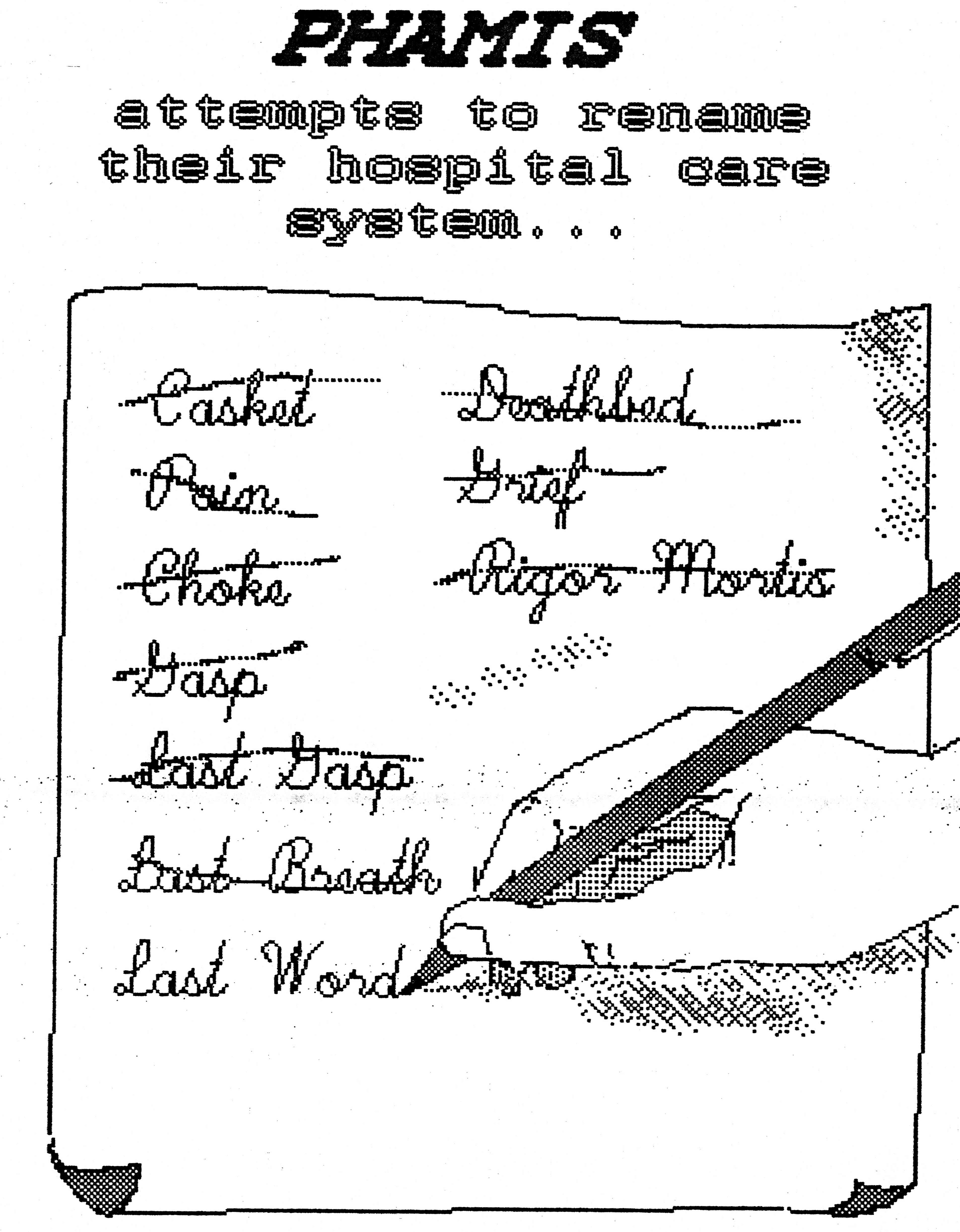
Then there was the president of the hospital, who Chris didn't think much of.
In fact, observing him wandering aimlessly along the corridors, Chris
referred to him as the Walking Dead Man. (Not to his face, of course!)
I'm not sure I even met him, certainly not more than once. But he got my ire
up when he decided to implement a dress code, even for people like us programmers
who were never seen by the public. I had something to say about that, too.
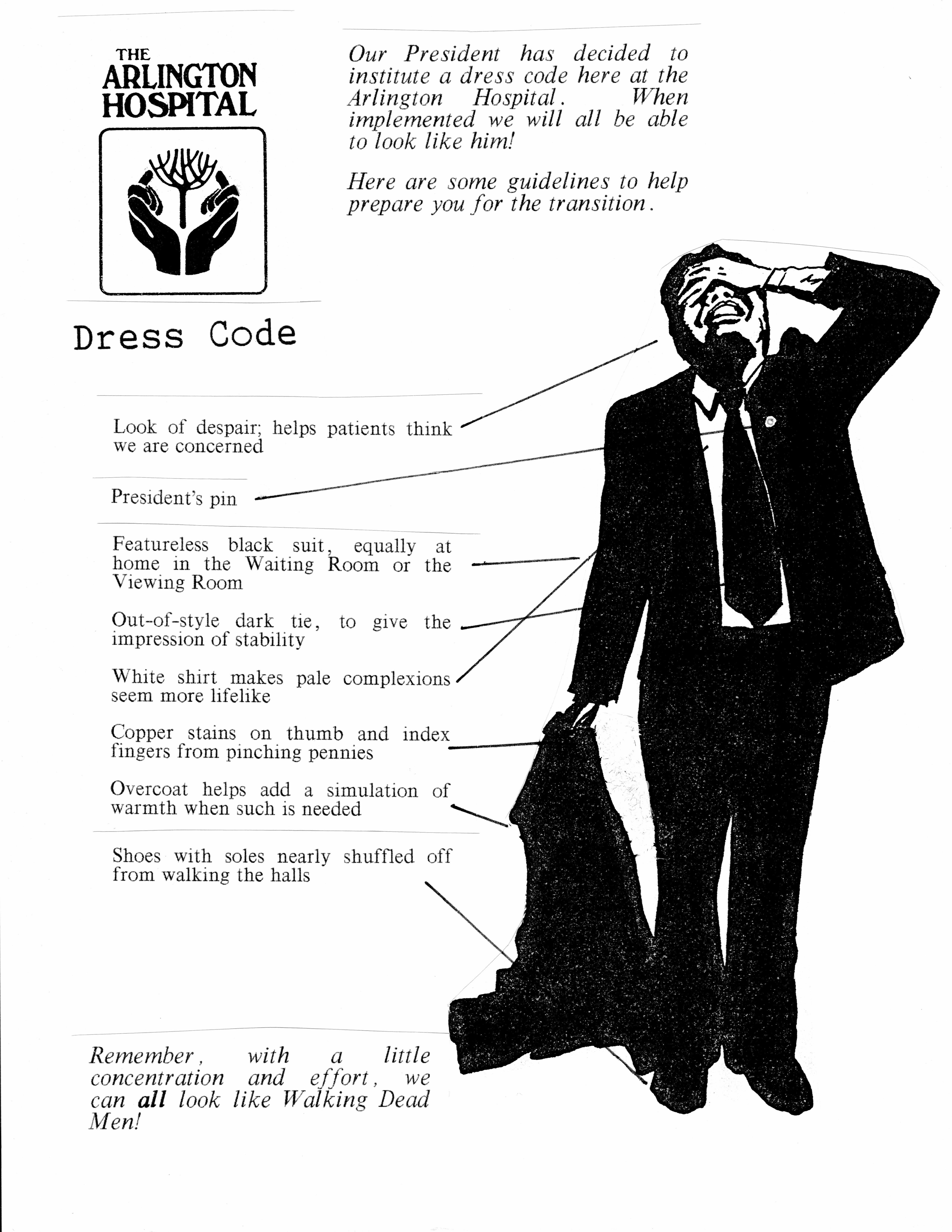
Looking back, that was a heck of a busy year, which does explain the lack of photos.
Several times we had to put in more than a 24-hour day. I slept under my desk at least
twice. Eventually, I got so sleep-deprived that I developed a migraine so bad Chris
had the emergency room see me. They kept me overnight, but at no cost whatsoever, so
at least there was that.
And somehow, in between I began to develop the idea of a 100% object-oriented
operating system. Windows was just introduced—one of the programmers
had demonstrated Windows 1.0 to us—but I thought the idea of having to run
"programs" to do things to documents, instead of doing them directly, was not
one that non-programming people would easily adapt to.
Chris and I had become close friends, and he and I talked over this idea a lot.
I had also just written for the hospital, a program to handle report distribution.
Chris suggested that it might be made more general, and could possibly be sold
as a product. We decided to create a new company, which Chris called Adventech,
and we would use it to develop and sell this new product and also work on the
operating system.
And so a new adventure began.