|
By: Paul S Cilwa |
Occurred: 12/25/1956 |
|
Page Views: 981 |
| Hashtags: #Autobiography #Christmas |
| How to teach a kindergarten student to distrust authority. |
| Estimated reading time: 9 minute(s) (1926 words) |

It had been more than a snowstorm; this year another blizzard had hit, dumping
maybe two feet of snow. Our gritty little New Jersey street had been turned into
something white and magical. The gutter, which always had water flowing along
it, was frozen solid. Snowplows had created huge white hills along the road for
climbing and sliding down. (Something we could do without harm since, in those
snowsuits, if we'd been dropped off a building we'd have just bounced.) Joined
by our friends, the Galluccios from two doors down, we slipped and slid and spun
and rolled, laughing ourselves silly.
I was in kindergarten and the next Monday I had to walk to school in the same
overblown suit. The principal of the school, a stern-faced nun with a hair that
grew out of her nose and who was called Mother Superior, came to our classroom
and announced that we would all participate in the Christmas play. She didn't
bother to explain what a "play" was, and no one dared ask. We simply followed
her to a large room with a raised floor on one end, and hundreds of chairs at
the other. She pointed at one kid and told him he would be "Joseph" which made
us laugh because his name was Bobby. Then she told Flora, the girl who peed on the
fence during recess, that she was to be "Mary." We began to worry. We'd had no
idea that Mother Superior could change our names. I was pretty sure that my
parents, who had named me after my grandfather, wouldn't stand for it.
However, when Mother Superior pointed at me, instead of renaming me
she said, "You are to be the orchestra conductor." Now that
was a real surprise. What orchestra did she mean, and why did
she want me to take it somewhere on a train? However, I kept quiet
because I'd only been on a train once and was very excited at the
idea of going for a ride on one again.
At the end of the day I was handed a piece of paper to bring home, which I
jammed into a pocket of my snow suit. It took two Sisters to get each of us
re-wrapped for returning outside; finally, we were allowed to waddle into the
brisk air and crunch our way home.
Mommy found the paper as she was
unwrapping me, and read it. "Oh!" she cried. "You're going to be in
the Christmas play!"
"I'm going on a train!" I told her, excitedly. "I'm the conductor!"
She laughed. "No, you're going to conduct the orchestra. That means you're
going to lead them—tell them when to play, and when to stop. You're
supposed to rehearse tonight." So Mommy had me hold a pencil, and she
held one, and we put on a record and she showed me how to mark the
beat with the pencil.
The next day we began rehearsals for the "play." The "orchestra" turned out
to the second graders, who had learned to sing "Hark! The Herald Angels Sing."
And I was supposed to lead them. The beat was simple enough, and when I was
handed a baton to hold, I moved it in time to the beat.

"No! Not like that!" Mother Superior snapped. She knelt behind me, so close I
could feel her starched collar on my back and her breath on my neck,
and gripped my right hand like a vice. It startled me so that I
resisted, and in trying to gain control of my arm, she whacked my
nose with the handle of the baton, hard. Oblivious to this,
she instructed the choir to resume singing and moved my imprisoned
hand in a triangular motion. Finally she let go. "Now, you
try it!" she commanded.
I did, but apparently did not duplicate perfectly enough whatever it was she'd had in mind.
Meanwhile, my nose was growing stuffy and my eyes were smarting. She
descended in front of me and growled, "What's that face
about? If you're going to have an attitude, we can just find another
conductor!" And she did, freeing me to
sit in one of the chairs and wipe the blood now dripping out of my
nose onto my sleeve. I didn't dare say anything about that.
When I got home, Mommy had apparently already been called by the school. "I'm
very disappointed in you," she said. "Your principal told me you made a face at
her. You know better than that."
I held up my bloodied sleeve. "My nose
was bleeding," I said. "She hit me in the nose with the baton."
Mommy frowned. She hated confrontation and to admit the principal was wrong
would have required one on her part—better to just assume the whole thing was
some kind of misunderstanding that would work itself out.
This, of course, left me feeling I was to blame somehow. And that meant I'd
been naughty. Now, I didn't know much about Santa Claus, but
we'd been learning about him in kindergarten. There was a song about
him, how he was coming to town and would know if we were naughty or
nice. I'd already had one mysterious figure
appear in my bedroom; I didn't need another one to show up and
judge me on my poor performance as an orchestra conductor.
I was a little fuzzy who Santa was, exactly. This was before the media had
become saturated with the jolly old elf and my friends seldom talked about him.
I knew he lived at the North Pole, and I knew he wasn't a relative or close
friend of Mommy and Daddy's or we'd have been instructed to call him Uncle
Santa. Since they talked about him in kindergarten, I thought Santa might be one
of God's friends, like Adam and Eve or The Three Wise Men. From going to church
I knew that God was about to have a baby; Mommy took me to see the life-sized
cr?che that had been erected in the church, and the empty little hay-filled
cradle where the Mary statue would put the baby when it arrived. Mary and Joseph
and the Wise Men were already there, and I thought if Santa Claus was a real
friend of God's, he'd be there by now. So, maybe not.
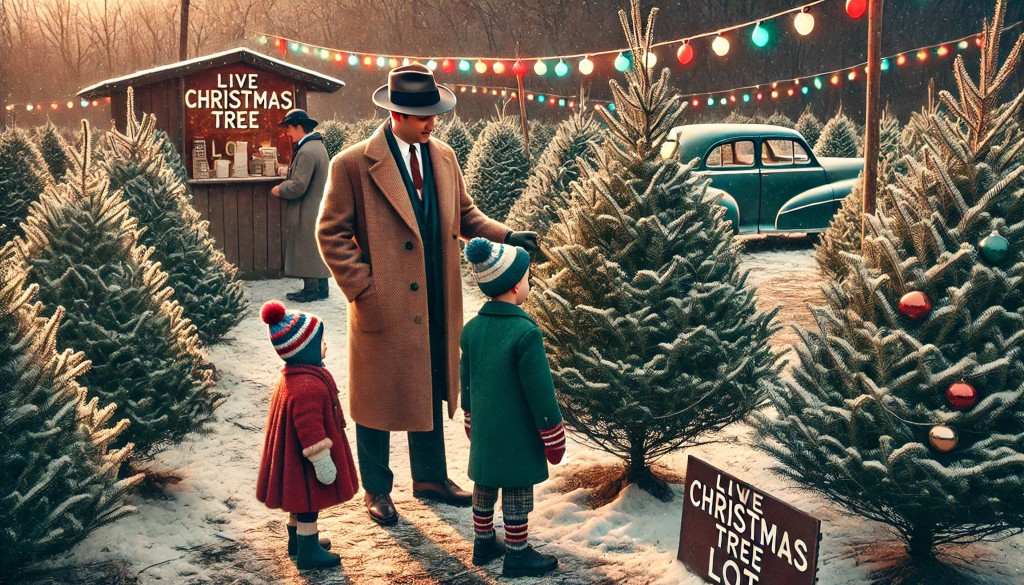
Daddy always took us with him to buy a tree, but his custom was to do this on
Christmas Eve, when the prices had usually gone down. We would come home, our
snowsuits damp and flecked with white, our noses runny from the cold, Dad
carrying the trussed-up fir into a space Mommy had cleared in the living room. The
wooden trunk would be lowered into a red metal bowl that was brought out for the
occasion and three metal screws were driven into the trunk to hold it steady.
Water was then poured into the bowl and my job was to keep water in that
bowl, since I was small enough to get to it without disturbing the decorations.
Every day for the next two weeks I would hydrate the tree, looking with wonder
each morning at the nearly-dry bowl, amazed that a dead tree could drink so
much.
However, on Christmas Eve the tree was not yet decorated. Mommy
explained that Santa decorated the tree for us, and that was how
we'd know he'd come to the house. We had to go to bed early on
Christmas Eve, because Santa couldn't get started on the tree until
we were asleep.
So now I figured Santa was someone they hired
to decorate the Christmas tree, like the man they hired to fix the
roof or the pest control man who came when Mommy thought there was a
mouse in the house.
First, though, Dad read us a book before Mommy put us to bed. My sisters and I
all sat in his lap as he began, "'Twas the night before Christmas, and all
through the house…" There were a lot of interruptions, because we wanted to
know why they hadn't gotten the pest control man to get rid of the mouse whether
he was stirring or not, why the father in the story wore a hat to bed, what
"sugar plums" were, and how, if Santa came down the chimney, would he get into
our house since we had a furnace and not a fireplace.
Eventually, we went to sleep. And, eventually, we woke up. How is it that
little kids are instantly alert on Christmas morning? When I wake up now, it
takes me fifteen minutes to remember what planet I'm on; but that
morning, I was up and running for the tree before I'd taken my first waking
breath.
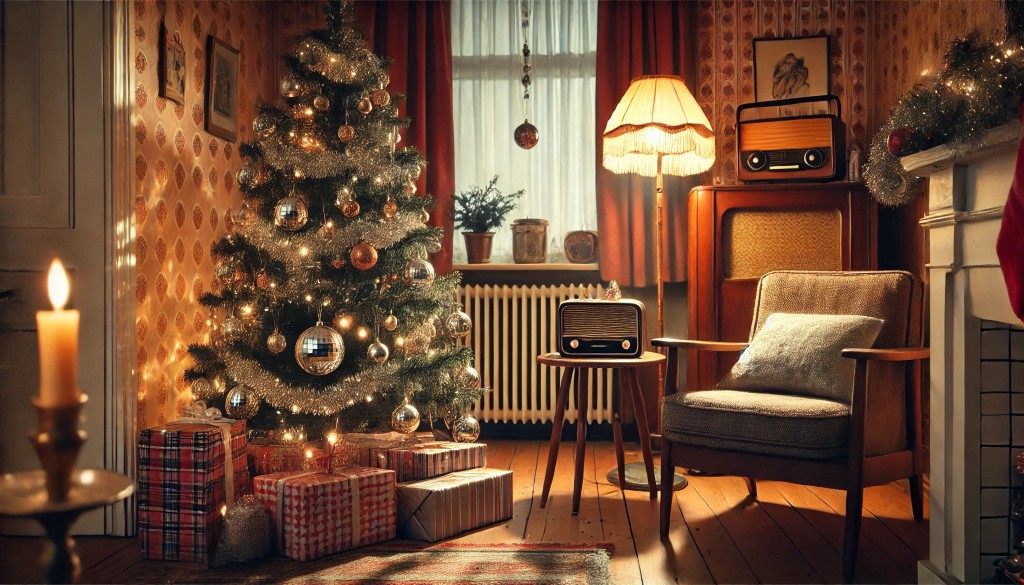
It was beautiful!—All lit up with big colored electric bulbs, and shiny
bright balls and glittering strips of tinsel. And the smell—that wonderful tangy
smell of a spruce in its death-throes. Beneath the tree were wrapped presents,
complete with bows and tape. My little sisters were there, too, four-year-old
Joanie tearing open the wrapping of one of her presents, three-year-old Louise
just hugging one of hers, thinking the pretty box with the ribbon and bow was
the present.
I was just happy to recognize my name on several. I knew the word "to" and
the word "from". I knew "Mommy & Daddy." But who was this
present from? S-A-N-T-A. "Who's this from, Mommy?" I asked.
"That's from Santa, dear," she replied.
To this day, I have no idea
what Santa brought me. I was just so thrilled it was anything,
and that he hadn't held a grudge against me for making Mother
Superior bloody my nose.
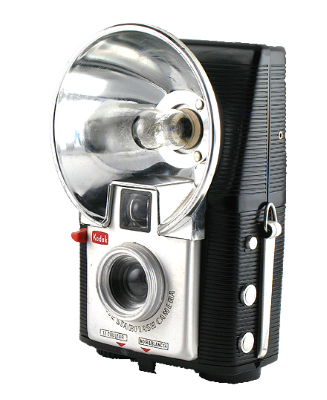
But I remember what Santa brought my mom: A Kodak Starflash camera!
The Kodak Starflash camera, a classic icon from the 1950s, combined
sleek design with practical functionality, making it a beloved choice
among photography enthusiasts of the era. This charming camera featured
a built-in flash, a novel addition at the time, which allowed photographers
to capture moments with improved clarity and reduced blur in low-light
conditions. Its user-friendly interface, coupled with a compact and
lightweight body, made it an ideal choice for everyday snapshots and
family gatherings.
The Starflash was renowned for its ability to produce vibrant, high-quality photos,
thanks to its reliable lens and Kodak's superior film technology. With
its nostalgic appeal and robust performance, the Kodak Starflash remains
a testament to the golden age of film photography, evoking a sense of
timelessness and vintage charm.
Of course, I wasn't allowed to use it. Yet. But almost all the photos of
our years in Vermont and Florida were taken with it…by me.