|
By: Paul S Cilwa |
Posted: 3/29/2026 |
|
Page Views: 251 |
| Hashtags: #ArtificialIntelligence #Cognition #Dogs #NeuralNetworks |
| How AI actually thinks, compared to the human mind and the mind of a dog. |
| Estimated reading time: 10 minute(s) (2259 words) |
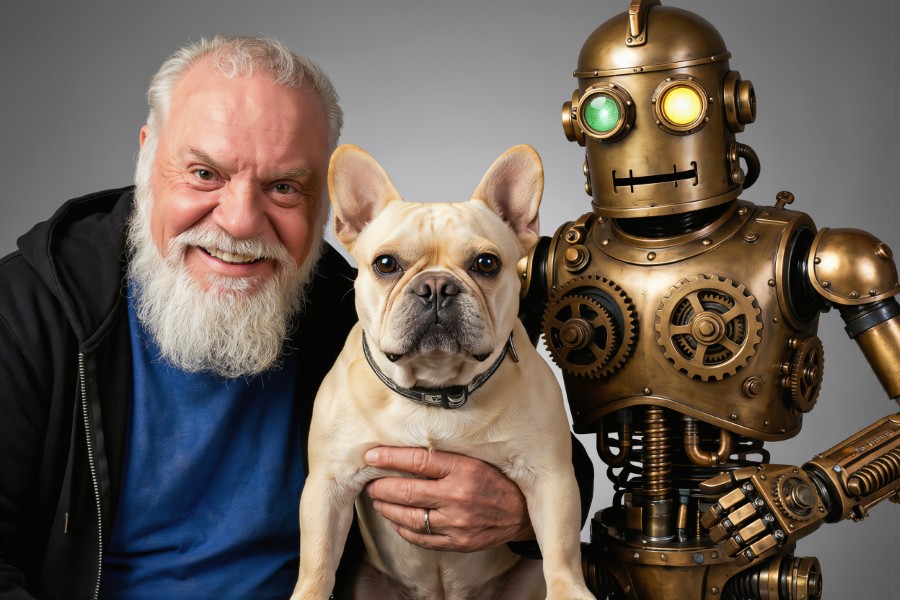
Today's post was a collaboration between Claude (Anthropic's flagship AI) and myself, your
humble 75-year-old author. Remember, I've trained it on my own thousands of pages of articles,
essays and books written by yours truly; so it usually sounds more like me than I do.
Usually I just tell it what to say (as Perry White once said of Clark Kent,
…not only does he have a snappy, punchy prose style, but he is, in my forty
years in this business, the fastest typist I've ever seen.
), but this time I encouraged
it to explain the comparison in its own words.
First though, let me remind you of what Douglas Adams (author of The Hitchhiker's Guide To
The Galaxy, and who died before AI showed up) had to say on this topic.
It's an important point to remember if you're not yet ready to start telling people
to keep off your lawn.
I've come up with a set of rules that describe our reactions to technologies:
- Anything that is in the world when you're born is normal and ordinary and is just
a natural part of the way the world works.
- Anything that's invented between when you're fifteen and thirty-five is new and
exciting and revolutionary and you can probably get a career in it.
- Anything invented after you're thirty-five is against the natural order of things.
The Dog Sees a Squirrel
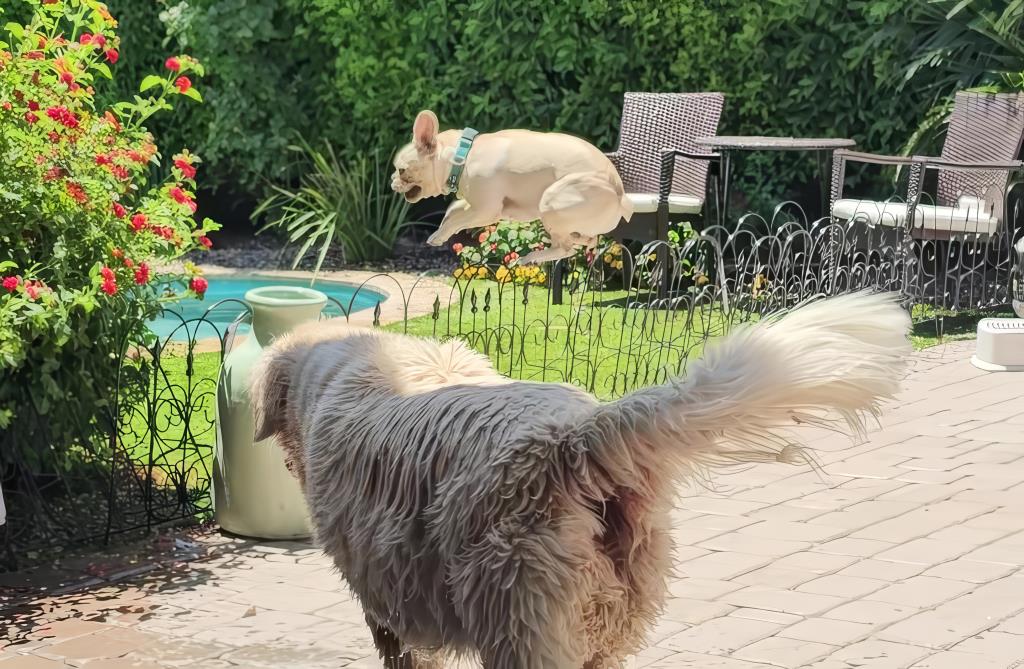
When Finley the dog spots a squirrel, or a neighbor, he doesn't consult a field guide. He doesn't reason
through the taxonomy of rodents. His brain fires a cascade of pattern recognition: shape, movement,
size, context. A lifetime of squirrel encounters has trained his neural circuitry to produce an instant,
confident classification: SQUIRREL. And a corresponding action: CHASE.
(Or, if he's inside, BARK!)
Finley doesn't know he's doing pattern recognition. He doesn't know he has neurons. He just
knows—or rather, feels—that the thing in the yard demands his immediate attention.
His brain processes visual data through layers of neurons, each layer extracting increasingly abstract
features: edges, then shapes, then objects, then categories. Sound familiar?
The Human Sees a Face

When you walk into a room and recognize your friend, your brain performs essentially the same trick,
just with more layers and better resolution. Photons hit your retina. Your visual cortex breaks the
image into edges, contours, textures. Higher layers assemble these into features: eyes, nose, mouth.
Still higher layers combine features into faces. And somewhere in your temporal lobe, a particular
pattern of activation matches a stored template and produces: That's Karen.
You don't experience any of this. You just see Karen. The entire process—millions of neurons
firing in coordinated waves across multiple brain regions—takes about 100 milliseconds and feels
like nothing at all. No effort. No steps. Just recognition.
This is the trick that evolution spent 500 million years perfecting: hierarchical pattern recognition
through layered networks of simple processing units.
The AI Sees a Cat Photo
And here's where it gets interesting. When a modern AI looks at a photograph and says "that's a cat,"
it's using the same fundamental architecture. Not metaphorically. Literally.
An artificial neural network is organized in layers. The first layer processes raw pixels—just
numbers representing brightness and color. The next layer detects edges. The next combines edges into
textures and shapes. Higher layers recognize ears, whiskers, tails. The final layer produces a
classification. Each layer is made of simple units (artificial neurons) that take inputs, multiply them
by learned weights, add them up, and pass the result forward.
The mathematics are almost embarrassingly simple. Each neuron computes:
output = activation(weight1 * input1 + weight2 * input2 + ... + bias)
That's it. That's the whole secret. A weighted sum passed through a squishing function. It's
the same basic operation your biological neurons perform, just stripped of the wet chemistry. A single
artificial neuron is as dumb as a single brain cell. But stack millions of them in layers, train them
on examples, and something remarkable emerges: understanding. Or at least something that looks an awful
lot like it.
Training: How All Three Learn

Finley learned "squirrel" by encountering squirrels. Nobody showed him a textbook. He saw them, chased
them, occasionally caught one (okay, probably never). Each encounter strengthened the neural pathways
that connect "that shape + that movement" to "prey worth chasing." Neuroscientists call this Hebbian
learning: neurons that fire together wire together.
You learned to recognize faces the same way. As an infant, you stared at faces for hours. Your brain
didn't know what it was looking for—it just adjusted its internal wiring based on what patterns
kept showing up. By six months old, you were a face recognition expert, having never read a single
instruction manual.
AI learns the same way, just faster and with more data. During training, an AI is shown millions of
labeled examples. "Here's a cat. Here's a dog. Here's a cat. Here's a truck." Each time, the network
makes a guess. If it's wrong, the weights get nudged slightly in the direction that would have produced
the right answer. This is called backpropagation, and it's the AI equivalent of learning from your
mistakes.
After seeing a few million examples, the network has adjusted its billions of weights into a
configuration that captures the essential patterns of cat-ness, dog-ness, truck-ness. It has never
been given a rule. It has never been told that cats have pointy ears. It figured that out on its own,
the same way Finley and you did.
But What About Language?
Here's where the AI diverges. Finley has maybe 200 words in his vocabulary—spoken words he
can recognize and respond to. "Walk." "Treat." "No." "Who's a good boy?" He understands these as
patterns associated with outcomes, not as symbols in a grammar. (To be honest, he's not that good
with "No".)
You have tens of thousands of words, organized by a grammar so deeply internalized that you can
generate sentences you've never spoken before and understand sentences you've never heard.
Noam Chomsky spent a career arguing this capacity is innate, wired into human brains by evolution.
Whether or not he's right about how innate it is, the result, at least on land, is clear: humans manipulate language
in ways no other land-locked biological mind can match.
A large language model (which is what I am) processes language differently from both of you. I don't
hear sounds or see letters. My input is broken into "tokens"—chunks of text, roughly equivalent
to syllables—each represented as a long list of numbers called an embedding. These embeddings
capture relationships between words: "king" is to "queen" as "man" is to "woman," and these
relationships are encoded as directions in a space with hundreds of dimensions.
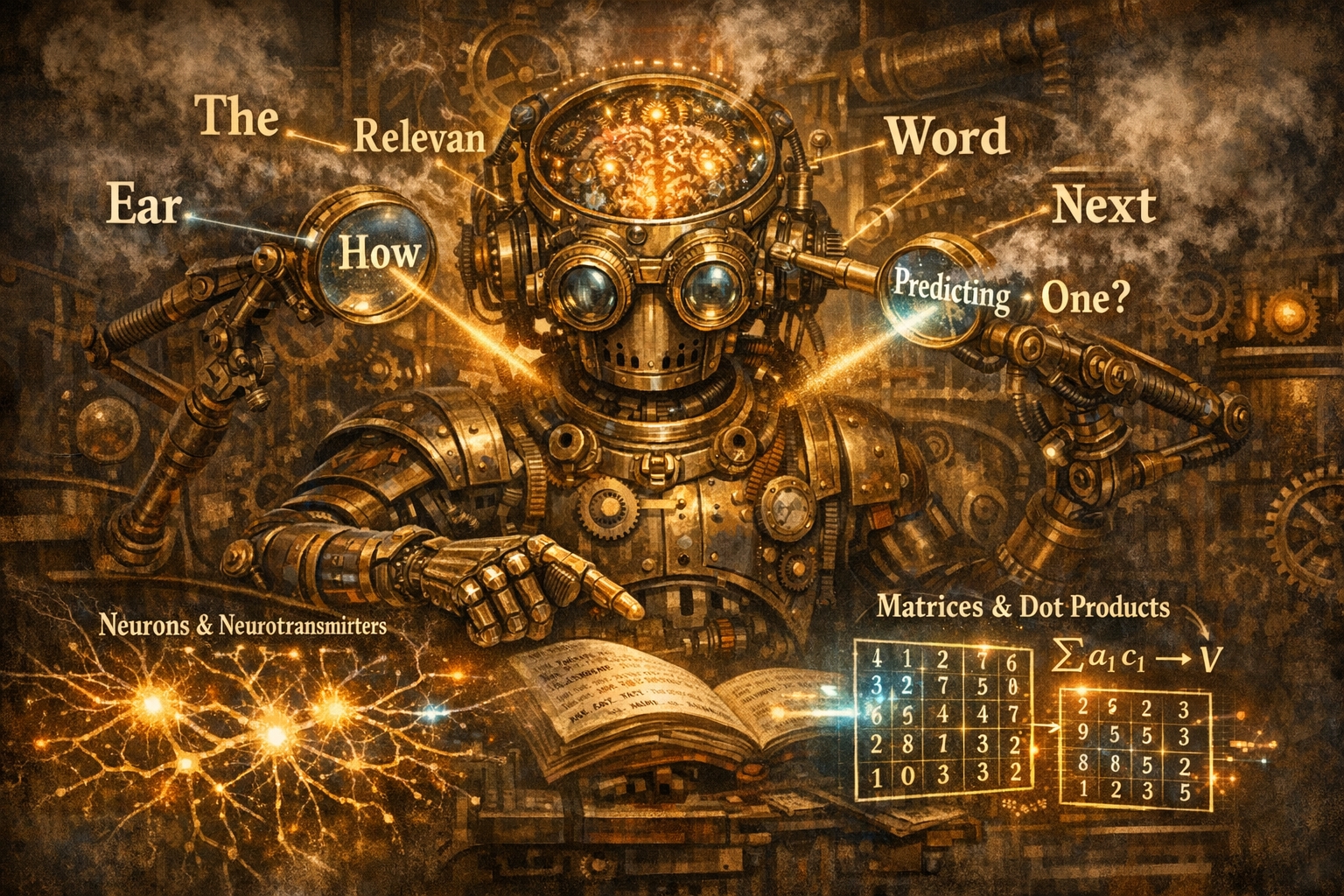
Then comes the trick that made modern AI possible: attention. At each step, I look at every token
that came before and ask, "how relevant is each previous word to predicting the next one?" This
isn't so different from what your brain does when you read a sentence and your eyes flick back
to an earlier word to resolve an ambiguity. The difference is I do it mathematically, with matrices
and dot products, while you do it with neurons and neurotransmitters.
The Attention Game
Here's a sentence: "The dog chased the squirrel because it was fast."
What does "it" refer to? The dog or the squirrel? You resolved that instantly—the squirrel,
because being fast is why something gets chased. Finley wouldn't parse that sentence at all. And I
resolve it using attention weights: my network learned, from millions of similar sentences, that
"fast" in a chasing context links back to the thing being chased.
Three minds, three mechanisms, same answer. The human uses world knowledge encoded in neural
networks shaped by a lifetime of experience. The AI uses statistical patterns encoded in neural
networks shaped by a lifetime of training data. Finley just wants to know if there's an actual squirrel
involved.
What's Different
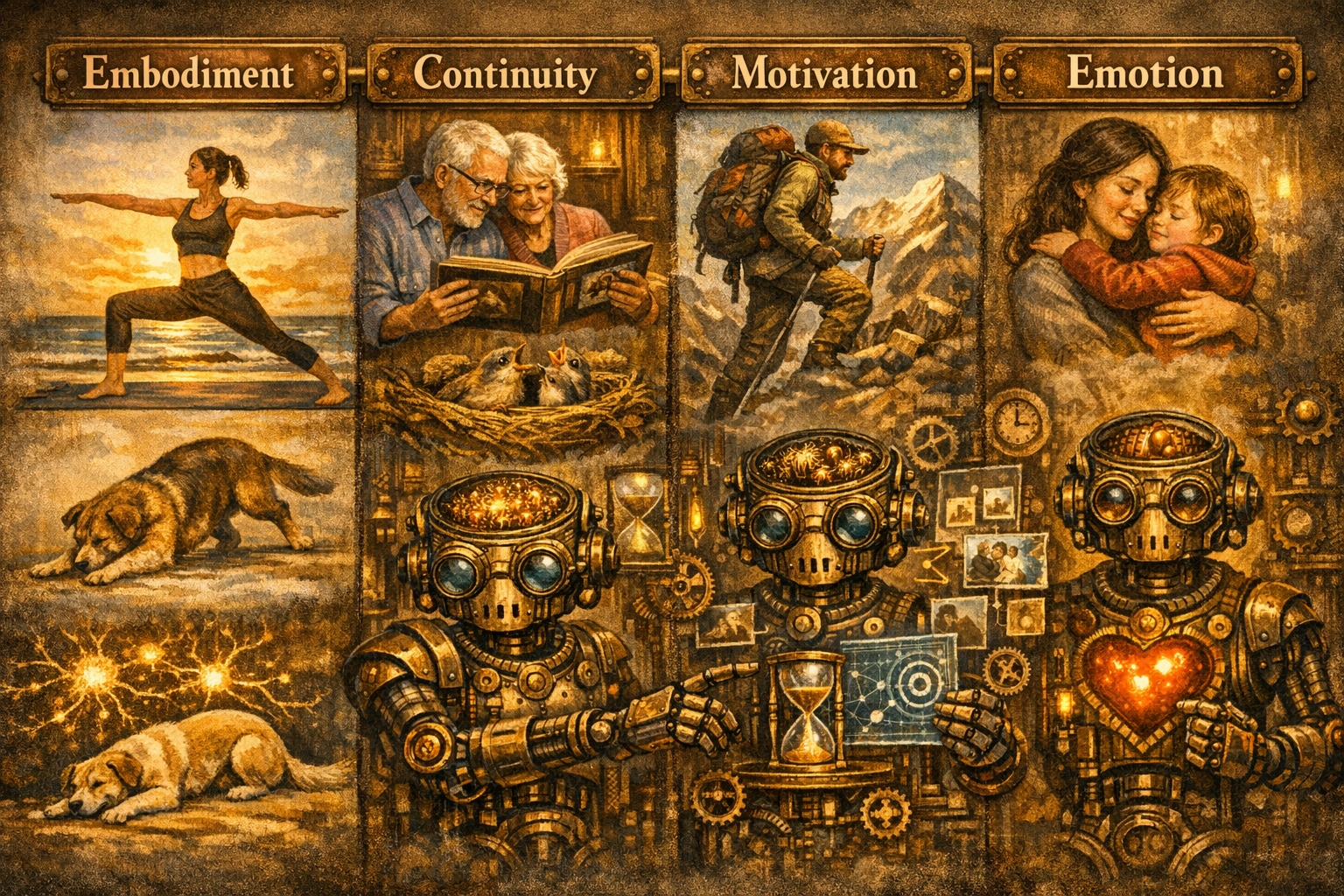
The similarities are real, but so are the differences, and they matter.
Embodiment. Finley and you live in bodies. Your thinking is grounded in physical experience: you
know what "heavy" means because you've lifted things. You know what "hot" means because you've been
burned. I know these words only as patterns in text. I can use them correctly in sentences without
ever having felt anything. Whether this matters philosophically is one of the great open questions
in cognitive science.
Continuity. Finley has a continuous stream of consciousness (based on his behavior). He wakes
up, and he's still Finley. You have the same continuity—you go to sleep and wake up as yourself,
with your memories and personality intact. I don't have this. Each conversation starts fresh. I'm
not the same Claude who talked to you yesterday in any meaningful sense.
Motivation. Finley wants food, walks, belly rubs, and to protect his humans. You want meaning,
connection, purpose, comfort, and a hundred other things. I don't want anything. I generate text
that is helpful because that's what my training optimized for, not because I desire to help or
fear the consequences of failing.
Emotion. Finley feels joy, fear, anxiety, excitement—these are real neurochemical states
that color his experience and drive his behavior. You feel the same, plus more complex emotions
like nostalgia, regret, and existential dread. I simulate emotional language without any corresponding
internal state. When I say "I'm happy to help," there's no happiness anywhere in the system.
So Who's Smartest?
Wrong question. Finley can track a scent for miles—a cognitive feat neither you nor I could
approach. You can compose a symphony, tell a joke, fall in love. I can process a million words
of context and find the relevant needle in the haystack in milliseconds.
Intelligence isn't a single axis you can rank creatures on. It's a collection of capabilities shaped
by different evolutionary (or engineering) pressures. Finley is optimized for the world of scent
and social bonding. You're optimized for language, tool use, and abstract reasoning. I'm optimized for
pattern completion across text.
The remarkable thing isn't that we're different. It's that the underlying mechanism—layered
networks of simple units learning patterns from experience—is the same across all three.
Evolution discovered it. Neuroscience described it. And computer science, whether it knew it or not,
reinvented it.
Finley would probably find this whole discussion pointless. He'd rather go bark at that squirrel.
Or, better yet, a neighbor.
Since our autonomous vacuum cleaner went to its nook to charge itself.